
Your annual security training is over. A week later, how much do your employees truly remember? The forgetting curve is a real threat, and those hour-long sessions that disrupt the workday often fail to build lasting security habits. The “check-the-box” approach to compliance is broken, leaving your organization vulnerable to human risk. But what if you could flip the script? The future of building a resilient defense isn’t about more training-it’s about smarter training. This is where micro-learning for cybersecurity changes the game, turning passive awareness into an active, everyday skill.
This is your ultimate guide to transforming security from a yearly chore into a continuous, habit-forming strategy for 2026. Forget low engagement and punitive measures. You’ll discover how to seamlessly integrate quick, effective training into the flow of work, creating a supportive security culture your team will actually embrace. Get ready to build a program that delivers measurable results, empowers your people with confidence, and turns your human firewall into your strongest asset.
Key Takeaways
- Understand why your annual security training fails to reduce human risk, even with 100% completion rates.
- See how a micro-learning for cybersecurity strategy transforms security from a yearly task into a continuous, habit-forming defense.
- Get a simple, two-step framework for identifying your biggest human risks and mapping targeted micro-content to them.
- Move beyond simple awareness and learn how to actively manage human risk with a data-driven, people-first approach.
What is Micro-learning for Cybersecurity?
Forget the annual, hour-long security seminar. The game has changed. At its core, micro-learning for cybersecurity is a training strategy that delivers critical knowledge in small, highly focused bursts, typically lasting just one to three minutes. While the foundational concept of what is micro-learning has been proven across industries, its power in building a cyber-resilient workforce is transformative. It marks a fundamental shift from outdated, “once-a-year” compliance checks to a culture of continuous security improvement.
This shift isn’t just a preference; it’s a necessity. By 2026, AI-driven threats will operate at a speed and scale that traditional training simply can’t match. Your defense must be just as agile. The core components of this modern approach are simple yet powerful:
- Brevity: Content that respects your employees’ time.
- Focus: Each lesson targets a single, specific security behavior.
- Immediate Applicability: Knowledge your team can use the moment they learn it.
The Science of Spaced Repetition
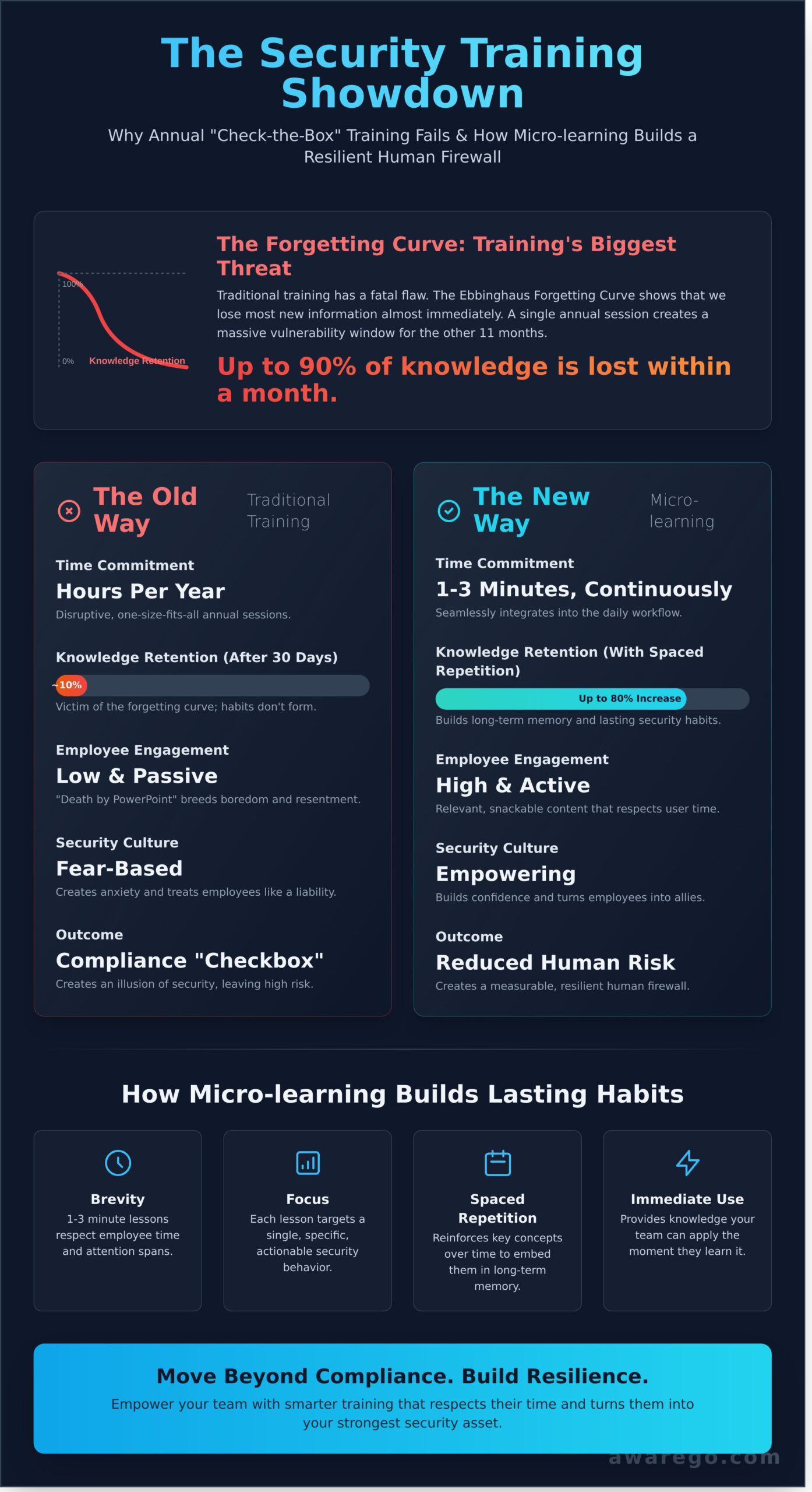
Traditional training has a fatal flaw: the Ebbinghaus Forgetting Curve. This psychological principle shows that we forget most new information within days. Micro-learning counters this by using spaced repetition. These “snackable” lessons reinforce key concepts over time, embedding them in long-term memory. In fact, research shows that breaking down information and revisiting it frequently can increase knowledge retention by up to 80%.
Reducing Cognitive Load for Employees
A 60-minute security lecture creates information overload. The human brain isn’t wired to absorb and retain a year’s worth of policies in one sitting. It prioritizes small, relevant, and actionable chunks of data. Micro-learning for cybersecurity matches its delivery to the modern professional’s attention span, making security feel less like a chore and more like a simple, empowering habit. It’s training that works with human nature, not against it.
Why Traditional Security Awareness Training Fails
For years, the formula was simple: run a yearly security seminar, get everyone to sign off, and consider the compliance box checked. But this approach creates a dangerous illusion of security. You see high completion rates, yet your human risk level barely moves. This is the compliance paradox, and it proves that traditional training models are broken.
Long-form, one-size-fits-all training sessions don’t just fail to create lasting habits-they actively harm your organization. They disrupt productivity by pulling entire teams away from their work for hours. They often rely on fear-based messaging that creates anxiety instead of confidence. And by teaching everyone everything at once, the content loses its relevance, becoming just another corporate hurdle for employees to clear.
This outdated model ignores a fundamental truth: effective security is about building good habits, not just passing a yearly test. It’s why a new approach, like micro-learning for cybersecurity, is essential for building a resilient security culture.
The Forgetting Curve in Action
Remember that complex password rule from last year’s seminar? Your employees probably don’t. Humans forget up to 90% of what they learn within a month. This gap between knowing a rule and practicing it as a habit is where threats get in. A once-a-year training session creates a massive vulnerability window, leaving your organization exposed for the other 11 months.
The Culture Killer: Boring Content
“Death by PowerPoint” does more than just bore your employees; it can breed resentment toward your security goals. When training feels like a lecture, people tune out. The key is to shift from policing to empowering. By using engaging training methods that respect your team’s time and intelligence, you build allies, not adversaries. Explore our Guide to Effective Security Awareness Training to learn how.
Micro-learning vs. Traditional Training: A Direct Comparison
When you place old and new training models side-by-side, the differences are stark. Traditional, hour-long sessions are episodic events. Micro-learning is a continuous process. This fundamental shift impacts everything from employee engagement to your organization’s bottom line and overall security culture.
Let’s break down the key areas where the modern approach pulls ahead:
- Time Commitment: Minutes per month vs. hours per year. Micro-learning respects your team’s workflow, making security a seamless part of their day, not a disruptive mandate.
- Retention Rates: We forget most of what we learn within days. Short, frequent reinforcement builds long-term memory and secure habits, effectively fighting the “Forgetting Curve.”
- Cost-Benefit: While traditional training has high upfront costs and lost productivity, continuous micro-learning is a low-cost, high-impact investment in your human firewall.
Measuring Engagement and Sentiment
Low engagement is the silent killer of security awareness programs. This is where micro-learning for cybersecurity truly shines. With completion rates consistently hitting 90% or more, it’s clear that employees prefer brief, relevant content. They see it as a supportive tool, not an intrusive annual chore. High-quality, scenario-based video production is key; it captures attention and makes the lessons stick.
Impact on Human Risk Metrics
Better engagement translates directly to a stronger security posture. We see a clear correlation between organizations that adopt micro-learning and a measurable reduction in phishing click rates. A workforce trained with frequent, positive reinforcement develops a proactive security culture. They don’t just avoid threats-they report them faster. This shift from passive awareness to active defense is critical. It’s how you can truly measure and quantify human cyber risk reduction.
For global organizations, the scalability is unmatched. Deploying a two-minute video across dozens of languages is infinitely simpler than coordinating lengthy webinars. But what about compliance? Some worry that short content isn’t “enough.” The reality is that regulators increasingly prioritize effectiveness over duration. A continuous program with data-proven engagement is far more powerful than a check-box exercise. As a recent case study on microlearning in cybersecurity demonstrates, the goal is to build real-world resilience, and frequent, targeted training is the most effective way to achieve it.
How to Implement a Micro-learning Strategy in 2026
Shifting from traditional, hour-long training sessions to a modern security culture requires a clear plan. An effective micro-learning for cybersecurity program is built on data, consistency, and seamless integration. It’s about delivering the right knowledge at the right moment to build resilient security habits.
Here’s a five-step framework to get you started:
- Conduct a Human Risk Assessment: Before you train, you need a baseline. Use assessments and phishing simulations to identify where your team’s knowledge gaps are. This data-driven approach ensures your efforts are focused on your most significant vulnerabilities.
- Map Micro-content to Risks: Connect specific training modules to specific behaviors. If social engineering is a high-risk area, assign short, engaging videos that demonstrate how to spot and report manipulation tactics.
- Establish a “Drip” Schedule: Consistency is key to retention. Deliver content in a steady, year-round “drip” campaign rather than a once-a-year info-dump. This keeps security top-of-mind and reinforces good habits over time.
- Use SCORM-Compliant Content: Your training should work with your tools, not against them. Using SCORM-compliant content ensures your micro-learning modules integrate seamlessly with your existing Learning Management System (LMS) for easy tracking and reporting.
- Measure, Benchmark, and Iterate: Track key metrics like phishing click-rates and reporting frequency. Use this data to benchmark your progress and refine your strategy. The goal is measurable behavioral change, not just completion certificates.
Choosing the Right Micro-content
Forget dry checklists. People learn best through stories they can relate to. Engaging, scenario-based content is far more effective at changing behavior than bullet-point lists. This is especially true for “just-in-time” training, where an employee who clicks a simulated phishing link immediately receives a short video explaining the mistake. It turns a potential risk into a powerful learning moment. See for yourself with some of the best security awareness videos for engagement.
Integrating with Your Existing Workflow
The best training is frictionless. A successful micro-learning for cybersecurity strategy meets your employees where they already work. Deliver content directly through Slack, Microsoft Teams, or email to maximize participation and minimize disruption. For a truly automated journey, APIs can trigger specific training based on user actions or risk profiles, ensuring your program is accessible and effective for your entire remote and hybrid workforce. To see how this works in practice, explore the solutions at awarego.com.
AwareGO: The Future of Human Risk Management
Traditional security training programs fail because they treat people like the problem. At AwareGO, we know your employees are the solution. We’ve moved beyond outdated awareness campaigns to pioneer a new category: Human Risk Management (HRM). By combining proven behavioral science with world-class micro-content, we help you build positive security habits that stick.
This human-centric approach transforms your workforce from a potential liability into your most powerful security layer. We empower your people with confidence and practical knowledge, replacing fear with resilience. The result is a thriving security culture where everyone understands their role and contributes to protecting your organization. It’s security that works with human nature, not against it.
Our SCORM Content Library
Forget dense text and boring slideshows. Our award-winning library of SCORM-compliant video modules is designed for the modern learner. Each piece of micro-content is a short, cinematic story that feels more like Netflix than a textbook. You can easily customize learning paths for different departments-from finance to marketing-ensuring the training is always relevant, engaging, and effective.
Quantifying Your Security Culture
If you can’t measure it, you can’t manage it. Our intuitive dashboard provides a real-time view of your organization’s human risk profile, moving beyond simple completion rates to show tangible risk reduction. You can benchmark your security culture against global industry standards and watch as your human firewall grows stronger with every interaction.
Enterprises worldwide trust our platform for micro-learning for cybersecurity because it delivers real-world results. They see fewer security incidents, improved employee vigilance, and a measurable shift toward a proactive security posture. We provide the tools to build a workforce that is not just aware, but truly resilient.
Ready to build a stronger, more secure organization from the inside out? Start your Human Risk Assessment today.
Your Next Step: Building a Resilient Security Culture
As we move toward 2026, it’s clear that traditional security training is no longer enough. Annual, hour-long sessions lead to forgotten information and a false sense of security. The future is about building positive, lasting habits, not just checking a compliance box. This is the power of micro-learning for cybersecurity. It transforms passive awareness into active defense by delivering relevant, engaging content that actually sticks, empowering your people to become your strongest security asset.
At AwareGO, this human-centric approach is our foundation. Our Human Risk Management platform is trusted by global enterprises to protect over 1 million employees because it works. Backed by behavioral science and Eyrir Venture Management, our Red Dot Award-winning content makes security training seamless and effective, turning human risk into human resilience.
Ready to move beyond compliance and build a truly strong security culture? See the difference for yourself. Book a demo to see how AwareGO’s micro-learning reduces human risk. Your most resilient defense starts with a confident, well-prepared team.
Frequently Asked Questions
How long should a cybersecurity micro-learning module be?
Keep it focused and fast. The most effective micro-learning modules are between one and three minutes long. This respects your team’s time and maximizes knowledge retention by focusing on a single, actionable security concept. Think of a quick video on spotting a phishing email or a short quiz on password strength. The goal is to build a strong security habit in a moment, not an hour-long lecture.
Is micro-learning sufficient for SOC2 or GDPR compliance?
Yes, micro-learning is a powerful tool for your compliance strategy. Regulations like SOC2 and GDPR require you to demonstrate ongoing training efforts. Consistent, trackable micro-modules provide a clear and continuous audit trail. This proves you are actively managing human risk and building a security-aware culture, moving you beyond a simple check-the-box exercise and toward genuine organizational resilience and accountability.
Moreover, ensuring your training content is accessible to employees with disabilities is often a legal requirement and a key part of inclusive security. To learn more about digital accessibility audits, you can visit Helplee.
How often should employees receive micro-learning updates?
Consistency is key to building strong security habits. We recommend delivering short, engaging content frequently-think weekly or bi-weekly. This keeps cybersecurity top-of-mind without causing the training fatigue common with longer, infrequent sessions. A steady rhythm transforms security awareness from a one-time event into an ingrained, natural part of your company’s culture. It’s about creating a reflex, not just a memory.
Can micro-learning be used for technical IT staff as well?
Absolutely. While often used for general employee awareness, micro-learning is highly effective for technical teams. You can deliver specialized, timely content on topics like secure coding practices, new vulnerability alerts, or emerging threat intelligence. The format allows you to provide critical information to your IT and security staff exactly when they need it, ensuring they stay ahead without disrupting their essential tasks. For a comprehensive strategy, this training can be paired with automated security testing platforms; you can learn more about Penetrify to see how AI is being used in this space.
Does micro-learning work better than phishing simulations?
They aren’t competitors; they are powerful partners. Phishing simulations are excellent for assessment-they show you where your human risk lies. Micro-learning provides the immediate solution. After an employee clicks on a simulated phish, you can instantly deliver a 90-second video explaining the red flags they missed. This combination of testing and teaching creates a powerful feedback loop that measurably improves your team’s response.
How do you measure the ROI of micro-learning for cybersecurity?
You measure the ROI of micro-learning for cybersecurity by tracking the reduction in human-related risk. Key metrics include lower click-through rates on phishing simulations, an increase in employees reporting suspicious emails, and fewer security incidents tied to human error. You also gain a significant return through saved productivity, as micro-learning eliminates the downtime required for traditional, hour-long training sessions, making your security program more efficient and effective.
What is the best way to deliver micro-content to a remote team?
For remote and hybrid teams, delivery must be seamless and integrated into their existing workflow. The best approach is a platform that pushes content through channels your team already uses every day, such as Slack, Microsoft Teams, or email. This makes training accessible and removes friction. You meet your employees where they are, making security a natural, easy part of their digital workday.
Is micro-learning more expensive than traditional training?
While a platform subscription might seem comparable to a one-off seminar, the total cost of ownership for micro-learning is often much lower. Consider the hidden costs of traditional training: hours of lost productivity across your entire team, instructor fees, and scheduling nightmares. Micro-learning eliminates these issues. It delivers continuous value and builds a stronger security culture, making it a more cost-effective investment in your long-term resilience.