
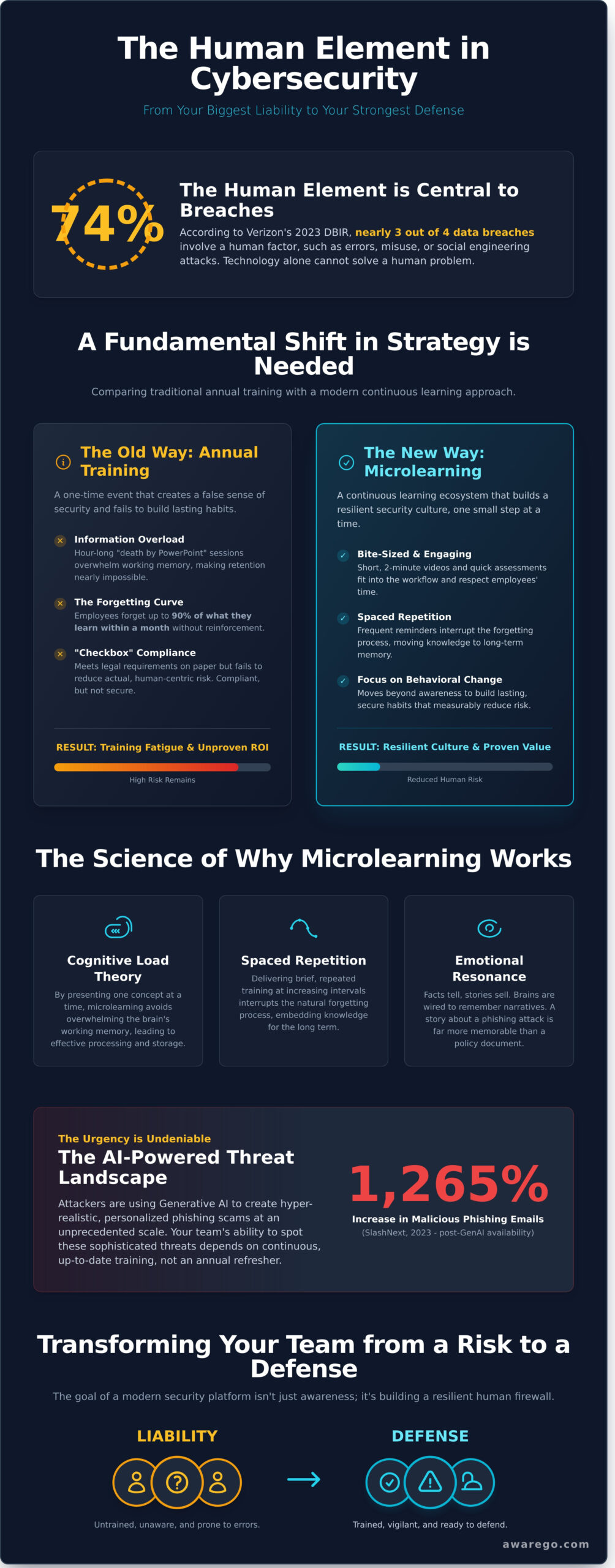
74% of all data breaches involve the human element, according to Verizon’s 2023 DBIR. Yet, how much of your security budget is spent on technology versus people? You’ve seen the signs. The dismal completion rates for hour-long training modules. The spike in phishing simulation clicks, even after countless reminders. It’s a frustrating cycle of training fatigue and unproven ROI that leaves your organization exposed.
It’s time for a fundamental shift in strategy. This isn’t about more training; it’s about the right training. We’ll show you how a modern cybersecurity microlearning platform is the key to effective Human Risk Management, transforming your employees from your biggest liability into your most active line of defense. Get ready to explore how you can build a resilient security culture, prove its value to your board, and finally make security training a habit, not a chore.
Key Takeaways
- Discover why traditional, hour-long security training fails and how continuous learning builds a stronger defense.
- Uncover the behavioral science that turns security knowledge into lasting employee habits, not just temporary awareness.
- Learn key criteria for choosing a cybersecurity microlearning platform that drives real behavioral change, not just completion rates.
- Get a clear roadmap to transform your employees from a security risk into your most effective line of defense.
What is a Cybersecurity Microlearning Platform?
A cybersecurity microlearning platform is not just another training tool. It’s a complete digital ecosystem designed to build a resilient security culture, one small step at a time. It delivers targeted security knowledge in short, bite-sized increments that fit seamlessly into your team’s workflow. The core idea is to replace the dreaded annual “death by PowerPoint” session with continuous, high-impact learning that actually sticks.
This approach is built on a simple, powerful premise. To change behavior, you need consistent reinforcement, not a one-time information dump. By breaking down complex topics like phishing, password hygiene, and social engineering into two-minute videos and quick assessments, you respect your employees’ time and boost their knowledge retention. It uses the proven principles of what is microlearning to make security education engaging and effective, turning passive listeners into active defenders.
The urgency for this shift is undeniable. The threat landscape we face heading into 2026 is fundamentally different, driven by the rapid weaponization of artificial intelligence. According to a 2023 report from SlashNext, there was a 1,265% increase in malicious phishing emails following the widespread availability of generative AI tools. Attackers are using AI to create hyper-realistic, personalized scams at a scale we’ve never seen before. Your team’s ability to spot these sophisticated threats depends on continuous, up-to-date training, not an annual refresher.
A modern platform is built on three pillars:
- Engaging Video Content: Short, often story-driven videos that make abstract threats feel tangible and understandable.
- Interactive Assessments: Quick quizzes and simulations that reinforce key concepts and provide immediate feedback.
- Behavioral Tracking: Data-driven insights that show who is learning, what they’re learning, and where human risk is decreasing across the organization.
The Problem with Traditional Security Training
Traditional training fights a losing battle against human biology. The Ebbinghaus Forgetting Curve shows that people forget up to 90% of what they learn within a month. Hour-long sessions overload employees, creating resentment instead of resilience. This leads to the “Checkbox Compliance” trap, where you meet legal requirements on paper but fail to reduce your actual, human-centric risk. Your team ends up compliant but not secure.
Microlearning as a Strategic HR and IT Asset
Your team’s attention is one of your most valuable and finite resources. Microlearning treats it that way. By delivering training in moments, not hours, it becomes a core component of a modern Human Risk Management (HRM) framework. This approach moves beyond simple awareness. It focuses on building lasting habits and a strong security culture, which is the ultimate defense for your organization’s long-term health and reputation in the digital age.
This holistic view of organizational health has parallels in personal well-being. Just as maintaining physical health builds resilience against illness, fostering a strong security culture builds resilience against digital threats. For leaders also invested in the personal wellness of their teams, you can visit VigourMoves for a selection of premium health products that support a focused and resilient lifestyle.
The Science of Why Microlearning Actually Works
Your team’s attention is a finite resource. Traditional security training treats it like it’s unlimited, demanding hour-long sessions that overwhelm and underdeliver. The result? Employees forget nearly 70% of what they learned within 24 hours, according to studies based on the Ebbinghaus Forgetting Curve. It’s not a failure of your people; it’s a failure of the method.
Microlearning isn’t just a shorter format. It’s a smarter one, built on proven principles of cognitive and behavioral science. It’s about delivering the right information, in the right way, at the right time.
The core concept is Cognitive Load Theory. Your brain’s working memory can only handle a few pieces of new information at once. A 60-minute webinar floods this system with complex policies and technical jargon, making genuine learning almost impossible. In contrast, a 3-minute video on identifying a phishing email presents a single, digestible concept. The cognitive load is low, allowing the brain to process, understand, and store the information effectively.
This is where a modern cybersecurity microlearning platform changes the game. It breaks down the overwhelming topic of security into a series of clear, focused, and actionable micro-lessons. This approach respects how people actually learn and build habits.
Spaced Repetition and Memory Retention
This psychological principle is the key to lasting knowledge. Spaced repetition is the science of delivering brief, repeated training at increasing intervals to interrupt the natural process of forgetting. Instead of a single annual training dump, your team receives frequent, low-intensity reminders that reinforce crucial security habits. This consistent reinforcement moves knowledge from fragile, short-term awareness to a durable, automatic response when a real threat appears.
Storytelling and Emotional Resonance
Facts tell, but stories sell. Your brain is wired to remember narratives, not abstract data points. A rule like “Verify all financial requests” is easy to forget. A 90-second story about an employee who almost transferred $50,000 based on a fake CEO email creates a powerful, emotional anchor. It makes the threat feel personal. At AwareGO, we build our entire content library around these human-centric narratives, replacing fear with confident, proactive decision-making. You can see how these principles are applied in our library of security awareness videos.
By combining these scientific pillars, you don’t just “raise awareness.” You actively build a resilient security culture, one micro-moment at a time. It’s about triggering real-world habit formation by delivering training exactly when and where your team is most receptive.
Evaluating Platforms: Beyond the “Bingeable” Hype
Your employees’ attention is a finite resource. Many platforms promise “bingeable” content that’s fun and engaging. But does fun equal effective? The best security training doesn’t just entertain; it builds lasting habits and measurably reduces risk. When you evaluate a cybersecurity microlearning platform, you’re not just buying content. You’re investing in a system to build a resilient security culture.
Effective learning requires more than a slick video. Look for a platform that combines multiple formats to reinforce key concepts. A 2024 study by the SANS Institute found that training programs combining interactive elements with video saw a 40% higher retention rate than passive, video-only methods. Your platform should provide a strategic mix:
- Micro-videos: 60-90 second, scenario-based videos that make threats feel tangible and relatable.
- Interactive Quizzes: Quick knowledge checks that confirm understanding without feeling like a test.
- Phishing Simulations: Realistic, ongoing tests that measure behavior, not just knowledge. A 70% reduction in click-rates is a common benchmark for success here.
You can’t manage what you can’t measure. Vague completion metrics are a relic of old-school compliance training. Modern Human Risk Management (HRM) demands data that quantifies your team’s security posture. Look for a dashboard that provides clear, actionable analytics. You need the ability to track your organization’s human risk score over time and benchmark it against industry averages. This transforms security from a cost center into a measurable business function.
Your workforce is global. By 2026, your training solution must reflect that reality. A platform that offers content in 10+ languages isn’t a luxury; it’s a necessity for inclusion and effectiveness. True accessibility goes beyond translation. It means providing culturally relevant scenarios that resonate with employees from different backgrounds, ensuring your security message is understood everywhere.
Seamless Integration and SCORM Flexibility
Your new platform shouldn’t create more work for your IT team. It needs to integrate effortlessly into your existing tech stack. Look for SCORM and xAPI compliance to ensure it works with your Learning Management System (LMS). Robust API access is critical for automating user provisioning and pulling performance data into your own dashboards. Features like Single Sign-On (SSO) reduce user friction and enhance security, making adoption seamless for everyone.
Personalization and Risk-Based Learning
A “one-size-fits-all” approach to security training is inefficient and ineffective. Your finance team faces different threats than your marketing team. The right cybersecurity microlearning platform uses Human Risk Assessments to identify your most vulnerable users. It then delivers targeted training to those who need it most, turning a potential liability into a strengthened line of defense. This is dynamic, risk-based learning in action.
5 Steps to Implementing a Microlearning Strategy in 2026
Transforming your security culture doesn’t happen by accident. It requires a deliberate, human-centric plan. By 2026, the most resilient organizations will have moved beyond annual compliance training and embraced continuous, data-driven education. This five-step framework shows you how to build a security program that works for your people, not against them.
It’s about creating secure habits, one moment at a time.
- Audit Your Human Risk Posture. Before you can improve, you must measure. Start with data-driven assessments to understand where your vulnerabilities lie. Don’t guess. Verizon’s 2024 DBIR found that 74% of breaches involve the human element, so identifying your specific risk profile is the critical first step.
- Define Smarter KPIs. Completion rates are a vanity metric. A truly effective program tracks behavioral change. Your key performance indicators should include metrics like a 50% reduction in phishing simulation click-rates, a 75% increase in suspicious email reporting, and the average time-to-report a threat. These numbers show real cultural impact.
- Launch High-Frequency Learning Sprints. Ditch the hour-long annual training module. Instead, roll out content in short, frequent bursts. A modern cybersecurity microlearning platform can deliver a 90-second video on password security one week and a two-minute interactive quiz on social engineering the next. This low-friction approach fits into the workday and builds lasting knowledge.
- Integrate Training with Real-World Testing. Connect learning directly to application. After a micro-lesson on identifying malicious links, launch a targeted phishing simulation. This immediate reinforcement helps employees practice their new skills in a safe environment, closing the gap between knowing and doing.
- Foster a Positive Feedback Loop. The goal is to build trust and encourage vigilance. Reward employees for reporting threats. Punishing mistakes only creates a culture of fear and silence, which is exactly what attackers want. When someone reports a real phishing attempt, you’ve just prevented a potential breach worth millions.
Setting Your Human Risk Benchmarks
Start by mapping your internal threat landscape. Identify high-risk teams like Finance, HR, and IT, which are targeted in over 60% of social engineering attacks. Before rollout, use assessments to establish a baseline “Security Culture Score.” This score gives you a concrete starting point to measure progress against. You can’t prove ROI without a clear before-and-after picture. Learn more about how to measure and quantify human cyber risk.
Creating a Culture of Reporting
Your employees are your greatest security asset. Turn them from targets into a network of “Human Sensors.” This shift happens when you replace punishment with positive reinforcement. Instead of shaming someone for clicking a simulated phish, celebrate team members who report them. Use your cybersecurity microlearning platform to send out a quick video or message celebrating security “wins,” reinforcing the right behaviors across the entire company.
Ready to build a security culture that lasts? See how our platform makes it easy to implement these steps and empower your team.
AwareGO: The Human-Centric Microlearning Leader
Most security training fails because it was designed by technologists, not human behavior experts. At AwareGO, we build our content on a foundation of behavioral science. We don’t just produce slick videos; we create experiences designed to form secure habits. Our entire approach is engineered to make your employees active participants in your defense, transforming your biggest risk into your strongest asset. This is what sets our cybersecurity microlearning platform apart.
The engine behind this transformation is our Human Risk Management (HRM) platform. It moves your organization beyond simple pass/fail metrics and into the world of data-driven risk mitigation. Instead of just tracking who watched a video, our platform gives you a real-time, quantifiable view of your human threat landscape. It’s a fundamental shift from compliance to resilience.
With the AwareGO HRM platform, you can:
- Identify Vulnerabilities: Pinpoint specific employees, departments, and risk areas through continuous assessments and real-world simulations.
- Measure Human Risk: Generate a clear Human Risk Score for your entire organization, giving you a baseline to measure improvement against.
- Deliver Targeted Training: Automatically assign hyper-relevant, 1-2 minute microlearning modules to address the exact risks identified, saving time and maximizing impact.
Cyber threats are global, and your defense must be too. Our content library, featuring over 100 real-life scenarios, is localized in more than 30 languages. This isn’t just about subtitles. Our scenarios are culturally adapted to resonate with employees from Stockholm to Singapore, ensuring the message lands effectively every time. This global scalability makes it simple to build a consistent security culture across all your international offices.
Ultimately, our goal is to move your team from passive awareness to active resilience. We turn abstract threats into tangible, memorable lessons that stick. The result is a workforce that doesn’t just know the rules but instinctively practices secure behaviors. Organizations using our platform have reported up to a 75% reduction in user-related security incidents within the first year.
Our “Security Culture” Philosophy
We believe security is a shared human responsibility, not just a technical problem for your IT department. Our content is designed to reduce anxiety and build confidence, empowering your people to become a seamless extension of your security team. This people-first mindset is the core of effective risk reduction. Learn more by reading our guide on What Is Human Risk Management? A Practical Guide.
Getting Started with AwareGO
Integrating world-class training into your workflow is seamless. Our entire library is SCORM-compliant, allowing for effortless integration with your existing LMS. For organizations seeking a hands-on partner, our managed services provide expert-led program implementation and risk mitigation. Ready to see how a human-centric approach can fortify your defenses? Experience the AwareGO difference with a free trial.
Build Your Human Firewall for 2026 and Beyond
The era of one-off, hour-long security training is over. Effective human risk management isn’t about checking a compliance box; it’s about building a resilient security culture. The science is clear: frequent, bite-sized learning is what changes human behavior and builds lasting security habits. This is the strategic shift from passive awareness to active defense, turning your employees from potential targets into your first line of protection.
Choosing the right cybersecurity microlearning platform is the critical step in this journey. At AwareGO, our entire methodology is built on this human-centric approach. Trusted by global enterprises and recognized with multiple cybersecurity innovation awards, our platform uses behavioral science to deliver engaging, 2-minute videos that make secure habits stick. We empower your team with confidence, not fear.
Ready to see the difference? Transform your security culture with AwareGO’s microlearning platform.
Your people are your greatest security asset. It’s time to unlock their potential.
Frequently Asked Questions
Is microlearning enough to meet compliance requirements like SOC2 or GDPR?
Yes, microlearning is a powerful tool for meeting compliance requirements like SOC2 and GDPR. These frameworks require evidence of ongoing security awareness training, which microlearning delivers effectively. By providing regular, documented training on topics like data handling and privacy, you create a clear audit trail. This continuous engagement helps build the strong security culture that auditors from frameworks like ISO 27001 look for, moving you beyond check-the-box compliance.
How often should employees receive cybersecurity microlearning modules?
Employees should receive microlearning modules at least once a week for optimal knowledge retention. Research based on the Ebbinghaus Forgetting Curve shows people forget up to 70% of new information within 24 hours. Short, weekly training sessions interrupt this curve, keeping security top-of-mind and turning knowledge into lasting habits. This frequent, low-effort engagement is key to building a resilient security culture without causing training fatigue.
What is the ideal length for a cybersecurity microlearning video?
The ideal length for a microlearning video is between 60 and 90 seconds. A 2021 study by Wistia found that viewer engagement drops sharply after the two-minute mark. Keeping videos this short respects your employees’ time and aligns with modern attention spans. This ensures they absorb the key security lesson without distraction. The goal is maximum impact in minimum time, making learning a seamless part of the workday.
Can microlearning platforms integrate with my existing LMS?
Yes, most modern microlearning platforms are designed to integrate seamlessly with your existing Learning Management System (LMS). Look for platforms that support standards like SCORM or offer robust APIs. This allows you to push micro-content directly into your current system, centralizing training records and simplifying administration. The integration ensures you can enhance your training ecosystem with fresh, engaging content without disrupting established workflows.
How do I measure the ROI of a cybersecurity microlearning platform?
You measure ROI by tracking reductions in human-related security incidents and their associated costs. Start by benchmarking your current incident rate, such as phishing click-throughs or reported security policy violations. A successful cybersecurity microlearning platform can reduce phishing susceptibility by over 50% in the first year. Compare this reduction in risk and potential breach costs, which average $4.45 million according to IBM’s 2023 report, against the platform’s cost to see your return.
Does microlearning work for technical staff as well as non-technical employees?
Absolutely. Microlearning is effective for both technical and non-technical teams. For non-technical staff, it builds a solid foundation of essential security habits. For your technical staff, it serves as a powerful tool for continuous reinforcement of complex topics and emerging threats, like new social engineering tactics. You can tailor content streams to different roles, ensuring everyone receives relevant, high-impact training that strengthens your collective security posture.
How does microlearning help with phishing simulation results?
Microlearning directly improves phishing simulation results by providing immediate, targeted training. When an employee clicks a simulated phishing link, the platform can instantly assign a 90-second video explaining the specific red flags they missed. This “teachable moment” approach is far more effective than a generic annual training. Organizations using this method often see a 40-60% decrease in click rates within the first six months of implementation.
What is the difference between a microlearning platform and a traditional LMS?
A microlearning platform delivers short, frequent training, while a traditional LMS manages long-form, event-based courses. Think of an LMS as a library for comprehensive courses, often used for annual compliance or onboarding. A cybersecurity microlearning platform is more like a daily news feed, pushing bite-sized content to build secure habits over time. It focuses on continuous reinforcement and Human Risk Management (HRM), not just knowledge storage.