
In 2023, the Verizon Data Breach Investigations Report confirmed a stark reality: 74% of all breaches involve the human element. Your technology stack is state-of-the-art, but your biggest vulnerability is still people.
You’ve likely poured resources into security awareness, yet you’re still fighting an uphill battle. The phishing simulations pass, but the real-world risk doesn’t seem to budge, and justifying your budget feels like a guessing game. This is where you move from awareness to resilience. We’ll give you a structured human risk assessment framework to precisely identify, measure, and mitigate the human factors in your security posture.
Get ready to transform vague metrics into a data-driven security culture, with a clear path from assessment to actionable remediation.
Key Takeaways
- Move beyond simple training metrics and learn how to measure the actual behaviors that create security risks in your organization.
- Discover how a human risk assessment framework provides a structured way to identify, quantify, and mitigate threats tied directly to your people.
- Get a clear, actionable guide to baseline your current human risk and identify the high-risk groups that need immediate attention.
- Understand the critical difference between what your employees know about cybersecurity and what they actually do when faced with a threat.
What is a Human Risk Assessment Framework in Cybersecurity?
Your firewall can’t click a phishing link. Your encryption software won’t reuse a weak password. Your people do. A human risk assessment framework is a systematic process for identifying, measuring, and managing the security vulnerabilities introduced by human behavior. It’s a fundamental shift in how we view security.
For decades, security focused on technical vulnerabilities, applying the classic fundamentals of risk assessment to firewalls and servers. But that model is incomplete. The 2023 Verizon Data Breach Investigations Report found that 74% of all breaches involve the human element. You can’t patch human error with a software update. You need a new approach.
The goal isn’t just passive awareness. It’s active Human Risk Management (HRM). A formal framework is the only way to achieve measurable security resilience because it turns guesswork into data. It moves you from hoping your employees are secure to knowing exactly where your human vulnerabilities lie and what to do about them.
The Core Components of the Modern HRA
A modern HRA isn’t a simple checklist. It’s a dynamic system built on three core pillars that work together to give you a clear picture of your human risk posture.
- Identifying ‘Human Stressors’: These are the specific, predictable situations where human error leads to a security incident. We’re talking about the big three: phishing susceptibility, poor password hygiene, and social engineering tactics. The framework identifies who is most vulnerable and to which specific threats.
- Quantifying Exposure: This step measures the frequency and severity of these stressors. How many malicious emails does your sales team actually face per month? What percentage of your organization uses multi-factor authentication? This isn’t about blame; it’s about understanding the real-world threat pressure on your team.
- Risk Characterization: Here, behavioral data becomes actionable intelligence. By combining stressor identification and exposure data, the framework generates a ‘Human Risk Score’ for individuals, departments, or the entire organization. This score tells you exactly where to focus your training and resources for maximum impact.
The Business Case for a Structured Approach
Without a structured framework, your security training is a shot in the dark. A systematic approach provides clear, defensible logic for your security program and delivers tangible business value.
A formal human risk assessment framework provides the metrics and evidence needed to align with standards like ISO 27001 and the NIST Cybersecurity Framework. It proves you are actively managing human-related controls, transforming compliance from a ‘check-the-box’ exercise into a driver of genuine culture change. It’s how you build an organization where secure habits are second nature, not an afterthought.
A human risk assessment framework is the bridge between your technical security controls and the daily habits of your people.
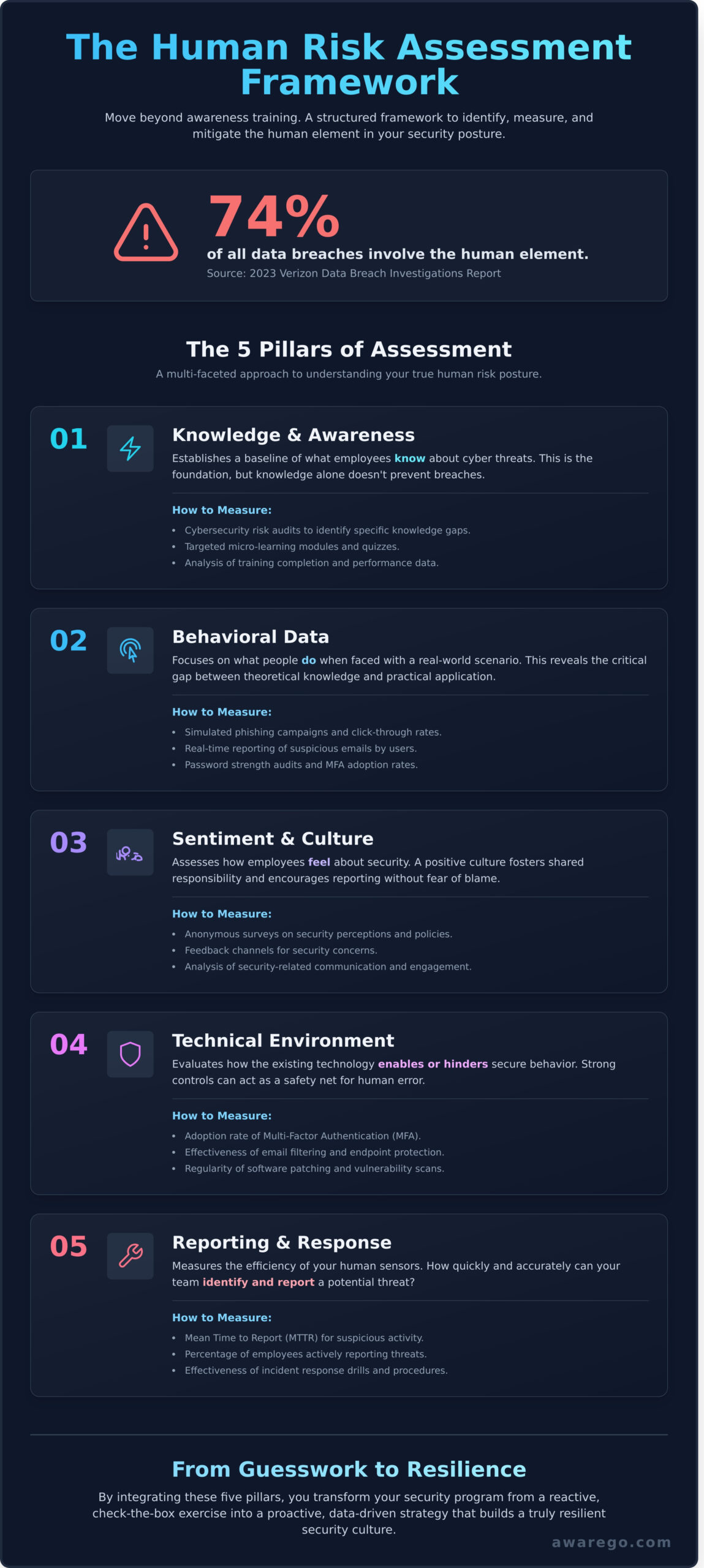
The 5 Pillars of a Cybersecurity Human Risk Assessment
A traditional security audit tells you if your software is patched. A modern human risk assessment framework tells you if your organization is resilient. It moves beyond compliance checklists to create a living, breathing picture of your security posture. This requires looking at your people from multiple angles. We break it down into five core pillars.
Pillar 1: Knowledge & Awareness
What do your employees actually understand about cyber threats? This is the foundational layer. But be careful. Knowledge doesn’t always translate to secure behavior. We’ve all seen it: a team member aces the annual phishing quiz but clicks on a real malicious link a week later. According to Verizon’s 2023 DBIR, 74% of all breaches involve the human element, proving that simple awareness training isn’t enough. The first step is to get a clear, unbiased baseline. An Employee Cybersecurity Risk Audit provides this crucial data, identifying specific knowledge gaps across your organization without the guesswork. From there, you can deploy targeted micro-learning to close those gaps effectively, avoiding the ‘training fatigue’ that plagues traditional, hour-long sessions.
Pillar 2: Behavioral Data
This is where the rubber meets the road. What do your people do when they think no one is watching? This pillar focuses on observable actions. It’s measured through simulated phishing campaigns, USB drop tests, and real-time reporting of suspicious emails. This data is infinitely more valuable than a quiz score because it reflects actual habits. It shows you the difference between what your team knows they should do and what they do under pressure in a real-world scenario.
Pillar 3: Sentiment & Culture
Do your employees feel like partners in security, or do they see it as IT’s problem? This pillar measures your security culture. A positive culture fosters a sense of shared responsibility, where people feel empowered and psychologically safe to report mistakes. You can measure sentiment through anonymous surveys and feedback channels. Do they feel security policies help them or hinder them? Do they believe the company truly values their role in staying safe? A strong security culture is your greatest asset; a weak one quietly undermines every technical control you own.
This sense of value is often tied to core HR practices. Ensuring compensation is fair and competitive is a foundational step in building this trust; you can explore Salary Benchmarking to see how your pay scales compare within your industry.
Pillar 4: Technological Controls
Your people are your first line of defense, but they shouldn’t be your only one. This pillar assesses your technical safety net. How well do your systems catch what humans miss? This includes evaluating the effectiveness of your email filters, endpoint detection, and multi-factor authentication (MFA) adoption rates. A comprehensive human risk assessment framework integrates these technical data points, ensuring your strategy aligns with proven standards like the NIST Risk Management Framework to create a defense-in-depth environment. Your tech should empower good human decisions, not just block bad ones.
Pillar 5: Remediation Agility
When a vulnerability is found, how fast can you fix it? This pillar measures the speed and efficiency of your response loop. If an employee clicks on a simulated phishing link, how quickly are they assigned a two-minute micro-learning video on that specific threat? A long delay leaves the risk wide open. True resilience isn’t about never failing; it’s about recovering and adapting instantly. Measuring your remediation agility shows how quickly your organization can learn and strengthen its defenses. To see how these pillars create a single, actionable view of your organization’s risk, explore how a human-centric platform can transform your security culture.
Human Risk Assessment vs. Traditional Awareness Training
For decades, the default response to a security incident was simple: more training. Another phishing simulation, another hour-long webinar. But if more training was the answer, why does human error still account for 74% of all data breaches? The truth is, traditional awareness training is a fundamentally flawed model. It treats a dynamic problem with a static solution.
A modern human risk assessment framework flips the script. It’s not about checking a box; it’s about changing behavior. Let’s break down the difference.
- Scope: Traditional training is a one-off event, an annual lecture that’s quickly forgotten. A framework provides continuous monitoring, identifying emerging risks and behavioral patterns in real-time.
- Data Depth: Old models measure completion rates. They tell you who watched a video, not who understood it. A framework provides deep, behavioral risk scores, showing you exactly who is vulnerable to what, and why.
- Outcome Focus: Awareness training aims for compliance. A framework targets actual threat reduction. The goal isn’t just to be “aware” of phishing; it’s to build the reflexive habit of spotting and reporting it.
This strategic shift from passive awareness to active mitigation is the core of effective human risk management. It stops the cycle of repetitive, ineffective training and replaces it with a data-driven program that adapts to your people and the threats they face.
The Failure of the ‘Fear-Based’ Training Model
Scaring employees with breach statistics and worst-case scenarios doesn’t create vigilance. It creates anxiety and ‘security disengagement.’ People feel overwhelmed and helpless, not empowered. At AwareGO, we champion an empathetic, human-centric approach. We replace fear with confidence by delivering micro-learning that builds secure habits. This fosters a true Security Culture, where your employees see themselves as your most valuable line of defense, not your weakest link.
Quantifying the ROI of a Framework-Based Approach
Presenting a new security initiative to the board requires a clear business case. A human risk assessment framework delivers one. The average cost of a data breach reached $4.45 million in 2023, according to IBM. Compare that catastrophic expense to the proactive investment in a continuous assessment program. By identifying and mitigating your top human risks, you aren’t just buying software; you’re buying down quantifiable financial risk. You can use tools for Benchmarking Human Risks to see how your organization’s security posture compares to industry averages, providing concrete data to justify your strategy. You can walk into the boardroom with confidence, armed with risk scores and a clear path to a more resilient workforce.
How to Implement Your Human Risk Assessment Framework
A framework on paper is just a plan. To truly reduce human risk, you need to bring it to life. This means moving from a static checklist to a dynamic, living system that adapts to your people and the threats they face. The process is a continuous cycle, not a one-time project. It’s about building a resilient security culture, one step at a time.
Here’s a five-step process to put your human risk assessment framework into action effectively.
- Step 1: Baseline Assessment. First, you need a starting point. Conduct an initial audit to understand your organization’s current security posture. This isn’t just about what people know; it’s about what they do. Use knowledge assessments, sentiment surveys, and a baseline phishing test. It’s common for organizations to see initial click rates as high as 30% before any training, giving you a clear, measurable benchmark for improvement.
- Step 2: Risk Mapping. Not all risks are created equal, and not all employees face the same threats. Use your baseline data to identify high-risk groups. For example, the 2023 Verizon DBIR shows that finance departments are heavily targeted by pretexting attacks. Map these specific vulnerabilities to employee roles. Your new hires, C-suite, and IT administrators all have unique risk profiles that require different attention.
- Step 3: Targeted Intervention. Generic, hour-long training modules don’t change behavior. Use your risk map to deploy targeted, engaging interventions. Deliver short, 90-second micro-learning videos that address specific threats relevant to each group. For your finance team, this could be a video on spotting invoice fraud. For everyone, it might be a quick lesson on identifying AI-generated phishing emails. This is precision education, not a blanket solution.
- Step 4: Continuous Monitoring. Human risk is not static. You need to track changes in real-time. Monitor engagement with training, report rates for simulated phishing, and sentiment scores. This data provides leading indicators of your security culture’s health. Are people feeling more confident? Are they reporting suspicious emails more often? This continuous feedback loop is critical.
- Step 5: Iterative Refinement. The threat landscape evolves constantly. Your defense must, too. Use the data from your monitoring to refine your approach. If a new threat like “quishing” (QR code phishing) emerges, you can quickly create and deploy a micro-learning module to address it. This iterative process ensures your human risk assessment framework remains relevant and effective against tomorrow’s attacks.
Setting Up Your Phishing Simulation Strategy
Effective phishing simulations are learning opportunities, not “gotcha” tests. The goal is to build resilience, not assign blame. A successful strategy moves beyond simple click rates and focuses on creating educational moments. When an employee clicks a simulated phish, they should immediately receive a short, contextual micro-learning video explaining the red flags they missed. This transforms a mistake into a memorable lesson.
Frequency and variety are key. According to a study from Terranova Security, running simulations at least quarterly can reduce click rates by over 60%. Mix up the templates, from fake package delivery notifications to urgent internal IT requests. Most importantly, integrate this data back into your employee risk score. A click isn’t a failure; it’s a valuable data point that helps you tailor future training.
Leveraging Automation and Software
Managing this cycle manually is impossible at scale. This is where dedicated Human Risk Management software becomes essential. These platforms automate the entire process, from deploying baseline assessments and targeted training to running complex phishing campaigns. They provide the engine that powers your framework, collecting and analyzing data to give you a clear view of your organization’s human risk profile.
Modern platforms use APIs and Learning Management System (LMS) integrations like SCORM to seamlessly fit into your existing tech stack. This streamlines data flow and makes security training a natural part of the workday. Ultimately, automation is what makes a framework ‘live’ rather than ‘static’. It transforms a theoretical plan into a responsive, data-driven system that continuously strengthens your human firewall. See how our platform automates every step of your human risk assessment and request a demo today.
Future-Proofing Your Strategy with AwareGO
You’ve mapped out the theory. You understand the components of a strong security strategy. But a framework on paper can quickly become outdated and difficult to manage. True organizational resilience comes from a living, breathing program. AwareGO transforms your human risk assessment framework from a static document into a dynamic, seamless software experience that continuously strengthens your human firewall.
Forget hour-long, check-the-box training sessions that employees dread. The modern workforce learns differently. Our entire methodology is built on high-impact micro-content. We deliver engaging, story-driven security lessons-like how to spot a spear-phishing email or secure your home Wi-Fi-in under two minutes. This isn’t just about saving time; it’s about neuroscience. Research from the Technical University of Denmark shows collective attention spans are narrowing globally. Our bite-sized videos boost knowledge retention by over 20% compared to traditional e-learning and fit naturally into the workday, making learning a habit, not a disruption.
How do you know if your strategy is actually working? You measure it. AwareGO moves you beyond simple completion rates and into meaningful behavioral analytics. Our platform gives you a real-time dashboard that visualizes your organization’s human risk profile, providing clear, actionable data perfect for reporting to the board and proving ROI.
- Individual Risk Scores: Pinpoint your most vulnerable employees with scores based on over 15 behavioral metrics, from assessment results to simulation performance.
- Organizational Benchmarks: See how your security culture stacks up against anonymized industry averages to set realistic improvement goals.
- Threat-Specific Insights: Understand your company’s unique weaknesses, whether it’s phishing, password hygiene, or social engineering, and assign targeted training automatically.
Innovative Content for the Modern Workforce
Our content works because it respects your employees. We’ve replaced the fear-mongering IT persona with a “cool expert” in our videos, making security feel approachable and empowering. This approach drives engagement rates 3x higher than industry-standard training. With content available in over 20 languages and managed services to help you customize learning paths and reporting, we help you build a security culture that resonates with your entire global team.
Next Steps: From Assessment to Resilience
Moving from outdated annual training to a complete Human Risk Management (HRM) model is a powerful evolution. AwareGO makes the transition smooth. We help you build a continuous cycle of assessment, education, and reinforcement that creates lasting behavioral change. Ready to see how our human risk assessment framework comes to life? Book a personalized demo with one of our specialists to explore the platform’s full capabilities.
Don’t let human risk remain an unquantified threat. Turn your employees into your strongest security asset. Build a resilient culture, backed by data you can trust. Start your Human Risk Assessment with AwareGO today.
Turn Human Risk into Cyber Resilience
Your people aren’t your weakest link. They’re your greatest defense. Moving beyond outdated, one-size-fits-all training means embracing a strategy that measures real-time human behaviors. A modern human risk assessment framework gives you the data to stop guessing and start targeting the specific risks that matter most to your organization.
Ready to build a smarter security culture? AwareGO’s platform is built on 15+ years of behavioral science and cybersecurity expertise. It’s trusted by global enterprises to secure over 1 million employees and has won multiple ‘Innovation in Security Training’ awards for its effectiveness.
Stop checking boxes and start building confidence. Book a demo to see our Human Risk Framework in action and empower your team to become your strongest line of defense.
Frequently Asked Questions
What is a human risk assessment framework?
A human risk assessment framework is a systematic process for identifying and measuring security risks tied to employee behavior. Instead of just tracking training completion, it provides a clear, data-driven view of your team’s security habits. Since Verizon’s 2023 DBIR found that 74% of all breaches involve the human element, this framework helps you pinpoint specific vulnerabilities. You can then create targeted interventions to build a stronger, more resilient security culture.
How do you measure human risk in cybersecurity?
You measure human risk by collecting and analyzing specific behavioral data points. This includes phishing simulation click-rates, security training assessment scores, and the number of reported security incidents. By combining these metrics with data from your existing security stack, like failed login attempts from an IAM system, you create a quantifiable risk score. This data transforms human risk from a vague concept into a clear, manageable KPI for your security program.
Is human risk management the same as security awareness training?
No, they aren’t the same. Security awareness training is a component of a much larger Human Risk Management (HRM) strategy. While training raises awareness, HRM actively measures and reduces risk through continuous assessment and behavioral interventions. Traditional annual training can have a knowledge retention rate as low as 12% after a year. HRM creates lasting security habits by making learning frequent, relevant, and measurable.
What are the common indicators of high human risk?
High human risk shows up in clear, measurable behaviors. Key indicators include phishing simulation click-rates above the 15% industry average, frequent password reuse reported by your systems, and a low incident reporting culture. If fewer than 5% of your employees report a suspicious email, it signals a lack of engagement. These data points are your early warnings, allowing you to intervene before a minor issue becomes a major breach.
How often should a human risk assessment be conducted?
Human risk assessment isn’t a one-time project; it’s a continuous process. Your risk landscape changes daily, as shown by the 800,944 complaints reported to the FBI’s IC3 in 2022 alone. We recommend continuous monitoring through an automated platform, with formal, in-depth reviews conducted quarterly. This rhythm allows you to track progress, adapt to new threats, and keep your security posture strong and responsive.
Can a framework really change employee security behavior?
Yes, absolutely. A well-designed framework changes behavior by making security easy and relevant. It works because it applies principles like the Fogg Behavior Model, where behavior change requires motivation, ability, and a prompt. By providing short, engaging training (increasing ability) and timely security nudges (the prompt), the framework makes secure actions the default choice. It transforms security from an annual chore into a daily habit.
What role does behavioral science play in risk assessment?
Behavioral science is the engine of an effective risk assessment. It moves beyond what people do to understand *why* they do it. By applying concepts like nudge theory, we can design interventions that work with human psychology, not against it. For instance, a 2021 study in the *Journal of Cybersecurity* found that personalized nudges can reduce risky clicks by up to 40%. It’s about making the secure choice the easiest choice.
How do I justify the cost of a human risk management platform?
You justify the cost by highlighting its return on investment. With the average data breach costing $4.45 million in 2023, according to IBM, preventing just one incident delivers massive value. A human risk management platform provides measurable data on risk reduction, turning your security spending from a cost center into a strategic investment. It gives you the C-suite-ready metrics to prove you’re actively lowering your company’s single biggest cyber vulnerability.