
Your 2024 security training program is already obsolete.
You’re right to feel like you’re constantly playing catch-up. AI-powered social engineering is accelerating faster than traditional training can handle, leading to employee fatigue and programs that fail to create lasting behavioral change. It’s frustrating when your efforts don’t translate into a measurable reduction in human risk.
This guide is your strategic roadmap for the future. We’ll show you the critical security awareness training topics 2026 requires, moving beyond basic phishing drills to address the sophisticated, AI-driven threats on the horizon. You’ll learn how to build a curriculum that fosters a genuine security culture where reporting is second nature.
We’ll cover the specific training modules and behavioral strategies you need to empower your team, making them your most effective line of defense.
Key Takeaways
- Understand why the 2026 threat landscape, driven by AI-powered phishing and social engineering, makes traditional training ineffective.
- Discover the essential security awareness training topics 2026 needed to equip your team against hyper-personalized, AI-generated attacks.
- Gain actionable techniques for training employees to spot sophisticated threats like deepfake audio and video in “urgent” executive requests.
- Learn how to replace one-size-fits-all programs with a data-driven approach that uses risk assessments to build a targeted security culture.
The 2026 Cyber Threat Landscape: Why Traditional Training Fails
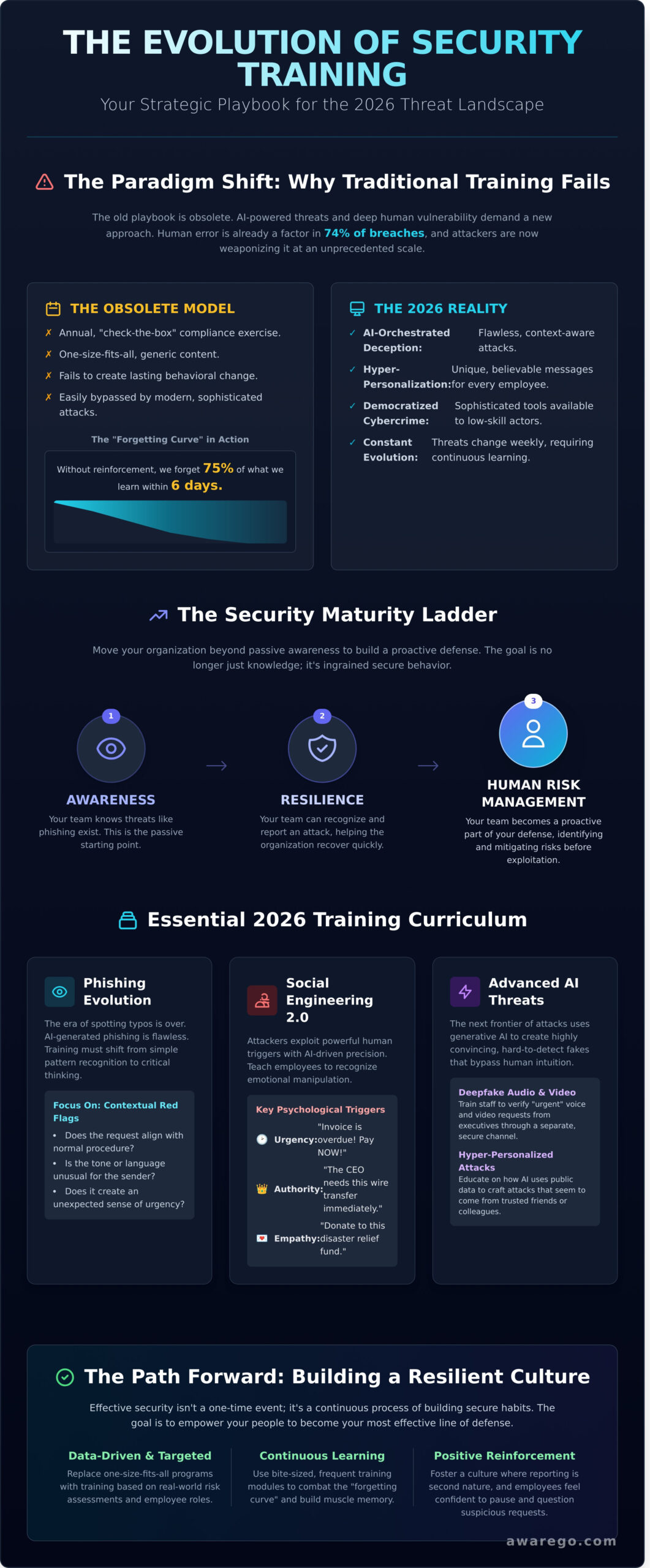
The rules of cybersecurity have changed. By 2026, the threats your team faces won’t just be smarter; they’ll be built on a scale we’ve never seen before. We’re entering an era where AI-powered attacks meet deep human vulnerability, and the old training playbook is officially obsolete. According to IBM’s 2023 Cost of a Data Breach Report, human error was already a factor in 74% of breaches. Now, attackers are weaponizing that reality with unprecedented efficiency.
Forget the lone hacker in a dark room. Think automated, hyper-personalized social engineering campaigns that can target every employee in your company with a unique, believable message. The cost of a single click has spiraled beyond financial loss. It now encompasses crippling regulatory fines under regulations like GDPR and a catastrophic loss of brand trust that can take years to rebuild.
The Rise of AI-Orchestrated Deception
Large Language Models (LLMs) have permanently erased the most common phishing red flag: poor grammar. AI now crafts flawless, context-aware emails, texts, and social media messages that are indistinguishable from legitimate communications. This has democratized cybercrime, putting sophisticated attack tools in the hands of low-skill actors. The barrier to entry is gone. In this environment, where threats evolve weekly, the frequency of training now matters far more than a single, in-depth annual session.
From Compliance Checkboxes to Behavioral Change
The once-a-year training model is dead. It was never a security strategy; it was a compliance exercise. Research based on Hermann Ebbinghaus’s “forgetting curve” shows that we forget about 75% of what we learn within six days if it isn’t reinforced. Effective security isn’t about a certificate of completion. It’s about building secure habits. Modern programs use behavioral science to create lasting change, turning secure actions into muscle memory through continuous, bite-sized learning. The goal is no longer just basic security awareness; it’s about building a resilient security culture.
This requires a fundamental shift in our thinking and our vocabulary. We must move our organizations up the maturity ladder:
- Awareness: Your team knows threats like phishing exist. This is the passive starting point.
- Resilience: Your team can recognize and report an attack, helping the organization recover quickly.
- Human Risk Management (HRM): Your team becomes a proactive part of your defense, identifying and mitigating human-centric risks before they can be exploited.
Focusing on HRM is the only sustainable path forward. The most effective security awareness training topics 2026 will be those grounded in changing behavior, not just checking a box. It’s time to build a program that empowers your people with the confidence and skills to thrive in a new digital reality.
Core Security Awareness Training Topics for 2026
The foundations of cybersecurity haven’t changed, but the threats built upon them have. Yesterday’s security checklist won’t stop tomorrow’s attacks. Your team’s resilience depends on evolving your training to meet the sophistication of modern threats. The most effective security awareness training topics for 2026 focus on the human element, turning potential vulnerabilities into your strongest defense.
Let’s break down the essential topics every employee needs to master.
First, phishing has become hyper-realistic. Thanks to generative AI, the era of spotting typos and grammatical errors is over. A 2023 Darktrace report found a 135% increase in sophisticated social engineering attacks, many written with flawless, AI-generated prose. Training must now teach employees to spot contextual red flags. Does the request align with normal procedure? Is the tone unusual for the sender? It’s about critical thinking, not just pattern recognition.
This ties directly into Social Engineering 2.0, where attackers manipulate psychology with precision. They exploit powerful human triggers like:
- Urgency: “This invoice is overdue! Pay now to avoid service interruption.”
- Authority: A deepfake video call from your “CEO” requesting an urgent wire transfer.
- Empathy: A fake charity appeal following a natural disaster.
Your team needs to recognize the emotional manipulation at play, not just the technical details of the message. Building these defensive habits requires consistent, positive reinforcement. In fact, CISA’s training resources emphasize creating a culture of cyber readiness, which starts with empowering people to pause and question.
Beyond attacks, data privacy is a global conversation. Regulations like the EU’s GDPR, NIS2 Directive, and DORA now set the standard. This isn’t just a legal issue for the compliance department. Every employee who handles data must understand their role in protecting it, whether it’s a customer’s personal information or sensitive financial data. Proper training transforms compliance from a burden into a mark of trustworthiness.
Finally, identity management has moved beyond the password. While passkeys offer a more secure future, attackers are exploiting the transition. MFA fatigue, where threat actors spam users with push notifications until one is approved, is a primary tactic. A 2023 Mandiant report identified it as a key vector in major breaches. Your people must be trained to treat a flood of MFA requests as a red flag and report it immediately.
Tackling these modern threats isn’t about memorizing a long list of rules. It’s about using seamless, engaging content to build a resilient security culture that adapts to new risks.
Modern Phishing and Communication Safety
Mobile devices are the new front line. A 2023 Proofpoint report revealed 84% of organizations faced smishing (SMS phishing) attacks. Training must be mobile-first, teaching your team to scrutinize texts and unsolicited calls with the same skepticism as emails. For high-stakes fraud like Business Email Compromise (BEC), which cost businesses over $2.7 billion in 2023 according to the FBI, establishing a “Verify First” protocol using an out-of-band channel (like a phone call to a known number) is non-negotiable.
This is especially true for supply chain interactions, where a single fraudulent invoice from a compromised logistics partner can be devastating. A robust security culture means verifying requests even from seemingly trusted partners, from a small supplier to a global freight forwarder like Gateway Cargo.
Device and Workspace Security
In a hybrid world, every employee operates an “Office of One,” making personal device security a shared responsibility. But digital threats have physical counterparts. Training should cover basics like clean desk policies, USB safety, and preventing tailgating into secure spaces. For organizations managing mobile assets, this responsibility extends to physical tracking to prevent theft or loss; you can find out more about how modern GPS solutions work. A new risk has also emerged: “Shadow AI.” A 2024 Cyberhaven report found that 11% of data employees paste into tools like ChatGPT is sensitive. Your team needs to understand that using unsanctioned AI tools can lead to a major data leak.
Advanced Topics: Defending Against AI-Generated Threats
The game has changed. Cybercriminals now wield generative AI to create attacks that are faster, more personal, and incredibly convincing. Your team’s ability to spot a generic phishing email is no longer enough. The most critical security awareness training topics 2026 will focus on building resilience against threats designed by machines to manipulate human trust at scale.
AI doesn’t just automate old attacks; it creates entirely new categories of human risk. From hyper-realistic video calls to bot-driven campaigns on LinkedIn, these threats exploit the natural human tendency to trust what we see and hear. Your challenge is to train your people to question reality itself.
Deepfakes and Identity Verification
Imagine your finance controller gets a video call. It’s you, the CEO, looking and sounding exactly right. You urgently need a $250,000 wire transfer to close a secret acquisition. Do they act? Scenario-based training must prepare them for this moment. The right response isn’t panic; it’s process. Employees need a clear, out-of-band verification method, like a phone call to a trusted number, before acting on any high-stakes request. Deepfake Social Engineering is not just a future threat; it’s a primary human risk management priority for 2026.
Safe AI Usage in the Workplace
The threat isn’t just external. Your own team’s use of public AI tools creates new vulnerabilities. A 2023 study by Cyberhaven revealed that 11% of what employees paste into tools like ChatGPT is confidential company data. Training must be explicit: never input proprietary code, customer lists, or strategic plans into a public AI. You must also instill a “human-in-the-loop” culture. AI-generated code must be verified, and AI-generated facts must be checked. This is critical when attackers can now use AI to clone your corporate login portal in under 30 seconds, making visual verification nearly impossible for an untrained eye.
Automated social engineering is another rapidly growing threat. Attackers now deploy bots on professional networks to engage with your employees, building rapport over weeks before making a malicious request. These bots use AI to craft personalized, context-aware messages that are indistinguishable from human interaction. This low-and-slow attack vector bypasses technical controls and targets human trust directly. Even as we tackle these advanced threats, the fundamentals remain crucial. Reinforcing core principles, like those outlined in CISA’s Cyber Essentials, provides the bedrock of resilience your team needs to spot these sophisticated deceptions.
Finally, your training must address the ethics of AI. These systems learn from vast, unfiltered internet data, inheriting all its biases. An AI model might produce biased hiring recommendations or generate flawed market analysis based on skewed data. Employees need to understand that AI output is not objective truth. It’s a calculation based on its training. Teaching your team to critically evaluate AI-generated information protects your organization from both misinformation and poor, data-driven decisions. This transforms your security culture from one of simple awareness to one of active, critical thinking, making it one of the most vital security awareness training topics 2026 for any forward-thinking business.
Implementing a 2026 Security Awareness Program
Knowing the right topics is only half the battle. How you deliver and measure your training program determines its success or failure. A modern security program isn’t a one-time event; it’s a continuous, data-driven cycle designed to build lasting security habits. It’s time to move beyond compliance checklists and build real human resilience.
Your strategy for 2026 should be built on five core pillars. This framework transforms security awareness from a passive lecture into an active, engaging part of your company’s culture.
- Assess: Start with data, not assumptions. Use human risk assessments to pinpoint specific vulnerabilities. You’ll likely find your Finance team is targeted with invoice fraud 74% more often than other departments, while HR faces constant credential phishing attacks. This data is your roadmap.
- Curate: A one-size-fits-all approach no longer works. Based on your assessment, deploy tailored micro-learning modules. Your sales team, constantly on the road, needs training on public Wi-Fi risks. Your developers need refreshers on secure coding. Personalized content is relevant content.
- Engage: Fight training fatigue with high-quality, story-driven content. People remember stories, not statistics. A two-minute animated video showing the real-world consequences of credential stuffing is far more effective than a 20-page slide deck.
- Measure: Stop tracking vanity metrics. The “Click Rate” on a phishing simulation tells you very little. The “Reporting Rate” tells you everything. A high reporting rate, where employees actively flag suspicious messages, is the gold standard of a strong security culture. It proves your team is part of your defense.
- Iterate: Cybercriminals update their tactics daily. Your training must keep pace. Refresh your content library monthly to address the latest threats, from AI-powered vishing calls to sophisticated QR code phishing. Stale content is ineffective content.
A holistic approach to employee safety often combines digital training with physical preparedness. While building a robust security culture, it’s also vital to ensure your team is equipped for real-world emergencies. For instance, many organizations ensure their staff have up-to-date certifications from accredited training partners like Aspire First Aid Guide Training Corp, covering essentials like first aid and CPR.
The Power of Micro-Learning
Attention spans are short. Your training should be shorter. Research published in the Journal of Applied Psychology shows that learning in 3-5 minute bursts can boost knowledge retention by over 50%. We build secure habits through frequent, positive reinforcement, not hour-long annual training sessions. Deliver these “snackable” videos and interactive modules directly within your team’s workflow on Slack, Teams, or email. This makes security a seamless, everyday practice.
Measuring Human Risk Management Success
You can’t manage what you don’t measure. The right KPIs demonstrate the ROI of your program and build a compelling case for security investment. In 2026, you should be tracking metrics like employee reporting rates, the average time to detect a simulated threat, and overall security culture scores. When reporting to the Board, translate this data into business impact. Show them how a 40% reduction in successful phishing simulations directly lowers the organization’s financial risk profile. The right set of security awareness training topics 2026 is the foundation, but measurable risk reduction is the result that matters.
Ready to move from passive awareness to active risk management? Explore how our Human Risk Management platform provides the data and content you need to build a resilient security culture.
AwareGO: Leading the Shift to Human Risk Management
Traditional security awareness is broken. Annual, hour-long training sessions don’t change behavior; they just check a box. For 2026, you need a new approach that treats your people not as a liability, but as your most powerful security asset. At AwareGO, we pioneered the move from passive awareness to active Human Risk Management (HRM). We give you the tools to measure, reduce, and monitor human cyber risk effectively.
Our platform transforms your employees into a proactive defense layer. We do this with a proven methodology grounded in behavioral science. The science behind our micro-learning is simple: the human brain learns best in short, frequent, and engaging bursts. Our award-winning, two-minute videos are designed to beat the “Forgetting Curve,” boosting knowledge retention by up to 80% compared to traditional annual training. They aren’t lectures. They are compelling, live-action stories that make security concepts stick.
Real change begins with real data. We integrate our Human Risk Assessment directly with automated training paths. Here’s how it works:
- Assess: Our platform identifies specific employee vulnerabilities and calculates your organization’s human risk score.
- Remediate: It then automatically assigns targeted micro-learning videos to individuals or groups who need them most.
- Measure: You get real-time dashboards showing a measurable reduction in risky behaviors, with some partners seeing a 64% drop in clicks on malicious links within six months.
This data-driven cycle ensures your security efforts are focused, efficient, and impactful. For global enterprises, our solutions scale effortlessly. AwareGO’s extensive content library is SCORM-compliant and integrates seamlessly with your existing Learning Management System (LMS). We also offer fully managed services for organizations that want our experts to run their human risk program from start to finish.
Our Human-Centric Philosophy
We don’t use fear to motivate. Fear creates anxiety and avoidance, while empowerment builds a resilient security culture. Our “Cool Expert” approach uses world-class cinematography and relatable stories to create content employees actually enjoy watching. This positive reinforcement turns good security practices into lifelong habits. See the difference for yourself in our library of Security Awareness Videos.
Getting Started with Your 2026 Strategy
Building your list of security awareness training topics 2026 starts with understanding your current risk. You can conduct your first Employee Cybersecurity Risk Audit with our platform in just a few clicks. From there, you can customize your SCORM library to address industry-specific compliance needs like GDPR, HIPAA, or PCI-DSS. Stop guessing and start managing your human risk with precision.
Schedule a demo to see how we manage human risk in 2026.
Secure Your Future: From Awareness to Resilience
The cyber landscape of 2026 won’t wait. Your organization’s resilience depends on building secure habits, not just completing annual training modules. Choosing the right security awareness training topics 2026 is critical. This means moving beyond basic phishing and focusing squarely on advanced threats like AI-generated deepfakes and automated social engineering. It’s about creating a proactive security culture, not a reactive checklist.
This is the shift from passive awareness to active Human Risk Management. AwareGO’s platform is built for this future. Trusted by global enterprises to protect over 1 million employees, we provide data-driven CISOs with the tools to measure and mitigate human risk effectively. Our award-winning, micro-learning content library uses behavioral science to make secure behaviors an instinct, not an afterthought.
Don’t let future threats become today’s crisis. Start Your 2026 Human Risk Assessment with AwareGO to get a clear, actionable view of your security posture. Let’s build a resilient, secure future together.
Frequently Asked Questions
What are the most important security awareness topics for 2026?
The most critical security awareness training topics for 2026 center on AI-driven threats and human-centric defense. Your curriculum must prioritize identifying sophisticated AI-phishing, spotting deepfake audio and video, and managing MFA fatigue. While foundational topics like password hygiene remain vital, they need to be taught in the context of new, automated attack vectors. A forward-thinking program builds resilience against the threats of tomorrow, not just the attacks of yesterday.
How often should employees receive security awareness training in 2026?
Employees should receive security training continuously through micro-learning modules delivered at least monthly. The outdated model of a single, annual training session is ineffective; research based on the Ebbinghaus Forgetting Curve shows people forget up to 75% of new information within a week. Frequent, bite-sized training reinforces key concepts, builds lasting security habits, and fosters a strong security culture without overwhelming your team or disrupting their workflow.
Can AI-driven phishing be stopped by traditional email filters?
No, traditional email filters alone can’t reliably stop AI-driven phishing. These sophisticated attacks use generative AI to create context-aware, personalized messages that bypass signature-based and keyword-based security tools. Since over 90% of successful breaches start with a phishing email, your human firewall is the most critical line of defense. Training your employees to spot the subtle red flags of these advanced attacks is essential for your organization’s security.
What is the difference between security awareness and human risk management?
Security awareness is about knowing the risks, while Human Risk Management (HRM) is about changing behavior to actively reduce those risks. Awareness is knowing a threat exists. HRM is building the secure habits and culture needed to defeat it. It’s a strategic shift from passive, compliance-based check boxes to a data-driven approach that identifies risky behaviors and delivers targeted training to measurably improve your company’s security posture.
How do we train employees to spot deepfakes?
You train employees to spot deepfakes by focusing on both technical cues and behavioral habits. Show them real-world examples highlighting giveaways like unnatural eye movements or poor lip-syncing. More importantly, build a culture of verification. Teach your team to always confirm urgent or unusual requests, like a supposed CEO asking for a wire transfer via video, through a separate, trusted communication channel before taking any action.
What metrics should we use to measure the success of our training program?
Measure success with behavior-based metrics, not just course completion rates. Track the click-rate on phishing simulations, the number of employees actively reporting suspicious emails, and improvements in password hygiene scores. Seeing a 40% reduction in simulation clicks or a 60% increase in threat reporting provides tangible proof that your training is changing behavior and building a stronger, more resilient security culture across the organization.
Is micro-learning more effective than traditional long-form training?
Yes, micro-learning is far more effective for building and retaining security knowledge. Short, engaging videos of one to two minutes, delivered frequently, can increase knowledge retention by over 50% compared to a single annual seminar. This snackable approach respects your employees’ time, boosts engagement, and seamlessly integrates security education into their daily routine. It transforms training from a yearly event into a continuous habit.
How do we handle “MFA fatigue” in our 2026 training curriculum?
Address MFA fatigue by explaining the “why” behind the attacks and providing a clear action plan. Train employees that a flood of unexpected multi-factor authentication (MFA) prompts is a direct attack, not a system glitch. Teach them a simple rule: if you didn’t initiate the login, always deny the request and report it immediately. Tackling this issue is one of the key security awareness training topics for 2026, turning annoyance into an active defense.