
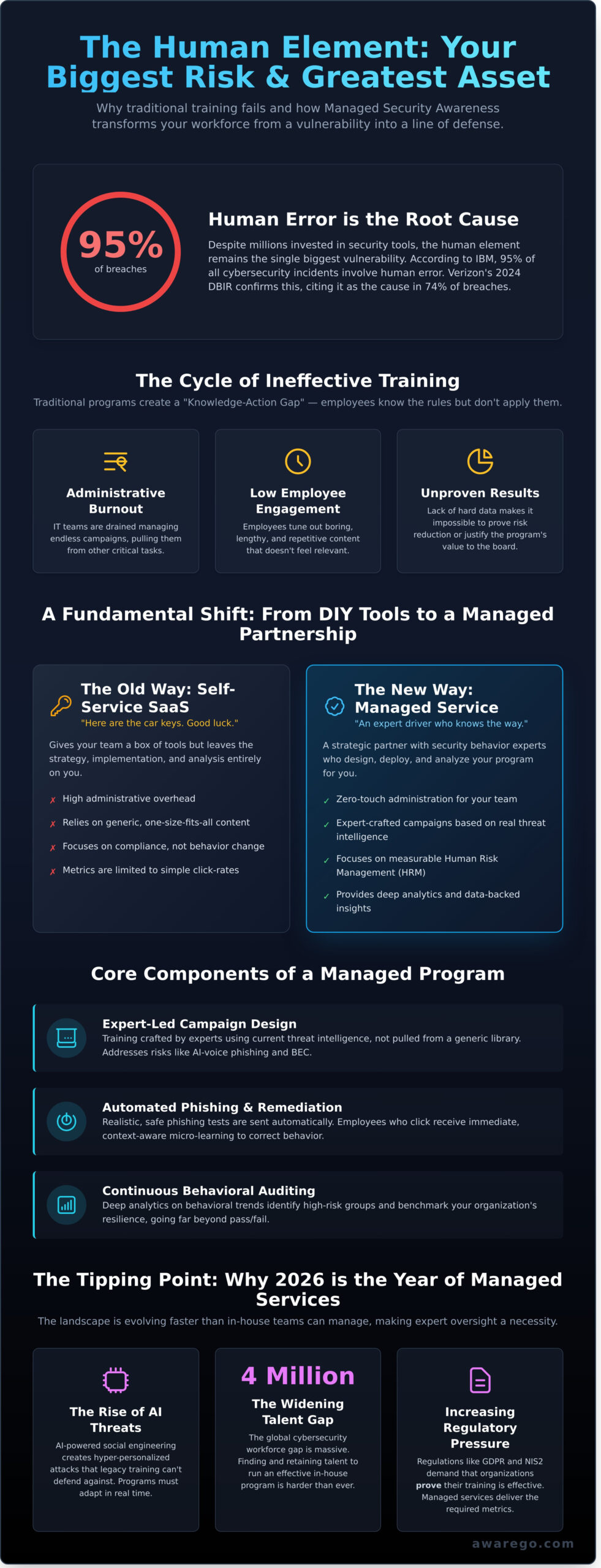
Human error is the root cause of 95% of all cybersecurity incidents, according to IBM’s 2023 Cost of a Data Breach Report. Think about that. Despite millions invested in security tools, the human element remains the single biggest vulnerability. So why do most training programs still fail to change behavior?
You already know the answer. You’re wrestling with administrative burnout from managing endless campaigns. Your employees tune out the same old boring content, and when it’s time to report to the board, you lack the hard data to prove you’ve actually reduced human risk. It’s a cycle of low engagement and unproven results.
It’s time for a fundamental shift from checking boxes to changing habits. This guide will show you how managed security awareness training leverages behavioral science and expert oversight to build a resilient security culture. Discover a zero-touch approach that measurably lowers risk scores, genuinely engages your team, and transforms your workforce into a proactive security asset by 2026.
Key Takeaways
- Discover why traditional training fails to change behavior and how to close the critical “Knowledge-Action Gap” in your team.
- Learn how managed security awareness training reduces your administrative burden while delivering expert-driven, measurable results.
- Get a strategic framework to evaluate providers, focusing on engaging content and data-backed Human Risk Assessments.
- Understand the difference between a compliance-based and a culture-based approach to transform your workforce into a security asset.
What is Managed Security Awareness Training?
You know the goal. You need to build a team that can spot and stop cyber threats. For years, the standard approach has been rooted in the concept of Security Awareness, a practice focused on educating employees about protecting assets. But traditional programs often just hand your IT team a box of tools and wish them luck. This DIY model is broken. It drains resources and rarely moves the needle on real human risk.
This is where a managed service changes the game. It’s not just software; it’s a strategic partnership. You get a team of security behavior experts dedicated to designing, deploying, and analyzing your training program. They handle the heavy lifting so you can focus on your business. Simply put, managed security awareness training is the strategic oversight of your human cyber-risk, handled by external specialists.
The difference from a standard SaaS platform is profound. A SaaS tool gives you the car keys. A managed service provides an expert driver who knows the map, avoids the traffic, and gets you to your destination safely. This partnership fuels the critical shift from passive “awareness” to active Human Risk Management (HRM). Awareness is knowing a threat exists. HRM is the measurable practice of changing behaviors to reduce that threat. With human error identified as the root cause in 74% of all breaches according to Verizon’s 2024 DBIR, this shift isn’t optional. It’s essential.
The Core Components of a Managed Program
A true managed program is built on a continuous, data-driven cycle. It’s a living strategy, not a one-time event. The core components work together to build a resilient security culture:
- Expert-Led Campaign Design: Your training isn’t pulled from a generic library. It’s crafted by experts using current threat intelligence to address risks like the latest AI-voice phishing scams or business email compromise (BEC) tactics.
- Automated Phishing Simulations: The system sends realistic, safe phishing tests. But the real value is in the expert-designed remediation. An employee who clicks receives immediate, context-aware micro-learning to correct that specific behavior on the spot.
- Continuous Behavioral Auditing: Forget simple pass/fail metrics. A managed service provides deep analytics on behavioral trends, identifying high-risk groups and benchmarking your organization’s resilience against industry standards.
Why 2026 is the Year of Managed Services
The threat landscape and business environment are evolving faster than most in-house teams can handle. Three key factors are making managed services a necessity, not a luxury:
- The Rise of AI-Driven Threats: AI-powered social engineering creates hyper-personalized attacks that legacy training can’t defend against. You need a program that adapts in real time.
- The Widening Talent Gap: The global cybersecurity workforce gap hit 4 million professionals in 2023, according to (ISC)². Finding and retaining the talent to run an effective, in-house program is harder than ever.
- Increasing Regulatory Pressure: Regulations like GDPR and NIS2 demand that organizations prove their training is effective. Managed services deliver the detailed reporting and risk reduction metrics that satisfy auditors.
Understanding the enterprise AI landscape is crucial for grasping how these threats develop. To learn about the operational side of enterprise AI and its strategic implications, you can read more.
The Science of Behavior Change: Why Expertise Matters
Your employees know what a phishing email is. They’ve probably sat through a 60-minute slideshow on cybersecurity. Yet, the dangerous clicks still happen. Why? Because there’s a huge difference between knowing something and doing it in a moment of distraction. This is the “Knowledge-Action Gap,” and it’s where traditional awareness training fails.
Closing that gap isn’t about more information; it’s about changing behavior. At AwareGO, our entire approach is built on behavioral science. We know that in a world of constant digital noise, you have seconds, not minutes, to make an impact. That’s why we focus on micro-learning. Our content is “snackable” by design, delivering critical skills in under two minutes. This isn’t just a convenience. It’s a strategic response to how the modern brain works, ensuring security habits stick without disrupting workflow.
This is where the expertise in managed security awareness training becomes a game-changer. A managed service doesn’t just hand you a library of videos. Our experts become an extension of your team. They dive into your data, using analytics to identify high-risk cohorts. For instance, they might find that your finance department is targeted with invoice fraud 60% more often than other teams, allowing them to deploy highly specific, role-based training that addresses the actual threats your people face every day.
Beyond the Click: Measuring Real Security Culture
For years, the industry has been obsessed with one metric: the click rate. But that only measures failure. A true security culture is proactive, not reactive. Our experts shift the focus to metrics that matter, like “Time to Report.” A low click rate is good, but a fast report time on a malicious email is even better. It proves your employees have become a vigilant human firewall. This shift is powered by empathy, not fear. We replace shaming tactics with positive reinforcement and behavioral nudges that build confidence and long-term security habits.
Human Risk Management (HRM) vs. Compliance
Simply “checking the box” on annual compliance training creates a false sense of security. It satisfies an audit, but it won’t stop a sophisticated cyberattack. True resilience comes from continuous Human Risk Management (HRM). It’s a philosophy even government agencies embrace; the resources on the DCSA Security Awareness Hub show a deep commitment to ongoing, dynamic training. A managed service elevates your program from a compliance task to a strategic function by providing a comprehensive Employee Cybersecurity Risk Audit. This allows you to finally quantify the “human element,” presenting clear, data-driven insights on risk reduction directly to your board.
Managed vs. Self-Service vs. DIY: A Strategic Comparison
Choosing your security awareness model is a defining moment for your program. It’s not just about buying software; it’s about building a resilient security culture. Your decision impacts cost, team workload, and how quickly you can reduce human risk. To be effective, you must aim for genuine behavioral change, Moving Beyond ‘Check-the-Box’ Compliance and into a state of active defense. Let’s break down the real-world differences between going it alone and partnering with an expert.
The core of the debate comes down to one thing: Total Cost of Ownership (TCO). A DIY or self-service platform might have an appealing sticker price, but the hidden costs quickly add up. Consider the salary of a security analyst, which averages over $100,000 annually. If they spend just 25% of their time creating content, running phishing simulations, and analyzing reports, you’ve added a $25,000 hidden cost to your “cheaper” solution. This administrative burden doesn’t scale well. For a 200-person company, it’s a major distraction. For a 2,000-person company, it becomes a full-time job.
This is where a managed service flips the script. It’s not just for large enterprises. In fact, for small to mid-sized businesses with lean IT teams, it’s the most efficient path forward. It offers:
- Predictable Costs: A clear, all-inclusive fee replaces unpredictable internal resource drain.
- Minimal Admin Burden: Your provider handles the campaign planning, execution, and reporting. You focus on the results, not the process.
- Rapid Speed to Maturity: You don’t spend 12 months building a program from scratch. You launch a mature, expert-designed program in weeks.
When Should You Keep It In-House?
A DIY approach can work, but only under specific conditions. You need a dedicated internal team with expertise in both cybersecurity and educational content creation. The biggest challenge isn’t launching the program; it’s keeping it relevant. The threat landscape evolves daily. A hybrid model, using a SCORM Content Library with your internal management system, offers a middle ground. You get world-class content without the creation burden.
The ROI of Managed Security Awareness
The return on investment is clear and compelling. The IBM Cost of a Data Breach Report 2023 found the global average cost of a data breach reached $4.45 million. A single phishing incident that leads to a ransomware attack can cost more than a decade of managed security awareness training fees. The value extends beyond preventing disaster. Better training reduces security-related help desk tickets as employees learn to identify and report threats confidently. Furthermore, the “Expert-in-the-Loop” service included in many managed programs provides immense value. When an employee reports a phishing email, you get immediate expert analysis, turning a potential crisis into a valuable, real-time training moment.
A Framework for Selecting a Managed SAT Provider
Choosing a partner for your security awareness program isn’t just a procurement decision. It’s a strategic choice that directly impacts your company’s resilience. The right provider becomes an extension of your team, helping you build a strong security culture. The wrong one just adds noise and checks a compliance box. Your goal is to find a true partner, not just a content library with a support line.
Here’s how to separate the innovators from the imitators.
- Prioritize Content Quality. Your employees are your first line of defense, but they won’t engage with content that feels like a lecture. Ditch providers who rely on long, generic “corporate videos.” Instead, look for a partner who delivers engaging, high-quality micro-learning. Research from the Journal of Applied Psychology shows that short, repeated training sessions can boost knowledge retention by up to 60%. Your content should be memorable, not mandatory.
- Demand Data-Driven Insights. Completion rates are a vanity metric. A modern managed security awareness training provider gives you deep, actionable intelligence on your human risk. Do they offer a Human Risk Assessment? This is the new standard. It moves beyond simple click rates to quantify your team’s specific vulnerabilities, behaviors, and security habits. You need to understand the why behind the click.
- Evaluate the “Managed” Depth. The word “managed” can mean very different things. For some, it’s a glorified support ticket system. For a true partner, it means you get a dedicated security strategist. This expert helps you interpret risk data, design targeted training campaigns, and prove the program’s ROI to leadership. Don’t settle for a reactive helpdesk; demand a proactive partner.
- Verify Global Reach and Localization. If your team spans multiple regions, a one-size-fits-all approach is doomed to fail. A 2023 Cloud Security Alliance report found 74% of multinational companies struggle with inconsistent security practices. Your provider must offer content that is not just translated, but culturally localized. A phishing lure that works in Chicago might be an obvious fake in Tokyo.
Key Questions for Your Potential Partner
Use these questions to cut through the sales pitch and get to the core of their service. A strong partner will have clear, confident answers.
- “How do you tailor training to our specific industry threats?” Generic templates aren’t enough. Ask for specific examples of content designed for threats common in finance, healthcare, or manufacturing. Your training must reflect the real-world attacks your team will actually face.
- “What behavioral metrics do you track beyond phishing clicks?” A low click rate is good, but a high reporting rate is better. Ask if they measure positive security behaviors, like how quickly employees report a suspicious email. These are the true indicators of a healthy security culture.
- “How does your platform integrate with our existing SOC/SIEM?” Your human risk data shouldn’t live in a silo. The best platforms integrate with tools like Splunk or Microsoft Sentinel, allowing your security team to correlate a user’s risk profile with active alerts and gain a complete picture of an incident.
Red Flags in Managed Service Contracts
Be wary of providers who exhibit these warning signs. They often signal a rigid, outdated approach that won’t deliver real value.
- Hidden Fees. Does the contract include extra charges for creating custom phishing templates or updating training content? A modern provider should offer an all-inclusive subscription. You shouldn’t be penalized for keeping your program fresh and relevant.
- Opaque Risk Scores. If a provider can’t explain exactly how their risk scores are calculated, the numbers are meaningless. Demand full transparency into their methodology. Without it, you can’t trust the data or demonstrate real improvement.
- Static, Annual Cycles. If the “managed” plan is just a once-a-year training module, walk away. That’s a compliance play, not a security strategy. Human risk is dynamic. Your training program must be continuous, adaptive, and integrated into the daily workflow.
Finding the right partner transforms security awareness from a chore into a core strength. See how AwareGO’s human-centric approach measures up and builds lasting security habits.
The AwareGO Approach: Managed Human Risk Management
Traditional security training is broken. It’s often boring, infrequent, and fails to create lasting change. At AwareGO, we do things differently. Born from Icelandic innovation and scaled with global cybersecurity expertise, our approach moves beyond compliance checklists. We focus on what truly matters: changing human behavior to measurably reduce risk. This is Human Risk Management (HRM), a continuous cycle of assessment, education, and reinforcement that builds a resilient security culture from the ground up.
Your team is your greatest asset, but they are also busy. That’s why our entire platform is built on the proven principle of micro-learning. We deliver powerful, engaging security lessons in cinematic, two-minute videos that employees actually want to watch. This isn’t just a theory. Our concise modules consistently achieve a 95% employee completion rate, a stark contrast to the 60% industry average for traditional, hour-long courses. Short, frequent training builds secure habits that stick, turning awareness into instinct.
Great content is only the first step. True risk reduction requires a dedicated strategy and expert execution. We’ve evolved our platform from a simple training tool into a fully managed service, giving you access to our team of HRM specialists. This is more than just software; it’s a partnership. We provide comprehensive Managed Cybersecurity Services that handle the heavy lifting, allowing you to focus on your core business while we strengthen your human firewall.
Seamless Integration and Expert Support
Forget the setup headaches and administrative burden. Our experts take the wheel from day one. We handle the entire process, ensuring your program is effective, efficient, and aligned with your goals. Your partnership with us includes:
- Custom Program Design: We assess your unique risk profile to build a training and phishing simulation schedule that targets your specific vulnerabilities.
- Full Campaign Management: Our team manages the deployment, scheduling, and tracking of all training content and assessments.
- C-Suite Ready Reporting: We distill complex data into a simple, one-page executive summary that quantifies your human risk score and demonstrates clear ROI.
Future-Proofing Your Workforce for 2026
The threat landscape is evolving faster than ever. Cybercriminals are now using AI to create hyper-realistic social engineering attacks and deepfakes that can fool even the most cautious employees. Gartner predicts that by 2026, AI-generated disinformation will trigger a major financial crisis. Our dynamic approach to managed security awareness training prepares your team for these emerging threats. We don’t just teach them to spot yesterday’s phishing email; we build the critical thinking skills needed to identify and resist the attacks of tomorrow.
Your people don’t have to be your biggest vulnerability. With the right training and support, they will become your strongest line of defense. It’s time to transform your security culture from a liability into a powerful organizational asset. Book a demo of AwareGO’s Managed HRM today.
Build a Resilient Workforce for 2026 and Beyond
The threat landscape of 2026 won’t wait for outdated training models. Effective security isn’t about checking a compliance box; it’s about building lasting, secure habits. True organizational resilience comes from applying the science of behavior change, a task that requires dedicated expertise.
Choosing the right managed security awareness training partner transforms your program from a simple requirement into a powerful, strategic defense. Global enterprises trust this model to mitigate human risk effectively. It’s a continuous, data-driven approach that builds a strong security culture from the inside out.
Ready to move beyond compliance? AwareGO’s expert-led services combine our award-winning micro-learning content library with data-driven Human Risk Assessment (HRA) technology. We handle the program management so you can focus on what you do best. Secure your human layer with AwareGO’s expert-led Managed Services and empower your team to become your strongest defense.
Frequently Asked Questions
What is the difference between security awareness training and managed security awareness?
The key difference is who runs the program. With standard training, your internal team manages everything from content creation to tracking. A managed service handles it all for you. Think of it as having a dedicated team of Human Risk Management experts. They design the curriculum, run phishing simulations, and provide detailed reports, freeing up your team to focus on other critical security tasks. This ensures consistency and expert oversight without the internal administrative burden.
How much does managed security awareness training cost?
The price for managed security awareness training typically falls between $1 and $5 per user, per month. The final cost depends on the level of service, the number of employees, and the complexity of the program. For example, a basic package might include monthly training and phishing tests, while premium services could add personalized coaching, advanced reporting, and compliance mapping. It’s a direct investment in building a resilient security culture.
Can managed SAT help with compliance requirements like SOC2 or HIPAA?
Yes, a managed program directly supports compliance with frameworks like SOC 2 and HIPAA. Managed SAT provides the structured training and documentation required by over 90% of major compliance frameworks. For example, HIPAA’s Security Rule (45 CFR § 164.308(a)(5)) mandates security awareness training. A managed provider ensures your program is continuous and well-documented, giving auditors clear evidence of your commitment to securing sensitive data.
How do you measure the success of a managed security awareness program?
Success is measured using clear Key Performance Indicators (KPIs) that track human behavior. We measure success by tracking changes in employee habits, not just completion rates. Key metrics include a 60-80% reduction in phishing simulation click-rates within the first 12 months. We also monitor the rate at which employees report suspicious emails and track their risk scores over time. This data provides a clear view of your organization’s improved security posture.
Is managed security awareness training suitable for small businesses?
Yes, it’s often more effective for small businesses than an in-house program. SMBs are targeted in 43% of all cyberattacks but often lack a dedicated security team. A managed service gives you access to enterprise-level expertise and resources without the high cost of hiring full-time staff. It automates the process, ensuring your team stays protected and your focus remains on growing your business, not managing a training platform.
How often should phishing simulations be conducted in a managed program?
For optimal results, phishing simulations should be conducted monthly. This frequency keeps security top-of-mind and builds strong, consistent habits without causing training fatigue. According to the 2023 Verizon DBIR, phishing is a factor in over 15% of breaches. Regular, varied simulations ensure your employees can spot the latest threats, turning your human firewall into your strongest defense.
What happens if an employee fails a phishing simulation in a managed program?
The employee receives immediate, targeted micro-learning, not punishment. If an employee clicks a simulated phishing link, they are instantly directed to a “teachable moment.” This is a short, engaging piece of micro-content, like a 1-2 minute video, explaining the specific red flags they missed. The goal is positive reinforcement, empowering employees to learn from mistakes in a safe environment and build confidence for the next time.
Do we still need an internal security team if we use a managed SAT provider?
You do. A managed SAT provider is a powerful partner, not a replacement for your security team. We handle the specialized task of Human Risk Management, which frees up your internal experts. This allows your team to concentrate on technical controls, incident response, and overall security strategy. Think of us as an extension of your team, dedicated to strengthening your human defenses while your team secures the technical side.