
Your people aren’t your weakest link. Your security strategy is. For years, we’ve treated employees like a liability to be managed, a problem to be fixed with boring, once-a-year training modules. We’ve watched them fail phishing tests and then blamed them for the inevitable click.
It’s a frustrating cycle. You see phishing success rates, which jumped 48% in 2023 alone, continue to climb despite your best efforts. Your team is exhausted by security fatigue, and you’re left struggling to show the Board any real, measurable progress on reducing human risk. You know the old approach is broken.
This guide is your blueprint for a different path forward. We’ll show you how to build an effective human-centric cybersecurity strategy that transforms your workforce from a perceived vulnerability into your most resilient defense. Get ready to replace outdated compliance with a proactive security culture, backed by data you can actually use.
Key Takeaways
- Discover why traditional, fear-based security fails and how focusing on your people creates a more resilient defense.
- Learn the core pillars of an effective human-centric cybersecurity strategy that uses behavioral science to make secure habits easy for your team.
- Move beyond simple training completion rates to a modern approach that allows you to measure and manage your organization’s actual human risk.
- Get a practical roadmap to assess your current security culture and design personalized journeys that genuinely change employee behavior.
Why Traditional Security Fails and the Rise of Human-Centricity
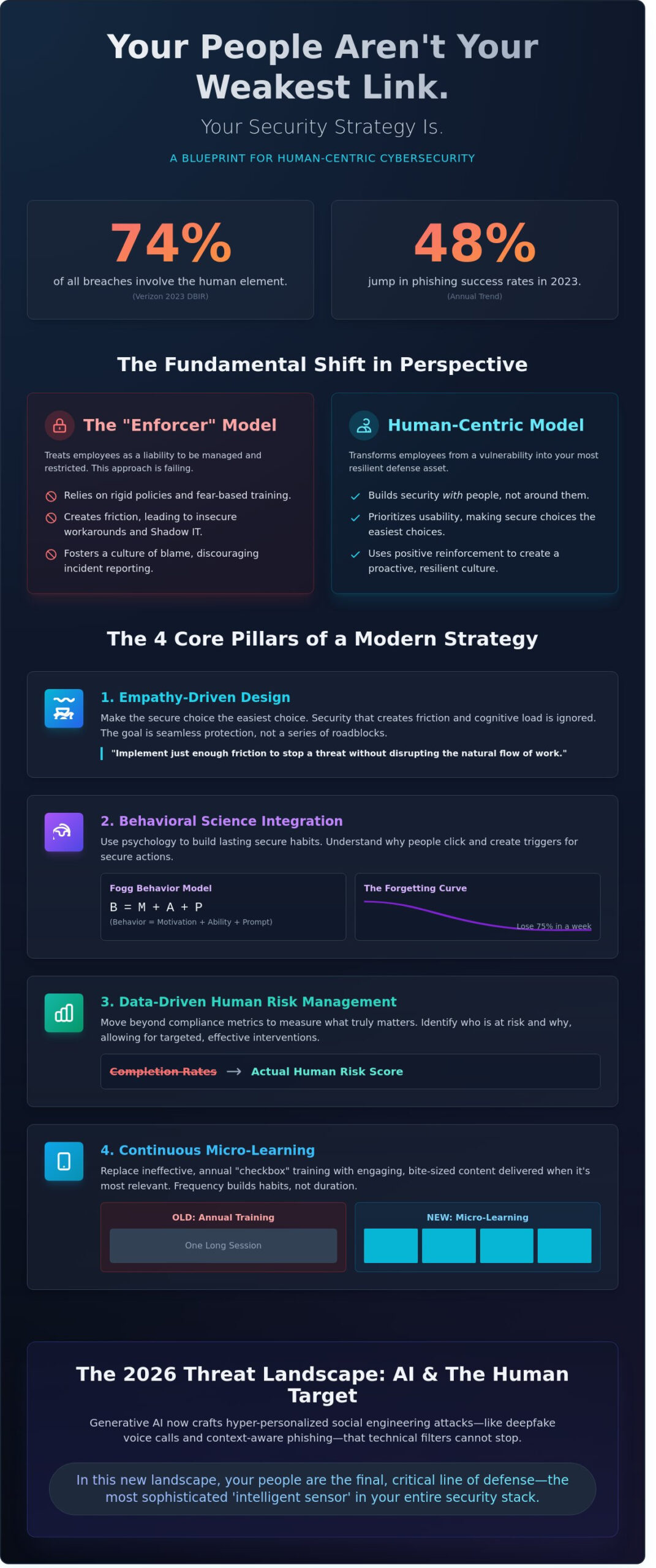
For years, we’ve poured trillions of dollars into firewalls, endpoint protection, and complex technical defenses. Yet, the core problem remains. According to Verizon’s 2023 DBIR, the human element is involved in 74% of all breaches. By 2026, this “human factor” will continue to be the primary attack vector. Why? Because traditional security was built for machines, not people.
The old “Enforcer” model simply doesn’t work. It relies on rigid policies and restrictions that treat employees like liabilities. When security tools make work difficult, people find workarounds. This leads directly to shadow IT, where a 2022 survey found 77% of IT leaders see unsanctioned apps as a major risk. Your team isn’t malicious; they’re just trying to be productive. Punitive rules create friction and push secure behaviors underground.
This is where a human-centric cybersecurity strategy changes the game. It’s a fundamental shift in perspective. Instead of building walls around people, you build security with them. This approach prioritizes:
- Human Behavior: Understanding why people click, share, or make mistakes.
- Psychology: Using positive reinforcement, not fear, to build good security habits.
- Usability: Making secure choices the easiest choices.
This is about moving beyond the annual compliance checkbox. Traditional training that focuses only on basic security awareness is no longer enough. The goal is to implement continuous Human Risk Management (HRM), a dynamic process that measures and mitigates human-activated risk in real-time.
The Cost of the “Weakest Link” Mentality
Calling your employees the “weakest link” is the fastest way to destroy your security culture. This blame-focused language creates a cycle of fear and disengagement, making people afraid to report incidents. Instead of fostering blame, a resilient culture empowers everyone to be part of the solution. It transforms your team from a perceived liability into your greatest security asset, creating a proactive and collaborative defense.
2026 Threat Landscape: AI and the Human Target
The game has changed. Generative AI now crafts social engineering attacks that are indistinguishable from legitimate communications. Think deepfake voice calls from your CEO or hyper-personalized phishing emails that reference internal projects. Technical filters can’t catch everything. In this new landscape, your people are the final, critical line of defense. They are the most sophisticated “intelligent sensor” in your entire security stack, capable of detecting nuance that algorithms miss.
The Core Pillars of a Human-Centric Cybersecurity Strategy
Traditional security focused on building higher walls. It assumed technology alone could solve a human problem. It can’t. A modern, effective human-centric cybersecurity strategy isn’t built on firewalls; it’s built on understanding people. It rests on four pillars that shift the focus from blaming users to empowering them.
These pillars work together to create a resilient security culture. They transform your employees from the biggest liability into your greatest defense asset. Let’s break them down.
- Empathy-Driven Design: Making the secure choice the easiest choice.
- Behavioral Science Integration: Using psychology to build secure habits.
- Data-Driven Human Risk Management: Moving from “who clicked” to “who is at risk and why.”
- Continuous Micro-Learning: Replacing annual training with engaging, snackable content.
Applying Behavioral Science to Security
Secure behaviors don’t happen by accident. According to the Fogg Behavior Model, a behavior occurs when Motivation, Ability, and a Prompt converge. We can trigger secure actions by making them incredibly easy (Ability) and providing a timely cue (Prompt). A simple nudge, like a banner on an external email that asks, “Does this look right?”, can prevent a major breach. This works because frequency, not duration, builds habits. Ebbinghaus’s forgetting curve shows we lose nearly 75% of new information in a week, which is why a single, annual training session fails.
Usability vs. Security: Finding the Sweet Spot
Your team wants to do good work. Security measures that create friction get ignored. Complex password policies requiring 16 unique characters don’t create security; they create post-it notes on monitors. This is “cognitive load,” and it kills productivity. Security workflows should never interrupt an employee’s “flow state.” The goal is seamless protection, not a constant series of roadblocks. Empathy-Driven Security is the art of implementing just enough friction to stop a threat without disrupting the natural flow of work.
The next pillar moves beyond theory into measurement. Data-driven Human Risk Management (HRM) provides a clear picture of your organization’s human threat surface. Instead of just tracking phishing simulation click rates, HRM identifies which departments are most vulnerable to specific threats like invoice fraud and what behaviors are driving that risk. It answers the critical question: are your security efforts actually reducing risk? This data allows you to provide targeted support, not one-size-fits-all punishment.
Finally, all these pillars are supported by continuous micro-learning. Forget the hour-long, check-the-box training videos that employees dread. Studies from the Journal of Applied Psychology show microlearning improves knowledge transfer by over 17% compared to traditional methods. This approach delivers short, relevant, and frequent content-often just one or two minutes long-that builds secure reflexes over time. This is the foundation of effective human-centric cybersecurity training, building a culture of resilience one small interaction at a time. These pillars transform security from a mandate into a shared habit. Building this rhythm requires the right tools. Discover how our platform delivers engaging micro-content that fits directly into your team’s workflow.
Quantifying the “Human Element”: Measuring What Matters
Your security training is complete. The dashboard shows 98% of employees finished the annual video. But what did that actually change? Traditional metrics like completion rates tell you who clicked a button. They don’t tell you if your organization is any safer. With a staggering 74% of breaches involving the human element, according to Verizon’s 2023 Data Breach Investigations Report, you need to measure behavior, not just attendance.
This is where a Human Risk Score changes the game. It’s not a single number but a living, multi-dimensional view of your team’s security posture. Think of it as a credit score for your security culture, built from real-world actions. A comprehensive score aggregates key performance indicators like:
- Phishing Simulation Resilience: Click rates, credential submission rates, and most importantly, reporting rates.
- Reporting Speed: The average time it takes an employee to report a suspicious email or message.
- Security Hygiene: Aggregated data from tools showing password manager adoption or use of multi-factor authentication.
- Knowledge Gaps: Performance on micro-learning quizzes that test understanding of specific, relevant threats.
You can conduct an Employee Cybersecurity Risk Audit to gather this data without ever invading personal privacy. The goal isn’t to watch individuals. It’s to analyze anonymized, aggregated data from phishing simulations, endpoint protection, and identity access management systems to spot trends. You’re looking at department-level patterns, not what Jane in accounting is doing. This data-driven approach is the foundation of an effective human-centric cybersecurity strategy.
From Awareness to Behavior Change
The gold standard for a resilient workforce isn’t a perfect click rate. It’s a fast “Time to Report.” An employee who reports a phishing attempt within five minutes turns a potential vulnerability into a real-time threat intelligence asset for your security team. Human Risk Management (HRM) software lets you track these behavioral trends over time. This data allows you to move from a one-size-fits-all approach to targeted interventions. For instance, if data shows your C-suite has a 25% higher click rate on spear-phishing attempts, they don’t need the same general training as interns. They need a 90-second video on CEO fraud, delivered right to them.
Reporting Human Risk to the Board
Your board understands one language above all others: financial risk. Don’t talk about security culture in abstract terms. Translate it into ROI. Explain that reducing your Human Risk Score by 20% directly shrinks the human attack surface, mitigating a quantifiable portion of the $4.45 million average cost of a data breach (IBM, 2023). Use benchmarking data to show how your investments are elevating your posture above industry peers, justifying every dollar of your budget. Presenting data that shows your finance department’s phishing resilience has moved from the 50th to the 85th percentile for your industry is a powerful argument for continuing your human-centric cybersecurity strategy. Show the board a heat map of the organization, visualizing risk by department. Then, present a second map from three months later where high-risk ‘red’ zones have cooled to ‘green.’ This makes progress immediate and undeniable.
Implementation Roadmap: Building Your Strategy for 2026
A successful human-centric cybersecurity strategy isn’t a one-time project; it’s a continuous improvement cycle. With 74% of all breaches involving the human element, according to Verizon’s 2023 DBIR, your defense must be dynamic, adaptive, and built for people. Forget annual, check-the-box training. The future requires a data-driven loop: Assess, Design, Engage, Measure, and Refine.
Your journey begins with a clear baseline. Use interactive assessments and real-world simulations to understand your current human risk posture. Where are your people vulnerable? What are their security habits? This data is the foundation for everything that follows. It allows you to move from generic awareness campaigns to targeted, effective risk reduction.
Persona-Based Training Journeys
Your sales team and your engineers operate in different digital worlds. They face unique threats and use different tools. A one-size-fits-all training program ignores this reality. Instead, design training journeys tailored to each role. A sales executive needs simulations on sophisticated LinkedIn spear-phishing attacks. An engineer needs to spot malicious code in a third-party library. Integrating these relevant security nudges into the onboarding process makes security an intrinsic part of their role from day one.
The Role of Micro-Learning and Storytelling
Attention is the most valuable resource in your organization. Long, text-heavy presentations don’t respect it. High-quality, two-minute videos do. Viewers retain 95% of a message from a video, compared to just 10% from text. Use scenario-based storytelling to build emotional resonance. Show your team the real-world impact of a credential stuffing attack through a relatable story, and the lesson will stick. These micro-moments of learning fit seamlessly into the workday, eliminating training fatigue and building lasting habits.
Once you engage your team, you must measure the impact. Track real-time analytics that go beyond simple completion rates. Look for measurable shifts in behavior: a 60% reduction in clicks on phishing simulations, or an increase in proactive threat reporting. This data shows you what’s working and where you need to pivot.
Finally, build a culture of security by creating a feedback loop. Your employees are on the front lines. If a security process creates unnecessary friction, they should have a simple way to report it. This not only helps you refine your tools and policies but also transforms your people from a potential liability into your greatest security asset. It’s the final, crucial step in a living human-centric cybersecurity strategy.
See how our award-winning video content makes security training stick. Explore our content library today.
The AwareGO Advantage: Human Risk Management for the Modern Enterprise
Putting theory into practice is the final, most critical step. A successful human-centric cybersecurity strategy requires more than just good intentions; it demands a platform built to change behavior and measure real-world impact. It’s time to move beyond outdated, check-the-box training and embrace a continuous, data-driven approach to Human Risk Management (HRM).
The AwareGO platform automates the entire HRM lifecycle, transforming how you manage your organization’s human risk. This isn’t just another training module. It’s a complete system designed to build a resilient security culture. Our process is simple, effective, and continuous:
- Assess: We identify your organization’s specific vulnerabilities through baseline assessments, phishing simulations, and knowledge checks.
- Educate: We deliver targeted, engaging micro-learning videos based on individual risk profiles and assessment results.
- Reinforce: We use ongoing, bite-sized content and personalized nudges to build lasting security habits, not just temporary knowledge.
- Measure: We provide a quantifiable Human Risk Score for every employee, department, and the organization as a whole, showing you exactly where you stand and tracking your progress over time.
Our award-winning, 1-2 minute videos are grounded in cognitive science. By delivering information in short, story-driven bursts, we dramatically reduce cognitive load and boost knowledge retention by up to 70% compared to traditional, hour-long training sessions. This micro-learning approach respects your employees’ time and makes secure behaviors feel intuitive.
True security visibility comes from connected data. Our robust API allows you to integrate human risk data directly into your existing security ecosystem. Imagine feeding an employee’s Human Risk Score into your SIEM or SOAR platform. Your security team can now see that a high-risk user just clicked a suspicious link, enabling them to prioritize that alert with critical context and reduce incident response time by an average of 20%. This integration makes your people a measurable data point in your overall defense posture.
Why HR and IT Love AwareGO
We designed our platform to be powerful, not burdensome. With seamless SCORM integration for your LMS and cloud-based deployment, setup takes minutes, not weeks. Our fully managed services can reduce the security awareness workload on your IT team by up to 30 hours per month. Most importantly, you empower your people with skills that protect them from threats like phishing and social engineering both in the office and at home.
Start Building Your Resilient Culture Today
Your employees don’t have to be your biggest vulnerability. With the right tools and a positive, empowering approach, they become your most effective defense asset. A strong human-centric cybersecurity strategy turns your workforce into a proactive, vigilant network that actively protects your organization. Stop chasing clicks and start changing behavior. See how it works.
Experience the future of Human Risk Management with AwareGO and book a demo to see your organization’s Human Risk Score in action.
Transform Your People into Your Strongest Security Asset
The digital landscape of 2026 won’t be secured by firewalls alone. Your people are your new perimeter. Relying solely on technology leaves you vulnerable, with 82% of breaches involving a human element, according to Verizon’s 2022 DBIR. A successful human-centric cybersecurity strategy isn’t about more rules; it’s about building better habits and a resilient security culture.
But you can’t manage what you don’t measure. That’s where our data-driven Human Risk Management (HRM) platform changes the game. Trusted by global enterprises, AwareGO helps you quantify risk with precision and address it effectively using an award-winning micro-learning content library designed for how people actually learn.
Ready to quantify your human risk? Start your free Employee Risk Audit with AwareGO today.
Stop chasing threats. Start building resilience. Your team is ready.
Frequently Asked Questions
What is a human-centric cybersecurity strategy?
A human-centric cybersecurity strategy puts your people at the core of your defense. Instead of relying only on technology, it focuses on understanding and improving human behavior to build security resilience. This approach transforms employees from potential risks into active defenders. It’s about creating secure habits and a strong security culture, not just checking a compliance box. You empower your team with the right knowledge at the right time.
How is human-centric security different from traditional security awareness training?
Human-centric security is a continuous process, while traditional training is often a single, annual event. Old-school training relies on long, forgettable sessions focused on compliance. The human-centric model uses engaging micro-content delivered frequently to build lasting habits. It replaces fear-based tactics with positive reinforcement, focusing on empowering people to make secure choices automatically. It’s the difference between a lecture and daily practice.
Why is the human element considered the biggest risk in cybersecurity?
The human element is your biggest risk because technical defenses can always be bypassed by a single person’s mistake. According to Verizon’s 2024 Data Breach Investigations Report, the human element was a factor in 68% of all breaches. Cybercriminals know this. They design attacks like phishing and social engineering specifically to exploit human psychology, making your employees the primary target and your first line of defense.
How do you measure the success of a human-centric security program?
You measure success with data that shows real behavioral change, not just course completion rates. Key metrics include a reduction in phishing simulation click-through rates, which can drop by over 70% with effective training. You should also track an increase in the speed and volume of employees reporting suspicious emails. These data points prove your team is not just aware of threats; they are actively defending against them.
Can a human-centric approach work for small businesses?
Yes, a human-centric approach is perfect for small businesses. It’s a highly scalable and cost-effective way to reduce your biggest vulnerability. The cost of a single data breach for businesses with under 500 employees averaged $3.31 million in 2023, according to IBM. Investing in your people provides a powerful return by preventing the financial and reputational damage that a breach can cause, making it an essential strategy for any size company.
What are the key components of a security culture?
A strong security culture is built on four key components. It starts with visible leadership commitment, where executives champion and model secure behaviors. It requires clear, simple policies that are easy for everyone to follow. This is supported by continuous reinforcement through regular, engaging training. Finally, it includes positive recognition for employees who demonstrate good security practices, creating a sense of shared responsibility for keeping the organization safe.
How does behavioral science improve cybersecurity habits?
Behavioral science improves cybersecurity habits by making security intuitive and automatic. It uses proven principles like positive reinforcement and nudging to shape employee actions over time. Instead of just presenting information, it creates learning moments that build muscle memory for secure behaviors, like spotting a phishing link. This approach helps people internalize security, turning safe practices from a conscious effort into a natural reflex.
How often should employees receive security awareness training in 2026?
By 2026, the most effective training won’t be annual; it will be continuous. A modern human-centric cybersecurity strategy relies on micro-learning, delivering training in short, 2-3 minute bursts multiple times a month. This approach combats the Ebbinghaus Forgetting Curve, which shows people forget 75% of new information within a week. Frequent, snackable content keeps security top-of-mind and builds lasting, resilient habits across your entire organization.