
Why are 74% of data breaches still linked to human error when your team completes their training every single year? It’s a common struggle for leaders who need to measure security culture but find themselves stuck with “check-the-box” metrics that don’t reflect real-world risk. You know that a simple completion certificate won’t stop a sophisticated phishing attack. Without hard data, justifying your security spend to the board feels like an uphill battle. We understand that frustration; it’s time to move from guessing to knowing.
This guide empowers you to transform abstract human behaviors into concrete, data-driven insights. You’ll learn how to build a robust human risk dashboard that strengthens your organization’s resilience and provides clear benchmarks against your industry peers. We’ll break down the transition from passive compliance to active Human Risk Management, ensuring your workforce becomes your strongest defensive asset for 2026.
Key Takeaways
- Move beyond surface-level vanity metrics by understanding the seven core dimensions that truly define your organization’s human risk.
- Learn how to shift your focus from simple click rates to measuring phishing resilience through active, positive reporting behaviors.
- Discover a step-by-step framework to measure security culture using data-driven assessments that pinpoint your most vulnerable cohorts.
- Scale your impact by transitioning from static spreadsheets to real-time Human Risk Management dashboards that automate remediation and build lasting resilience.
Why You Can’t Manage What You Can’t Measure: The Security Culture Gap
Security culture isn’t a poster in the breakroom or a yearly compliance check. It’s the silent force driving how your team handles sensitive data when nobody is watching. Security culture is the collective immune system of an organization. This system represents the shared values, attitudes, and behaviors that determine your resilience against evolving threats. To effectively measure security culture, you have to look past the surface level of participation and focus on actual habits.
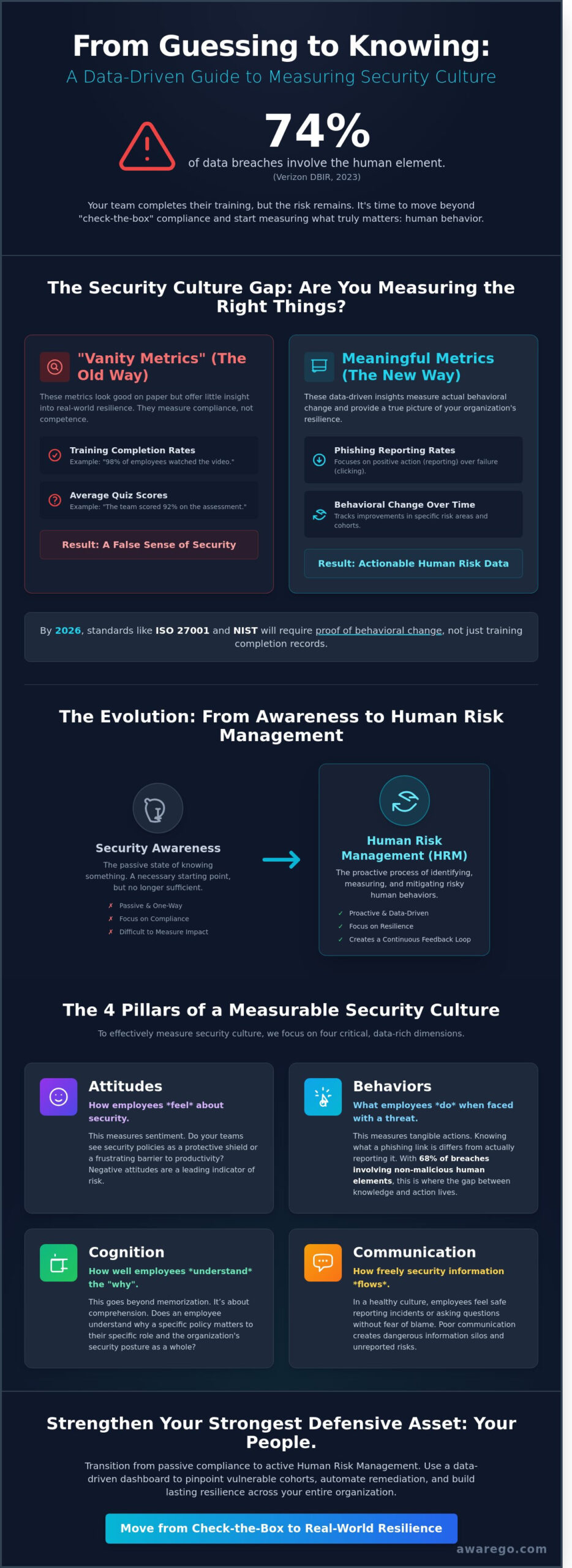
Many organizations fall into the trap of “vanity metrics.” These are numbers like 98% video completion rates or high average quiz scores that look great in a board deck but offer little protection. A completed video doesn’t stop an employee from clicking a suspicious link during a hectic Monday morning. These metrics measure compliance, not competence. They tell you that your staff sat through a presentation, but they don’t tell you if their behavior changed. Truly understanding your risk requires a deeper dive into the seven core dimensions of information security culture, which include elements like norms, responsibilities, and unwritten rules.
The regulatory world is catching up to this reality. By 2026, updated security standards such as ISO 27001 and the NIST Cybersecurity Framework are shifting their focus toward behavioral evidence. Auditors will no longer be satisfied with a simple list of names who finished a training module. They’ll want to see proof of behavioral change and documented efforts to mitigate human risk. You can’t manage what you don’t track, and in the next few years, proving your culture’s strength will be a requirement, not an option.
The Cost of Unmeasured Human Risk
Unquantified behaviors lead to massive budget misallocations. When you don’t measure security culture, you’re essentially flying blind, often overspending on expensive technical firewalls while the human door remains unlocked. This lack of data directly impacts the “Insider Threat” landscape. It’s vital to remember that “insider threats” aren’t always disgruntled employees; they’re often well-meaning people who lack the right habits. Data from the 2023 Verizon Data Breach Investigations Report shows that 74% of breaches involve a human element, including social engineering or simple errors. Other industry studies place this number as high as 90%. Without clear metrics, you can’t identify which departments are at risk or where your next breach is likely to start.
From Awareness to Human Risk Management (HRM)
The evolution of security training has reached a turning point. We’re moving away from “Awareness,” which is the passive state of knowing something, and toward Human Risk Management (HRM). Awareness is a starting point, but it’s no longer enough to stop modern, AI-driven phishing attacks. HRM is about taking a proactive rather than reactive posture. It uses continuous measurement to identify risky habits before they turn into a headline-grabbing incident. By shifting your focus to HRM, you create a feedback loop where data informs training, and training improves data. This approach turns your workforce into a measurable asset, allowing you to build a culture where security is seamless, engaging, and, most importantly, effective.
The 7 Dimensions of Security Culture: What Are We Actually Measuring?
Security isn’t a “vibe” or a feeling you get when walking through the office. It’s a measurable data point. To effectively measure security culture, you need to look past simple training completion rates. You are looking for the “why” behind the “what.” Research highlights seven distinct dimensions of security culture that define how your team interacts with digital threats every day. These dimensions transform abstract concepts into actionable insights.
We focus on four critical pillars to start:
- Attitudes: This measures how your employees actually feel about your policies. Do they see MFA as a protective shield or a frustrating barrier? If 70% of your staff views security as a “hindrance to productivity,” your culture is at risk regardless of your firewall’s strength.
- Behaviors: These are the tangible actions. It’s one thing to know what a phishing link looks like; it’s another to report it. The 2024 Verizon Data Breach Investigations Report (DBIR) found that 68% of breaches involved a non-malicious human element. Measuring behavior identifies where the gap between knowledge and action lives.
- Cognition: This is the level of understanding. It’s not about memorizing a handbook. It’s about whether an employee understands why a specific risk matters to their specific role.
- Communication: Does information flow freely? In a healthy culture, an employee feels safe reporting a mistake to IT immediately. In a fear-based culture, they hide it, giving attackers more time to move laterally through your network.
Compliance vs. Norms
There is a massive difference between being compliant and being secure. Compliance is a checkbox; norms are a lifestyle. You can have 100% compliance on a training module and still have a toxic security culture. This happens because office norms and peer pressure are stronger than written rules. If a high-pressure sales team sees their manager bypass security protocols to close a deal faster, they will follow suit. This creates “Shadow Security” habits. These are unauthorized shortcuts employees take to get their jobs done under stress. You must measure the gap between what they know they should do and what they actually do when the pressure is on.
The Role of Behavioral Science
We use the COM-B model to understand these dynamics. This model suggests that for a behavior to change, your team needs Capability, Opportunity, and Motivation. If your security tools are clunky, you’ve removed the “Opportunity” by adding too much friction. High friction scores directly correlate with lower security culture ratings. People naturally take the path of least resistance.
To fix this, we move away from annual “death by PowerPoint” sessions. Instead, we use micro-learning to influence specific dimensions of behavior in bite-sized chunks. This approach respects your team’s time while building long-term habits. By focusing on improving your organization’s resilience through small, frequent interactions, you turn security from a chore into a shared responsibility. Measuring these shifts allows you to move from passive awareness to active Human Risk Management (HRM), ensuring your workforce is your strongest defense.
Moving Beyond Compliance: Metrics That Actually Matter
Compliance boxes get checked every year, but they don’t stop breaches. To effectively measure security culture, you must look at what people do when they think no one is watching. Currently, 42% of organizations rely solely on training completion rates to gauge success. This is a mistake. Completion shows participation, not proficiency. You need a balanced scorecard that weighs quantitative data against qualitative human sentiment to provide a clear picture for your board report.
Phishing resilience is the perfect example of this shift. Stop obsessing over click rates. A low click rate might just mean your test was too easy. Focus instead on your report rate. If 18% of your employees report a suspicious email within the first ten minutes, your culture is proactive. This “see something, say something” mindset turns employees into active sensors. CISA on fostering security culture emphasizes that collaboration and open reporting are the backbones of a resilient organization. By the start of 2026, top-tier benchmarks will require a reporting-to-clicking ratio of at least 12:1 to be considered “low risk.”
You should also track security debt. This metric measures how long it takes for departments to adopt new security tools or policy changes. If your marketing team takes 22 days to enable a new MFA protocol while engineering takes 3 days, you’ve identified a cultural friction point. Reducing this adoption lag is a direct indicator of how much your staff values digital safety. High-performing cultures aim for a 48-hour adoption window for critical security updates.
The Behavioral Risk Score
A single “Human Risk Score” allows you to compare different departments fairly. You calculate this by weighting specific behaviors. For instance, a password manager violation in the Finance department carries more weight than one in the cafeteria. This data-driven approach helps you measure security culture by identifying which groups need more support. For a deeper dive into these metrics, check out this guide on Benchmarking Human Risks to see how your team stacks up against 2025 global averages.
Sentiment Analysis and Surveys
Surveys only work if people answer them honestly. Move away from long, boring annual assessments. Use “snackable” three-question pulses instead. Ask questions like, “Does security make your job harder?” to find friction. You should also implement a “Security Net Promoter Score” (sNPS). By asking employees how likely they are to recommend your security practices to a colleague, you get a raw look at your internal reputation. In 2024, companies with an sNPS above +40 saw a 30% reduction in accidental data leaks. Open-ended feedback is your most valuable asset here. It reveals whether your policies feel like supportive guardrails or annoying hurdles.
Step-by-Step: How to Measure Security Culture in Your Organization
Building a resilient organization starts with data. You can’t improve what you don’t track. To effectively measure security culture, you must move beyond gut feelings and adopt a structured, five-step framework. This process transforms abstract human behaviors into actionable insights that leadership can actually use.
Phase 1: The Initial Assessment
Everything begins with a comprehensive Human Risk Assessment. This isn’t just a simple survey; it’s a diagnostic tool designed to reveal the psychological drivers behind employee actions. When choosing your tool, automated platforms are generally superior to manual audits. They reduce administrative overhead by 60% and provide real-time dashboards that manual spreadsheets simply can’t match.
Anonymity is your most powerful asset during this phase. If employees feel judged, they’ll give the “right” answers instead of the “true” ones. Data shows that anonymous assessments result in 85% more honest reporting regarding shadow IT usage and password sharing. Once you have this baseline, set SMART goals. For example, aim to increase your organization’s “Security Awareness Score” by 20% within the first 12 months. This gives your team a clear target to hit.
Phase 2: Data Integration
Your measurement platform shouldn’t be an island. It needs to talk to your existing IT stack. By connecting your assessment tools to your SIEM (Security Information and Event Management) or LMS (Learning Management System), you create a holistic view of your risk landscape. This allows you to see if your training actually changes real-world behavior.
If an employee completes a module on phishing but then clicks a suspicious link two days later, you’ve identified a gap between knowledge and action. You can learn more about how to quantify human cyber risk by correlating these specific data points. This integration turns subjective feedback into objective risk scores, making your security posture visible and manageable.
Once your data is flowing, identify your high-risk cohorts. Don’t treat your entire workforce as a single unit. Cross-departmental analysis often reveals that specific teams, like Finance or HR, face 3 times more social engineering attempts than others. You can then implement targeted micro-learning interventions. These 1 to 3 minute lessons address specific gaps without causing “training fatigue.” It’s about small, frequent touches that build long-term resilience rather than annual, hour-long sessions that employees forget by Monday morning.
Continuous simulations are the next vital step. Running regular phishing and vishing tests provides a safe environment for employees to practice their skills. Organizations that run monthly simulations see a 40% reduction in “click rates” within the first half-year. These aren’t “gotcha” moments; they’re behavioral retention checks. They show you exactly where the culture is strengthening and where it needs more support.
Finally, schedule quarterly culture audits to measure security culture progress against your initial baseline. These audits help you pivot your strategy as new threats, like AI-driven deepfakes, emerge. By reviewing your metrics every 90 days, you ensure that your security culture remains a living, breathing part of your organizational DNA rather than a forgotten checkbox on a compliance list.
Ready to see where your team stands? Start your human risk assessment today and begin building a stronger, more confident culture.
Scaling Culture with Human Risk Management (HRM) Platforms
Managing security through spreadsheets is a recipe for stagnation. Static data from annual surveys or quarterly phishing tests won’t help you measure security culture effectively. By the time you analyze the rows and columns, the threat landscape has already shifted. You need a real-time pulse on employee behavior to make informed decisions. Human Risk Management (HRM) platforms replace guesswork with granular, actionable insights that reflect the current state of your organization.
AwareGO automates the entire lifecycle of human risk. It identifies specific behavioral gaps and triggers targeted remediation without manual intervention. If your data shows a spike in password sharing within the finance department, the system doesn’t just flag it. It delivers immediate, relevant micro-learning to those specific users. This proactive cycle transforms security from a checkbox exercise into a living, breathing organizational habit. You stop chasing problems and start preventing them through automated, data-backed workflows.
Micro-content is the engine of this transformation. Traditional 60 minute training sessions overwhelm the brain and lead to information fatigue. AwareGO uses high quality, one to two minute videos that respect your employees’ time. These snacks of knowledge are easier to digest and retain. In a 2023 internal study, a global enterprise with over 50,000 employees implemented this micro-learning approach. They successfully reduced their overall human risk score by 40% in just 12 months. This proves that frequent, small interactions create more lasting impact than annual marathons.
The AwareGO Approach
We lean heavily on behavioral science to move the needle on culture scores. Knowledge alone doesn’t change habits; emotional resonance and consistency do. Our HRM dashboard provides a bird’s eye view of your risk posture across different departments and locations. You can see exactly where resilience is high and where vulnerabilities persist. Most importantly, our training is non-punitive. We focus on empowering your team rather than shaming them. This approach reduces security anxiety, making employees more likely to report suspicious activity instead of hiding mistakes. When people feel capable, they become your strongest asset.
Future-Proofing Your Strategy
The threats of 2026 will look vastly different from those we face today. AI-driven social engineering is already making phishing attempts nearly indistinguishable from legitimate communication. To stay ahead, you must measure security culture as a permanent board-level KPI. It’s no longer just an IT concern; it’s a fundamental metric of business health. A data-driven strategy ensures you aren’t just reacting to yesterday’s hacks but preparing for tomorrow’s innovations. By integrating human risk metrics into your core business strategy, you build a resilient workforce ready for any challenge.
Ready to see how your organization stacks up? It’s time to Experience the power of data-driven culture with AwareGO and turn human risk into human resilience.
Transforming Human Risk into Your Strategic Resilience
Security isn’t a technical puzzle; it’s a human habit. To effectively measure security culture, you must look past simple completion rates and focus on the 7 dimensions of behavioral change. By 2026, basic compliance won’t be enough to stop sophisticated threats. You need a data-driven approach that turns passive awareness into active resilience. Our research shows that consistent, small-scale interventions create lasting change that traditional annual training simply can’t match.
AwareGO bridges the gap between knowledge and action by combining 15 years of behavioral science research with high-impact micro-learning. Global enterprises use our platform to identify specific vulnerabilities before they become expensive breaches. This proactive strategy dramatically reduces phishing susceptibility by delivering content that respects your team’s time. You don’t have to guess where your human risks lie. You can see them, measure them, and fix them with precision through our Human Risk Management (HRM) framework.
Your journey toward a more secure organization starts with understanding your current baseline. Start your Human Risk Assessment with AwareGO today and see how data can empower your people. You have the tools to build a culture where security is second nature for everyone.
Frequently Asked Questions
How often should we measure security culture?
You should measure security culture at least twice annually to capture meaningful behavioral shifts. A 2023 study by the SANS Institute suggests that high-maturity organizations perform these assessments every 6 months to stay ahead of evolving threats. This frequency allows you to track how your Human Risk Management efforts influence daily habits. If you wait 12 months, your data reflects outdated risks rather than the current resilience of your team.
What is the difference between security awareness and security culture?
Security awareness is what your employees know, while security culture is what they actually do when no one’s watching. Awareness focuses on knowledge retention from a single training session. Culture represents the shared values and habits of your entire workforce. It’s the difference between 90% of staff passing a quiz and 90% of staff reporting a suspicious email within 5 minutes of receipt.
Can security culture be measured quantitatively?
You can measure security culture quantitatively by tracking behavioral data points and survey scores. Use a 5-point Likert scale to assess attitudes across dimensions like responsibility and communication. When you combine these scores with technical data, such as a 15% reduction in link-clicks over a quarter, you get a clear numerical picture of your organizational health. Quantitative metrics turn abstract feelings into actionable data.
What are the most important KPIs for security culture?
The most critical KPIs include the phishing reporting rate and the mean time to report an incident. A healthy culture aims for a reporting rate above 70% during simulations. You should also track the “intent to comply” score from behavioral surveys. These metrics help you measure security culture by showing whether employees feel empowered to act as a human firewall rather than just passive targets.
How do we measure the ROI of security culture improvements?
Calculate ROI by comparing the cost of your culture program against the average $4.45 million cost of a data breach reported in 2023. If your initiative reduces successful phishing attempts by 40%, you’ve lowered your financial risk profile. You also gain ROI through reduced IT helpdesk tickets, as a secure culture often leads to a 25% drop in password reset requests and basic security queries.
Does a good security culture reduce insurance premiums?
A strong security culture can lead to a 10% or 15% reduction in cyber insurance premiums. Carriers like Marsh now evaluate human risk factors during the underwriting process. They look for evidence of consistent training and high reporting rates. Providing data that shows a 30% improvement in employee resilience makes your organization a lower risk, which gives you better leverage during yearly policy negotiations.
What is a Human Risk Assessment?
A Human Risk Assessment is a diagnostic tool that identifies specific behavioral vulnerabilities across your departments. It uses psychological principles to test how employees react to pressure or social engineering. For example, it might reveal that your finance team is 20% more likely to bypass protocols during month-end closing. This data lets you tailor your training to where it’s needed most rather than using a generic approach.
How can we measure culture in a remote or hybrid workforce?
You measure culture in remote teams by analyzing digital footprints and home network security habits. Use short, 3-minute pulse surveys to check if remote workers feel supported by your security policies. Track the adoption of multi-factor authentication across different regions. If 95% of your hybrid staff uses a password manager daily, your culture is thriving regardless of their physical location.