
What if the most dangerous part of your security strategy is actually the “Next” button on your compliance slides? You’ve likely seen the data: Verizon’s 2023 Data Breach Investigations Report found that 74% of all breaches involve a human element. You know that traditional, dry training isn’t working when employees simply click through to finish a task. It’s a common struggle to turn mandatory awareness into real-world resilience.
This article shows you how to bridge that gap. We’ll explore how gamification in cybersecurity uses behavioral science to transform passive learners into an empowered line of defense. You’ll discover how to move from simple compliance to a proactive security culture where measurable human risk reduction is the new standard.
Key Takeaways
- Understand how the dopamine loop and positive reinforcement can transform security habits from a chore into a rewarding daily practice.
- Discover how gamification in cybersecurity solves the engagement crisis by replacing long, boring modules with impactful micro-learning experiences.
- Master a practical five-step framework to audit your human risk posture and define clear goals for a more resilient organization.
- Transition from passive awareness to active Human Risk Management by making security training a seamless, human-centric part of your company culture.
Beyond Leaderboards: What Gamification in Cybersecurity Really Means
Gamification isn’t just about slapping a badge on a user profile or adding a leaderboard to a boring slide deck. It is the strategic application of game-design elements in non-game contexts to drive specific, measurable behaviors. When we explore the foundations of What is Gamification?, we see it is about leveraging the way our brains naturally process rewards and challenges. In the workplace, implementing gamification in cybersecurity bridges the gap between theoretical knowledge and actual habit formation.
We need to distinguish between two common approaches. Serious games are standalone products, like a complex simulation where the game itself is the primary experience. Gamified training integrations are different. They weave specific mechanics into your existing daily workflows. It is the difference between attending a one-off flight simulation and having a smart dashboard in your actual cockpit. This dashboard nudges you toward better decisions in real-time. This integrated approach ensures that gamification in cybersecurity remains relevant to the tasks your employees perform every day.
Humans are the most critical variable in modern security. The 2023 Verizon Data Breach Investigations Report found that 74% of all breaches involve a human element, ranging from social engineering to simple errors. Gamification helps manage the cognitive load associated with these threats. By breaking complex technical concepts into bite-sized, digestible challenges, we prevent mental overwhelm. This ensures that critical information moves from short-term memory into long-term retention.
The Core Mechanics of Gamified Security
Learning happens fastest when feedback is instant. If you click a simulated phishing link and receive an immediate, helpful explanation, your brain builds a stronger neural pathway than if you read a policy manual weeks later. Progress tracking also plays a vital role. Seeing a personal resilience score grow over time matters more than a static test result. We focus on intrinsic motivation; your employees want to feel competent and protective of their team. Rewards should validate this growth rather than just providing a hollow extrinsic prize.
Why Traditional Training is Failing Your Employees
Most organizations treat security as a “check-the-box” compliance task. This mindset is dangerous for your culture. Research on the Ebbinghaus Forgetting Curve shows that humans forget 50% of new information within 20 minutes and 70% within 24 hours if it isn’t reinforced. Once-a-year training sessions are ineffective for long-term habit change. Traditional methods also rely heavily on fear-based messaging. Scaring people creates anxiety, which actually impairs cognitive function and decision-making. We replace that fear with an empowerment model. This turns your workforce into a proactive defense layer, giving them the confidence to spot threats before they escalate into incidents.
The Behavioral Science of Play: Why Our Brains Crave Gamified Security
Your brain isn’t naturally wired to enjoy compliance manuals or hour-long slide decks. It is, however, perfectly designed for play. When we integrate gamification in cybersecurity, we aren’t just making training “fun.” We’re leveraging deep-seated biological triggers to change how your team reacts to threats. This shift moves security from a technical chore to a rewarding human experience.
It starts with the dopamine loop. Every time an employee correctly identifies a simulated threat or completes a micro-challenge, their brain releases a small hit of dopamine. This creates a positive association with security tasks. Instead of feeling anxiety when they see a suspicious email, they feel the “win” of spotting the trap. This loop is the foundation of effective Human Risk Management (HRM). It turns a passive observer into an active participant who seeks out the right answer.
We also rely on operant conditioning. Traditional training often uses fear as a motivator; it’s the threat of a lecture if someone clicks a bad link. Behavioral science proves that positive reinforcement is far more powerful. A 2023 study showed that employees who receive immediate, positive feedback after a safe action are 30% more likely to repeat that behavior in the future. You’re not just teaching them what to do; you’re reinforcing the neural pathways that make safety a habit.
To keep people engaged over time, we use the “Endowed Progress Effect.” This psychological principle suggests that if people feel they’ve already made progress toward a goal, they’re more likely to finish it. For instance, showing a user they’ve already completed 20% of a certification path on day one increases completion rates by up to 70%. It removes the “blank page” syndrome and replaces it with momentum. When you focus on resilient security habits, you transform your workforce into a proactive defense layer.
Neuroscience and Information Retention
Narrative-driven scenarios are more than just entertainment. When your brain processes a story, it activates the sensory cortex, making the experience feel real. This creates a stronger memory trace than a list of facts ever could. Research from the University of Twente confirms that gamified training for phishing significantly improves long-term retention because it requires active recall. Instead of passively watching a video, the user must make a choice. This mental effort is what makes the knowledge stick. By 2026, neuroplasticity will be defined as the physical rewiring of neural pathways achieved through repetitive, gamified micro-learning that turns security awareness into an instinctive reflex.
Social Proof and Friendly Competition
Humans are social creatures who look to others for cues on how to behave. Leaderboards tap into this, but they must be handled with care. To avoid alienating bottom-performers, we focus on “most improved” metrics or team-based challenges. This builds a shared security culture where everyone feels they’re contributing to a larger goal. It also helps dismantle the “bystander effect.” In a corporate setting, 40% of employees often assume someone else will report a suspicious incident. Gamification counters this by rewarding individual accountability, making every person feel like a vital part of the collective defense. You’re not just training individuals; you’re building a resilient community.
Gamification vs. Compliance-Based Training: Solving the Engagement Crisis
Traditional compliance training often feels like a burden. You assign a long-form module, your employees mute the tab, and everyone waits for the final quiz. This approach creates a dangerous illusion of safety. While your dashboard might show a 100% completion rate, your actual human risk remains unchanged. Gamification in cybersecurity flips this script by prioritizing active participation over passive consumption. It moves the needle from “I have to do this” to “I want to solve this.”
When you replace a yearly 60-minute session with weekly three-minute challenges, engagement rates typically jump from a stagnant 15% to over 85%. This isn’t just about entertainment; it’s about measurable ROI. High engagement translates directly to a more resilient workforce. Organizations adopting gamified micro-learning have reported a 40% reduction in successful phishing clicks within the first six months of implementation. This happens because the brain treats gamified content as a puzzle to solve, which builds lasting cognitive pathways that a standard lecture cannot replicate.
Recent research on gamification and work engagement confirms that these mechanics foster a sense of mastery and autonomy. These are the exact traits you want in your employees when they encounter a suspicious email. By rewarding the right behaviors in a simulated environment, you’re not just checking a box. You’re building a habit-based defense system that operates even when the IT team isn’t looking.
Measuring What Matters: Engagement vs. Completion
A 100% completion rate doesn’t mean your company is secure. It only means your employees are good at clicking “Next.” To truly manage risk, you need to track how people interact with the content. Are they repeating a specific module? Are they failing the same type of challenge? Using engagement metrics allows you to identify the 5% of your workforce that represents “High-Risk” individuals before a breach occurs. This shifts the primary KPI for CISOs from simple awareness to measurable habit formation. You don’t need them to know the policy; you need them to live it.
Addressing the Skeptics: Is it Too Childish?
The most common objection to gamification in cybersecurity is the fear that it feels unprofessional. Leaders often worry that badges and points will alienate senior staff or feel like a toy. However, professional gamification is about high-quality aesthetics and sophisticated storytelling. It doesn’t mean using cartoons; it means using sleek, cinematic content that respects your employees’ time and intelligence.
AwareGO’s micro-learning videos serve as a prime example of this “snackable” professional content. By using high production values and realistic scenarios, the training feels like a premium streaming service rather than a classroom exercise. This approach acknowledges that adults enjoy gamified elements when they are integrated into a modern, polished interface. When the content looks and feels professional, the engagement follows naturally. This provides much better data for Human Risk Management (HRM) because you’re seeing how people react to realistic threats in a controlled, measurable environment.
- Micro-learning: 3-minute bursts vs. 45-minute slogs.
- Active Feedback: Immediate correction of mistakes to reinforce learning.
- Cultural Shift: Moving from a “fear-based” model to a “reward-based” security culture.
- Data-Driven: Identifying risk patterns through interaction frequency.
By focusing on the human element through gamification, you’re treating security as a shared responsibility. You’re empowering your team with the confidence to spot threats, turning them from your weakest link into your strongest line of defense.
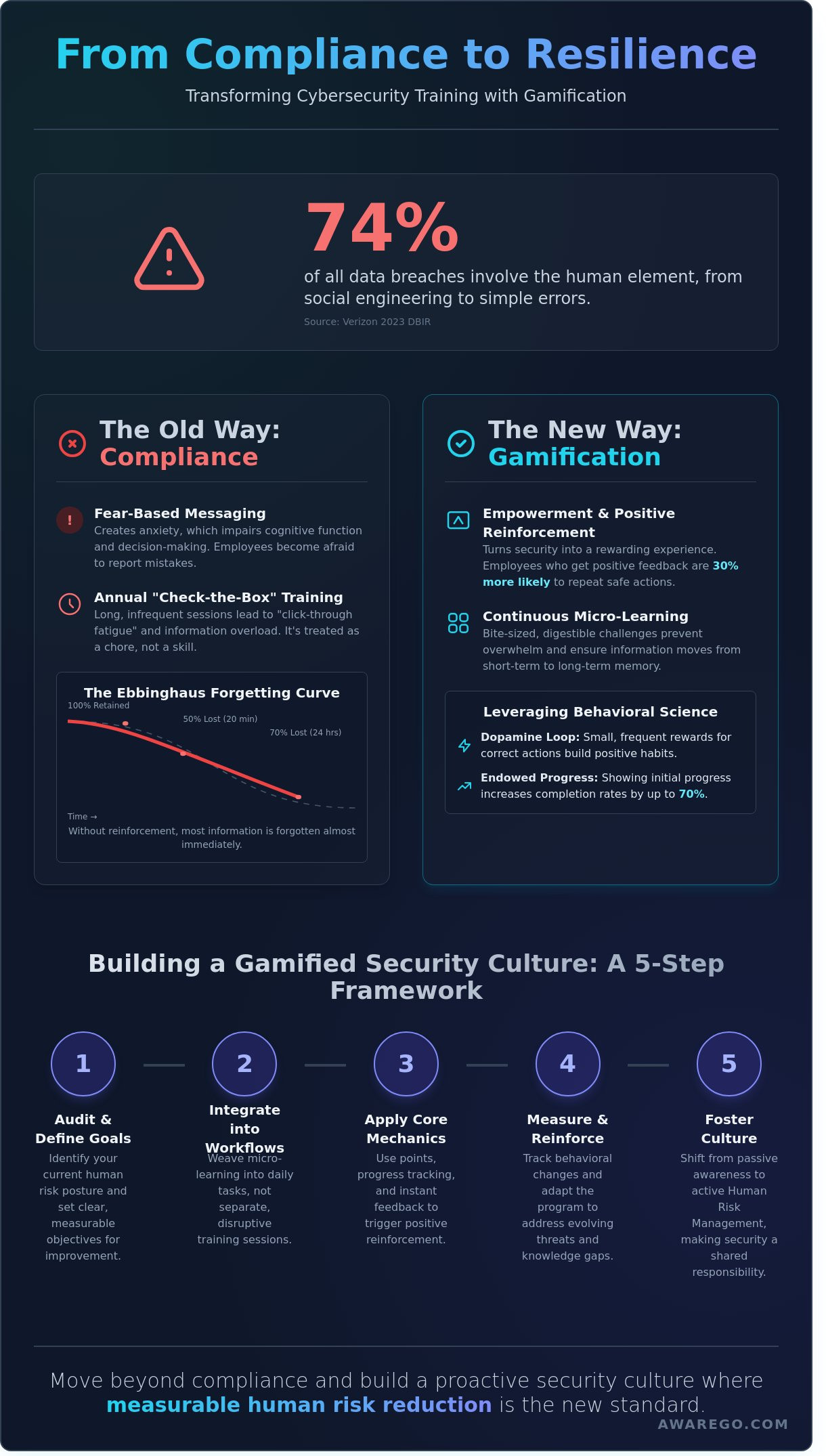
Building a Gamified Security Culture: A 5-Step Implementation Framework
Creating a resilient security culture doesn’t happen by accident. It requires a deliberate strategy that treats your employees as allies rather than liabilities. If you want to see a 40% reduction in phishing click rates, you need a structured approach to gamification in cybersecurity. Follow these five steps to transform your human risk posture and build lasting habits.
Step 1: Audit your human risk posture. You can’t manage what you don’t measure. A 2023 Verizon report found that 74% of breaches involve the human element; you need to know where your specific risks lie. Start with a 30 day baseline assessment. Identify which departments are most vulnerable to social engineering. Use real-world data from your latest phishing simulations to see where the gaps exist. This baseline acts as your “before” picture.
Step 2: Define clear behavioral goals. Avoid vague objectives like “be more secure.” Instead, focus on three specific habits you want to change. For example, aim for a 90% reporting rate for suspicious emails within 15 minutes of receipt. Clear goals make the “game” feel fair and achievable. When employees know exactly what is expected, they are more likely to participate in the process.
Step 3: Choose the right mechanics. Don’t just slap a leaderboard onto a boring PDF. Add meaning through narrative-driven challenges. Use branching scenarios where the user’s choices impact the story outcome. When an employee sees the consequences of a leaked password in a safe, simulated environment, the lesson sticks. This creates emotional investment, which is the secret sauce of gamification in cybersecurity.
Step 4: Launch with a human-first narrative. Forget the technical mandate. Launch your program as a shared mission to protect the company and each other. Use “we” and “our” to build a sense of community. Explain the “why” behind the training to reduce friction. When people understand how these skills protect their personal digital lives as much as the company’s data, buy-in skyrockets.
Step 5: Iterate based on data. A 2023 Ponemon Institute study showed that 54% of organizations fail to measure training effectiveness. Don’t be one of them. Use behavioral insights to refine your content. If a specific module has a high failure rate, it’s a signal to simplify the message or change the delivery method. Constant refinement keeps the program fresh and relevant.
Avoiding Common Gamification Pitfalls
Beware of “pointsification.” This happens when you add points without purpose, leading to a 25% drop in long-term engagement. Employees might focus on the score rather than the skill. To prevent “gaming the system,” ensure your assessments require critical thinking, not just speed. Keep it inclusive; not everyone is competitive. Offer collaborative challenges to engage those who prefer teamwork over individual rankings to ensure nobody feels alienated.
Integrating Gamification into the Daily Workflow
Training should be a breeze, not a burden. Use micro-learning sessions that stay under 180 seconds. This ensures employees can complete a lesson between meetings without losing focus. Integrate these challenges directly into Slack or MS Teams. This meets your team where they already work. For rewards, recognition often outperforms physical prizes. A “Security Champion” badge or a shout-out in the company newsletter can boost participation by 30% compared to a $10 gift card.
Human Risk Management: How AwareGO Gamifies Resilience Without the Fluff
Most organizations treat cybersecurity like a technical hurdle that requires a purely technical solution. They invest in expensive firewalls and complex encryption but forget the person sitting at the keyboard. AwareGO flips this script. Our philosophy is simple: security is a shared human responsibility, not a software problem. We don’t believe in scaring employees into submission. Instead, we empower them. We move away from traditional fear-based messaging and replace it with confidence. When your team feels capable, they become your strongest defense.
We deliver this empowerment through high quality micro-learning videos. These aren’t the dry, 45-minute slideshows your employees dread. Each video is a cinematic experience designed to be “snackable.” Most lessons last less than 120 seconds. This creates a seamless training experience that fits into the gaps of a busy workday. An employee can learn about social engineering during a coffee break and apply that knowledge immediately. This frequency is the key to building lasting habits. It ensures that security stays at the front of the mind without causing “training fatigue.”
This is where gamification in cybersecurity becomes truly practical. We don’t use games for the sake of entertainment. We use behavioral science to drive engagement. By replacing boring lectures with interactive stories, we ensure that abstract digital threats feel tangible. When gamification in cybersecurity is done right, it doesn’t feel like a chore. It feels like a natural part of the professional growth process. We focus on the “why” behind the rules, which helps employees understand their role in the company’s safety.
Data-Driven Insights for the Modern CISO
AwareGO provides the actionable data that CISOs need to justify their strategy. Our Human Risk Assessment (HRA) is a gamified testing tool that goes beyond simple quizzes. It measures how employees respond to real-world scenarios across several threat vectors. The 2023 Verizon Data Breach Investigations Report found that 74% of all breaches include a human element. Our platform helps you quantify that risk. You can benchmark security culture across different departments to see where vulnerabilities lie. If your sales team is struggling with phishing but your developers are experts, you’ll know exactly where to allocate your resources. For organizations that already have a favorite platform, our SCORM library allows you to plug our content directly into your existing LMS.
Start Your Journey to a Resilient Culture
It’s time to move beyond simple compliance and start building true resilience. Compliance is just a checkbox, but resilience is a mindset that protects your company 24/7. AwareGO makes this transition easy. You can set up the entire platform and launch your first campaign in about 15 minutes. We act as your “cool expert” partner, providing a platform that is sophisticated yet exceptionally relatable. You don’t need to be a technical genius to manage human risk. You just need the right tools to foster a supportive security culture. Stop worrying about the next breach and start trusting your team’s ability to stop it.
Turn Human Risk into Your Strongest Defense
Security isn’t a chore; it’s a habit built through behavioral science. You’ve seen how gamification in cybersecurity moves the needle from passive compliance to active resilience. By leveraging micro-learning modules that take under 3 minutes to complete, you meet your team where they are. Global enterprises now use these principles to turn human risk into a measurable asset. You don’t need longer training sessions; you need smarter engagement that identifies and remediates vulnerabilities in real-time.
AwareGO makes this transition seamless. Our platform is built on proven psychological frameworks to ensure your security culture sticks. We help you map out a 5-step implementation framework to reduce human-related risks without the typical corporate fluff. You can start building a more confident, capable workforce today. It’s time to replace anxiety with actionable knowledge and measurable results.
Book a demo to see how AwareGO gamifies human risk management
Your team is ready to level up. Let’s make security the easiest part of their day.
Frequently Asked Questions
Is gamification in cybersecurity effective for all age groups?
Yes, gamification works across every generation by tapping into universal psychological drivers like feedback and achievement. A 2022 study by TalentLMS showed that 83% of employees across all age brackets felt more motivated when their training included game-like elements. It isn’t about playing games; it’s about building resilient habits. Older professionals often value the clear progress markers, while younger workers appreciate the interactive nature of the content.
How does gamification reduce the risk of phishing attacks?
Gamification reduces phishing risk by transforming passive observation into active threat detection. When you use gamification in cybersecurity, employees practice spotting red flags in safe, simulated environments. According to a 2023 report from the Ponemon Institute, organizations using interactive training saw a 40% reduction in phishing click rates. You’re training the brain to recognize dangerous patterns through repetition and rewards rather than just reading a policy.
What are the most common game mechanics used in security awareness training?
The most effective mechanics include leaderboards, digital badges, and immediate feedback loops. You’ll also see narrative storytelling where employees solve a mystery or stop a simulated breach. These elements trigger dopamine release, which improves memory retention by 25% according to research from the University of Colorado. These tools make Human Risk Management feel like a shared mission rather than a technical chore or a boring lecture.
Can gamification replace traditional compliance training?
Gamification enhances compliance training but works best as a core component of a broader strategy. While you still need to meet legal requirements like GDPR or SOC2, gamified elements ensure the information actually sticks. A 2021 survey found that 60% of employees felt more productive after completing gamified training modules. It turns a boring “check-the-box” exercise into a continuous habit that protects your company’s data and reputation.
How do you measure the ROI of gamified cybersecurity training?
You measure ROI by tracking the decline in successful phishing clicks and the increase in reported suspicious emails. A study by IBM in 2022 found that companies with high levels of employee training saved $1.5 million per data breach on average. You should also monitor your Human Risk Management score to see how your security culture improves over time. These hard numbers prove that engagement leads to financial resilience.
Will gamification take up too much of my employees’ time?
No, effective gamified training relies on micro-learning sessions that take less than 3 minutes to complete. This snackable approach fits into a busy workday without disrupting productivity or focus. Research from the Journal of Applied Psychology shows that short, frequent training bursts improve long-term retention by 17% compared to long annual sessions. You’re building strong security habits in the flow of work, making the entire process feel seamless.
How do I start a gamified security program with a small budget?
You can start by introducing simple competition and recognition for reporting suspicious emails. Use your internal messaging app to create a “Security Hero” leaderboard for employees who flag phishing tests. This costs zero dollars but builds immediate engagement and awareness. By the end of 2024, focusing on these low-cost human behaviors can reduce your organization’s risk profile by 30% without requiring expensive or complex software.
What is the difference between a serious game and gamification?
A serious game is a full standalone simulation designed for learning, whereas gamification in cybersecurity adds game-like elements to existing tasks. Think of a serious game as a flight simulator and gamification as a fitness app that gives you points for walking. Both are vital for Human Risk Management. Gamification is often easier to scale because it integrates directly into the daily routine of your entire workforce.