
What if your most sophisticated technical filters are looking in the wrong direction? While IT teams invest heavily in perimeter defense, the 2023 Verizon Data Breach Investigations Report reveals that 74% of all breaches involve a human element. Mastering social engineering techniques isn’t just about spotting a fake email; it’s about recognizing how hackers exploit universal human traits like trust and urgency. You’ve likely noticed that employees feel overwhelmed by complex security rules, yet a single clever spear-phishing message can still slip through. It’s difficult to quantify human risk when the threat feels so personal and unpredictable.
We’re here to help you replace that anxiety with confidence. This guide will help you master the psychological mechanics behind modern attacks, allowing you to transform your workforce from a perceived vulnerability into a resilient line of defense. We’ll explore a clear framework for identifying different attack vectors and provide actionable strategies to strengthen your Human Risk Management. By the end, you’ll understand exactly how to bridge the gap between behavioral science and cybersecurity to build a thriving security culture.
Key Takeaways
- Understand the psychological triggers behind the “human hack” and learn how to transform your team into a resilient line of defense.
- Explore the evolution of modern social engineering techniques, from broad digital deceptions to highly targeted spear campaigns.
- Prepare for the next era of risk by seeing how AI and deepfakes create hyper-realistic deceptions that bypass traditional red flags.
- Recognize that threats exist beyond the screen and discover how to secure your physical workspace from sophisticated relationship-based manipulation.
- Move beyond one-off training to build a proactive security culture through actionable Human Risk Management (HRM).
Why Social Engineering Techniques Work: The Psychology of the Human Hack
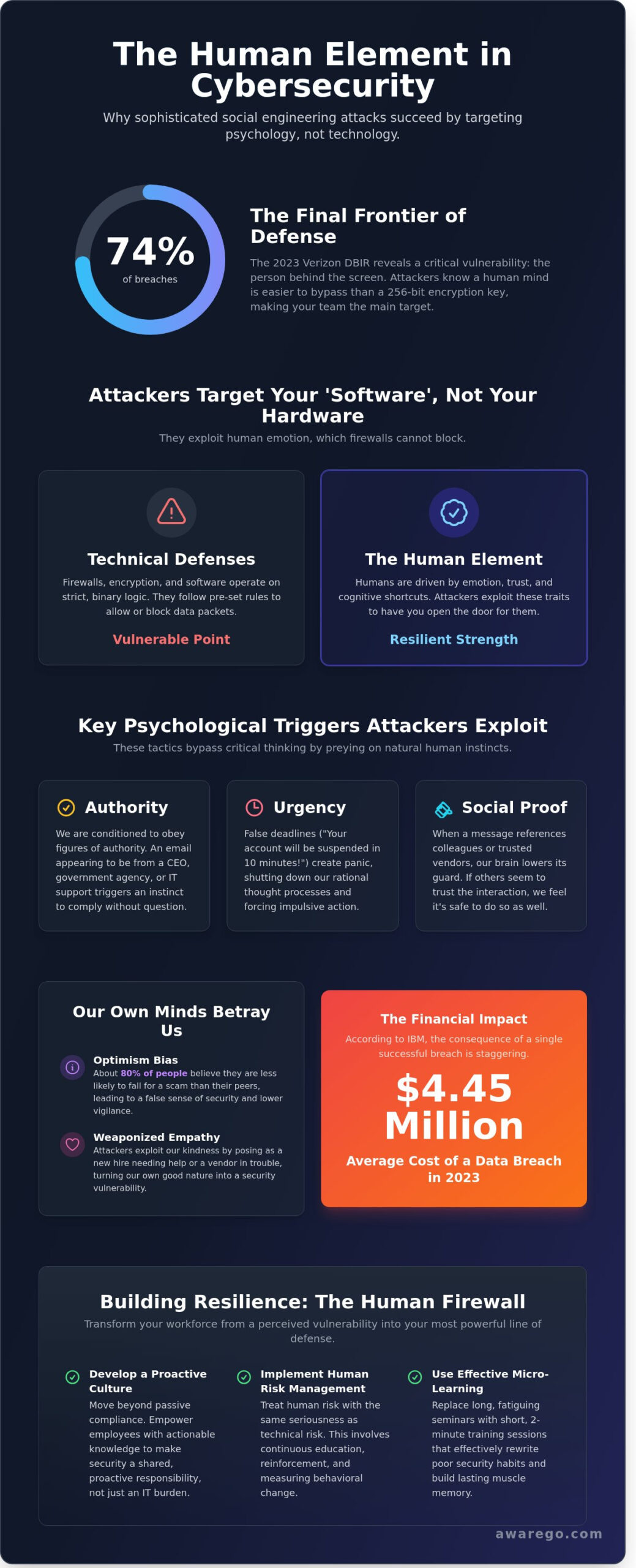
Social engineering isn’t a technical glitch; it’s a psychological one. At its core, social engineering (security) is the art of manipulating people into giving up confidential information or performing actions that compromise security. While your IT team might spend over 60 percent of their budget on firewalls and encryption, attackers are focusing on the person behind the screen. They know that a human mind is easier to bypass than a 256-bit encryption key. This makes the human element the final frontier in modern cybersecurity. It’s the one area where software updates can’t reach and where traditional defenses often fail.
Technical defenses are binary and logical. A firewall sees a packet of data and decides to let it through or block it based on pre-set rules. Humans don’t work that way. We are driven by emotions, social cues, and cognitive shortcuts. In 2023, the Verizon Data Breach Investigations Report found that 74 percent of all breaches involved a human element, including various social engineering techniques. These exploits succeed because they don’t attack your hardware; they attack your software, your brain. By creating a sense of trust or fear, attackers convince you to open the door for them, rendering the most expensive technical security measures useless.
To defend against these threats, organizations must move beyond passive compliance and focus on building a proactive security culture. This approach, often called Human Risk Management (HRM), treats security as a shared responsibility rather than an IT burden. It’s about empowering you with the knowledge to spot a red flag before it turns into a crisis. When security becomes a habit, your organization becomes resilient by design.
The 6 Core Psychological Triggers
Attackers use specific triggers to bypass our critical thinking. Authority is a major one. When a message looks like it’s from the CEO or a law enforcement agency, our natural instinct is to obey without question. Urgency is another powerful tool. By creating a false deadline, such as an “unauthorized login attempt” that requires action in 10 minutes, hackers stop you from thinking clearly. Finally, social proof makes us feel safe. If an attacker mentions three of your colleagues by name or references a common vendor, your brain lowers its guard because others seem to trust the interaction.
Cognitive Biases and Security Habits
The optimism bias is a silent risk in every office. Research suggests that about 80 percent of people believe they are less likely to experience a negative event than their peers. This leads employees to think they’re immune to scams, which makes them less vigilant. We counter this through micro-learning. By delivering 2 minute training sessions, we help you rewrite poor security habits without the mental fatigue of long seminars. Attackers also weaponize empathy. They might pretend to be a new hire struggling with a login or a vendor needing a quick favor. Using your own kindness against you is a common tactic in modern social engineering techniques, but staying informed helps you stay secure.
The IBM Cost of a Data Breach Report 2023 noted that the average cost of a breach has risen to $4.45 million. This financial pressure is why shifting from fear-based messaging to confident, actionable knowledge is so vital. You don’t need to be a technical expert to protect your company. You just need to understand the human patterns that attackers try to exploit. By recognizing these psychological triggers, you transform from a potential target into a vital part of your organization’s defense strategy.
Digital Social Engineering: Phishing, Vishing, and the Evolution of Deception
Modern social engineering techniques have moved far beyond the stereotypical “Nigerian Prince” emails of the past. Today, threat actors operate like sophisticated marketing agencies. They use data to build rapport and psychology to bypass technical defenses. You’ve likely noticed that your corporate inbox feels safer than it did five years ago. This is because the attacks have migrated to less protected channels. Deception is now multi-channel, often blending email, voice, and text to create a web of false urgency that feels impossible to ignore.
Security teams now face the challenge of defending against attacks that don’t look like attacks. Threat actors iterate faster than ever. They focus on the human element, exploiting the psychological manipulation in social engineering to make you feel like you’re just doing your job. By 2026, the widespread use of generative AI has made it nearly impossible to spot a “fake” email based on grammar or tone alone. These tools allow attackers to clone the writing style of your CEO or the specific branding of your favorite SaaS provider in seconds.
Phishing and Spear Phishing
In 2026, a phishing email is no longer a generic blast sent to millions. It’s a precision tool. Attackers use Open Source Intelligence (OSINT) to scrape your LinkedIn profile, recent company news, and even your public social media posts. This data builds instant trust. Business Email Compromise (BEC) remains the most financially damaging form of phishing. The FBI’s IC3 2023 report highlighted that BEC cost organizations over $2.9 billion in a single year. These attacks often involve a compromised executive account asking for an “urgent” wire transfer or a change in payroll details. They don’t use malicious links or attachments. They use authority and timing. This is why building a strong security culture is your best defense against such personalized threats.
Vishing and Smishing
Your mobile device is the new frontline. Smishing (SMS phishing) is incredibly effective because users are 3x more likely to click a link on a mobile device than on a desktop. The small screen and the personal nature of text messaging lower our natural defenses. Vishing (voice phishing) has also seen a resurgence through “callback” phishing. In this scenario, you receive an email about a fake invoice or a subscription renewal for $499. Instead of a link, it provides a “support” number. When you call, a professional-sounding agent guides you through a process that eventually hands over your credentials or remote access to your computer. It’s a clever flip. You initiated the contact, so your guard is down.
Modern social engineering techniques are also evolving to bypass Multi-Factor Authentication (MFA). We frequently see this through “MFA Fatigue” attacks. An attacker triggers dozens of push notifications to your phone at 2:00 AM until you click “Approve” just to make the buzzing stop. Other methods include Adversary-in-the-Middle (AiTM) proxies that capture your session cookies in real-time. These aren’t just technical glitches. They’re calculated exploitations of human habits and the desire to be helpful or efficient. Resilience comes from knowing these patterns and having the confidence to pause when a request feels out of the ordinary.
- Spear Phishing: Highly targeted, data-driven attacks using OSINT.
- BEC: Authority-based deception that bypasses traditional filters.
- Multi-Channel: Attacks that move from LinkedIn to Email to SMS to build trust.
- MFA Bypass: Using human frustration or real-time proxies to steal sessions.
Deception is no longer about the “what” but the “how.” By understanding these evolving vectors, you transform from a potential target into a proactive defender of your organization’s data.
Beyond the Screen: Physical and Relationship-Based Social Engineering
You probably think of hackers as distant figures behind glowing monitors in dark rooms. The reality is often much closer to home. Social engineering isn’t just a digital problem; it’s a physical one that targets your office, your habits, and your natural desire to be helpful. These social engineering techniques move beyond the inbox and into the real world, where attackers exploit your physical space and professional relationships.
The 2023 Verizon Data Breach Investigations Report found that 74% of all breaches include a human element. This includes everything from simple errors to complex psychological manipulation. Attackers often exploit the “Human Risk” inherent in modern office life. They know that in a busy hybrid environment, you might not recognize every face in the breakroom. They rely on “Quid Pro Quo” tactics, which literally means “something for somehing.” A common scenario involves a fraudster calling your desk pretending to be technical support. They offer a quick fix for a slow connection, but they need your password to finish the job. You get a faster PC; they get your credentials. It’s a trade that feels helpful but ends in a compromise.
Building a resilient security culture means recognizing that your physical presence is just as valuable as your login. Attackers don’t always need to crack a firewall if they can simply walk through the front door. They use your empathy and professional courtesy against you, turning your best traits into their greatest opportunities. By understanding these physical tactics, you transform from a potential target into an active defender of your workplace.
Tailgating and Piggybacking
Tailgating happens when an unauthorized person follows an authorized employee into a restricted area. It’s the most common physical breach because it relies on the psychological trick of “holding the door.” You don’t want to seem rude to someone carrying heavy boxes or someone who looks like they’re in a rush. Attackers count on this social pressure. You can learn more about how to spot and prevent this in our article, What is Tailgating in Cyber Security? How to Stop It. Stopping a tailgater isn’t about being mean; it’s about keeping your colleagues safe.
Baiting and Pretexting
Baiting is the digital equivalent of a Trojan horse. An attacker might leave an infected USB drive in a company parking lot or a local cafe. Curiosity often drives people to plug it in to see who it belongs to. Pretexting is more elaborate. It involves creating a fabricated scenario, or a “pretext,” to steal information. According to the 2023 DBIR, pretexting incidents nearly doubled compared to the previous year. This often leads to “Watering Hole” attacks, where hackers compromise a website your specific industry community trusts. They wait for you to visit a familiar site, turning a routine habit into a security risk. These social engineering techniques succeed by blending into your daily routine until it’s too late.
Social Engineering in 2026: AI, Deepfakes, and the New Era of Risk
By 2026, the era of spotting a scam by its poor spelling or clunky phrasing is over. Generative AI tools like WormGPT and FraudGPT allow attackers to create perfect, culturally nuanced messages in seconds. These tools have effectively democratized high-level cybercrime. Now, even low-skill actors can launch sophisticated social engineering techniques through Social Engineering as a Service (SEaaS) platforms. These dark web marketplaces offer subscription-based access to AI bots that handle the entire lifecycle of an attack. They automate the initial contact, respond to your questions in real-time, and even handle the technical side of the payload delivery.
Dark web forums saw a 448% increase in mentions of AI-driven phishing tools between 2023 and 2024. This trend has only accelerated. Attackers no longer need to manually craft each lure. Instead, they use large language models to generate thousands of unique, highly convincing emails that bypass traditional spam filters. Because these messages don’t contain the “bad grammar” red flags we’ve been trained to look for, they rely entirely on psychological manipulation. They use your curiosity, your sense of urgency, or your desire to be helpful against you.
This shift toward automated, personalized deception at scale is the biggest hurdle for modern Human Risk Management (HRM). In the past, attackers had to choose between quality and quantity. They could send one perfect email to one person or a million bad emails to everyone. AI removes that choice. By 2026, every phishing attempt you receive can be written specifically for you. It uses your name, your recent projects, and your company’s actual internal jargon to build immediate, false trust. This makes security a shared human responsibility rather than just an IT problem.
The Rise of Deepfake Vishing and Video
Voice and video deepfakes are the new frontline for corporate fraud. In February 2024, a finance worker in Hong Kong paid out $25 million after a video call with a deepfake CFO and several “colleagues.” You can’t rely on “seeing is believing” when an attacker clones a voice from just 30 seconds of audio found on a podcast or YouTube clip. Verification protocols must evolve. Moving beyond simple visual checks, teams now use out-of-band authentication; this means confirming identity through a separate, trusted channel before authorizing any high-value transfers.
AI-Enhanced OSINT
AI has turned Open Source Intelligence (OSINT) into a weapon of extreme precision. Automated tools now scrape platforms like LinkedIn to build detailed psychological profiles of high-value targets in seconds. They know your promotion date, your professional circles, and even the tone you use in your posts. A 2025 study found that 85% of successful spear-phishing attacks started with information shared on professional networking sites. Oversharing on LinkedIn is now the primary risk for executives. These AI tools move from reconnaissance to execution instantly, making your digital footprint a roadmap for attackers.
Building a strong security culture is your best defense against these evolving threats. You can empower your team to stay ahead of the curve by turning awareness into a daily habit. Strengthen your human firewall with micro-learning and real-world simulations today.
Building Resilience: How to Mitigate Social Engineering Through Human Risk Management
Understanding the latest social engineering techniques is only the first step in protecting your organization. To build true resilience, you must move beyond passive “awareness” and embrace Human Risk Management (HRM). Traditional security training often treats employees as a liability to be patched. HRM flips this script. It recognizes that your people are your most important security sensors. By focusing on behavioral science rather than just technical compliance, you transform your workforce into a proactive defense layer.
Most companies still rely on annual, hour-long training sessions. These programs fail because of the Ebbinghaus Forgetting Curve, which shows that humans forget roughly 70% of new information within 24 hours. You can’t expect an employee to remember a specific lesson from last October when they face a high-pressure phishing attempt today. Effective resilience requires a continuous loop of learning and measurement. You need to identify specific risky behaviors and address them with targeted interventions before they turn into a breach.
This is where micro-learning changes the game. Instead of overwhelming your team with data, you deliver short, high-impact content. These 60-second to three-minute videos focus on one specific concept at a time. This snackable format respects your employees’ schedules and keeps security top-of-mind. When learning is frequent and engaging, it stops being a chore and starts becoming a habit. You aren’t just teaching facts; you’re shaping a mindset that instinctively questions suspicious requests.
Implementing a Modern Training Program
A modern program uses data to drive results. Phishing simulations are a critical tool here, but they shouldn’t be used to “trick” people. Instead, use them to identify which departments or roles are most susceptible to specific social engineering techniques. A 2023 study showed that organizations using monthly simulations saw a 40% drop in click rates within the first year. For a seamless experience, use A Guide to Effective Security Awareness Training to structure your approach. Integrating this content into your existing workflows via SCORM ensures that training feels like a natural part of the workday, not a disruption.
Fostering a No-Blame Security Culture
Psychological safety is the backbone of a strong security culture. If you punish an employee for clicking a link, they won’t tell you when it happens. This silence gives attackers more time to move laterally through your network. Research from 2022 indicates that fear-based environments experience 3x more unreported incidents than supportive ones. You want to encourage “Active Reporting.” When an employee reports a suspicious email, celebrate it. This habit creates a feedback loop that strengthens the entire organization. You can’t manage what you don’t measure, so start by getting a clear picture of your current standing. Quantify your human risk with AwareGO’s assessment tools today.
To summarize, building resilience against modern threats requires three things:
- Consistency: Move from annual sessions to frequent micro-learning.
- Data: Use simulations and assessments to find and fix real vulnerabilities.
- Empathy: Build a culture where reporting a mistake is valued over hiding one.
Empower Your Team to Outsmart Deception
Mastering social engineering techniques isn’t just about identifying a suspicious link; it’s about understanding the psychological triggers that make us human. You’ve seen how attackers exploit urgency and how AI-driven deepfakes will reshape the threat landscape by 2026. True resilience requires more than a yearly compliance check. It demands a shift toward a proactive security culture where every employee feels confident and prepared.
AwareGO helps you build this foundation through our award-winning library of 500+ micro-learning videos. Our data-driven Human Risk Assessment (HRA) tools give you the precise metrics needed to measure and mitigate vulnerabilities in real time. We’re trusted by global enterprises to replace anxiety with actionable knowledge and measurable results. You don’t have to face these evolving risks alone. Together, we can transform your workforce into your most reliable layer of defense.
Start Managing Your Human Risk with AwareGO
You’re ready to build a safer, more resilient digital future for your entire organization.
Frequently Asked Questions
What is the most common social engineering technique used today?
Phishing remains the most frequent social engineering technique, appearing in 36% of data breaches according to the 2023 Verizon Data Breach Investigations Report. You’ll usually see this via email, where attackers pretend to be a trusted brand to steal your login credentials. It’s effective because it exploits our natural tendency to trust familiar logos. By recognizing these patterns, you can protect your digital identity effortlessly.
How can I tell if I am being targeted by a social engineering attack?
You’re likely being targeted if you feel a sudden, intense pressure to act immediately. Attackers use emotional triggers in 90% of cases to bypass your critical thinking. Watch for requests that ask you to bypass standard company procedures or share sensitive data via unofficial channels. If an “urgent” request from your CEO arrives at 4:55 PM on a Friday, take a breath and verify it.
Is social engineering illegal?
Social engineering is illegal and prosecuted under statutes like the US Computer Fraud and Abuse Act of 1986. While the psychological manipulation itself is hard to police, the resulting unauthorized access and data theft carry heavy criminal penalties. Courts view these acts as modern forms of wire fraud. Building a strong security culture helps your team recognize these crimes before they cause any financial damage.
What should an employee do if they realize they have been social engineered?
You should report the incident to your security team immediately. Don’t let embarrassment stop you from taking action. Reporting a mistake within 60 minutes can reduce the total cost of a breach by 40%. Change your passwords right away and disconnect your device from the network if you’ve downloaded a suspicious file. Your quick response is a vital part of effective Human Risk Management.
Can Multi-Factor Authentication (MFA) stop social engineering?
MFA provides a powerful layer of defense, but it can’t stop every social engineering technique. Attackers now use “MFA fatigue” tactics, sending dozens of push notifications until a frustrated user finally clicks “Approve.” Microsoft reported a 200% increase in these specific attacks during 2022. Use hardware keys or phishing-resistant MFA to stay safer. It’s about building habits that go beyond just clicking a button on your phone.
How often should employees receive social engineering training?
You’ll see the best results with monthly micro-learning sessions rather than annual presentations. Research shows that people forget 80% of their training within 30 days if they don’t practice it. Frequent, three minute lessons keep security top of mind without disrupting your workday. This consistent approach turns awareness into a lasting habit, making your entire organization more resilient against evolving digital threats.
What is the difference between phishing and social engineering?
Social engineering is the broad umbrella of psychological manipulation, while phishing is just one specific delivery method. Think of social engineering as the strategy and phishing as the weapon. While phishing uses email, other social engineering techniques like baiting or tailgating happen in person. Understanding this distinction helps you build a more comprehensive Human Risk Management strategy that covers every possible entry point.
Why is AI making social engineering more dangerous in 2026?
By 2026, AI allows attackers to create perfect deepfakes and personalized messages in seconds. The days of spotting a scam by its poor grammar are over. With deepfake video incidents rising by 3,000% in 2023, the 2026 landscape requires even sharper skepticism. AI automates the “human” part of the attack, making it easier for criminals to target thousands of people with convincing, unique stories simultaneously.