
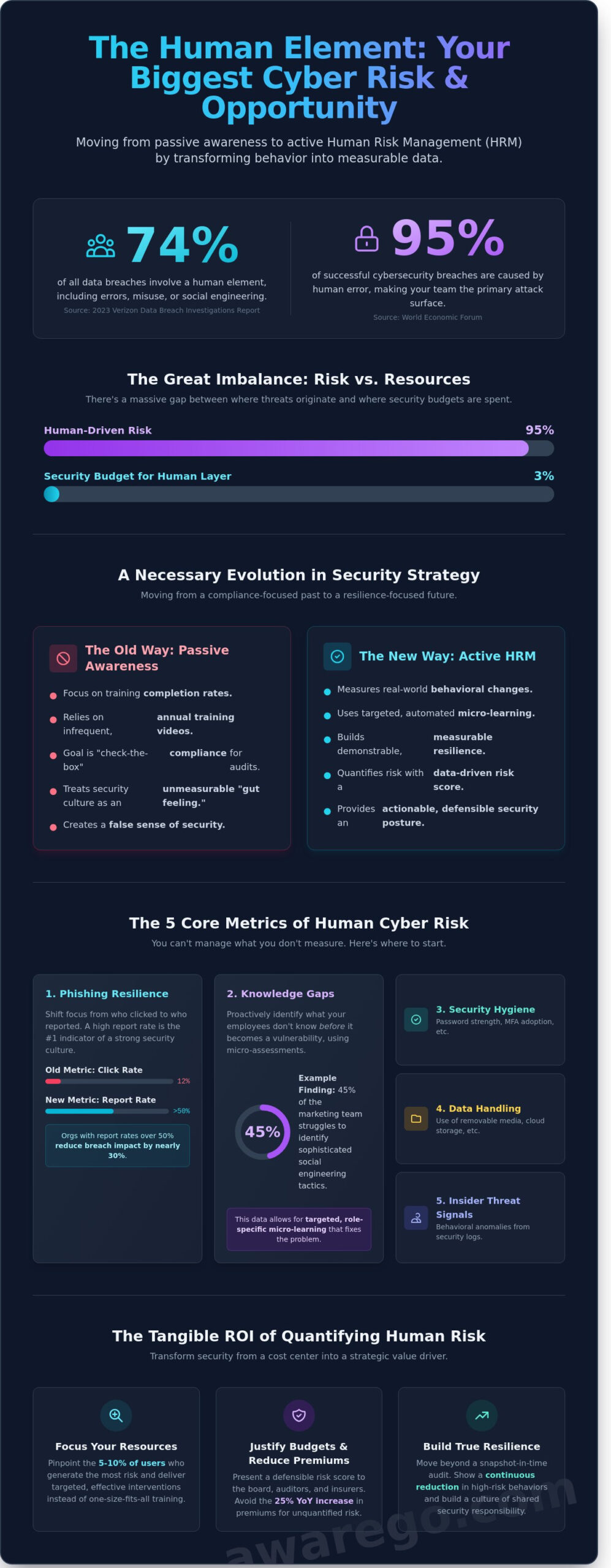
The 2023 Verizon Data Breach Investigations Report reveals that 74% of all breaches involve a human element, yet most security leaders still treat employee behavior as an unmeasurable variable. You’ve likely felt the pressure when a Board member asks for the direct ROI of your security training budget while your phishing simulation click rates hover stubbornly at 12% or higher. It’s frustrating to manage a threat you can’t see, especially when your current tools only tell you who finished a video rather than who is actually changing their habits. You deserve a way to quantify employee risk that feels as concrete and actionable as your firewall logs.
We’re here to help you move from passive awareness to active Human Risk Management. This guide shows you how to transform unpredictable actions into measurable data points that reduce your organizational vulnerability. You’ll learn how to build a defensible risk score for compliance and insurance purposes while creating a clear dashboard for your executive team. We’ll explore how to identify the specific 5% of your workforce creating the most risk and how to deliver targeted micro-learning that builds real resilience.
Key Takeaways
- Shift your strategy from passive awareness to active Human Risk Management (HRM) to effectively address the human element behind most modern breaches.
- Learn why traditional training completion rates fail and how to quantify employee risk using a data-driven, five-step framework.
- Identify the high-impact metrics that measure true phishing resilience and reveal critical knowledge gaps before they become vulnerabilities.
- Discover how to transform raw security logs into actionable insights that align your human attack surface with your organizational risk appetite.
- Explore how micro-learning automates the path from risk identification to measurable resilience, building a stronger security culture for your entire team.
Why You Must Quantify Employee Risk in 2026
For years, security leaders relied on intuition to gauge their organization’s safety. They looked at participation rates in annual training and hoped for the best. That approach doesn’t work in 2026. We’ve moved beyond the era of simple “Security Awareness” and entered the age of Human Risk Management (HRM). This shift treats security as a behavioral science rather than a technical checkbox. It’s about empowering your team to become your strongest defense line.
The data paints a clear, if lopsided, picture. The World Economic Forum reports that 95% of successful cybersecurity breaches involve a human element. This includes everything from accidental data leaks to sophisticated social engineering. Despite this, Gartner research shows that organizations still only allocate roughly 3% of their total security budgets to the human layer. This massive gap between where the risk lives and where the money goes is why modern leaders now prioritize the need to quantify employee risk with precision.
Relying on a “gut feeling” about your security culture is a liability. Without hard evidence, you’re flying blind. Unquantified risk leads to skyrocketing insurance premiums, which have increased by an average of 25% year-over-year for companies that cannot demonstrate proactive risk mitigation. Beyond premiums, regulatory fines under frameworks like the GDPR or the EU AI Act are now tied directly to an organization’s ability to prove they’ve taken reasonable steps to manage understanding insider threats and human vulnerabilities. Data gives you the power to replace anxiety with actionable confidence.
The ROI of Risk Quantification
CFOs and Board members don’t make decisions based on vague promises of “better culture.” They invest in metrics. When you quantify employee risk, you transform security from a cost center into a value driver. Data-backed risk scores allow you to secure larger budgets by showing exactly where the vulnerabilities lie and how much it costs to fix them. This precision also reduces “alert fatigue” for your IT team. Instead of treating every employee as a high-threat target, you can focus your resources on the 10% of users who actually drive 90% of your risk. Human Risk Management is a strategic business function that continuously measures and mitigates the security risks stemming from human behavior to build organizational resilience.
Compliance vs. Resilience
Passing an annual audit is a snapshot in time. It doesn’t mean your employees are safe; it means they were compliant on a Tuesday in October. The danger of “check-the-box” training is that it creates a false sense of security while your actual resilience remains low. In a 2026 threat environment defined by deepfakes and AI-driven phishing, a once-a-year video isn’t enough to change habits.
- Audits measure what people know.
- Quantification measures what people do.
- Resilience is the result of turning those measurements into better habits.
Quantification bridges the gap between the server room and the boardroom. It allows the CISO to present a dashboard that shows a 15% reduction in high-risk behaviors over six months. This level of transparency builds trust and ensures that security remains a shared human responsibility across the entire company.
The 5 Core Metrics for Measuring Human Cyber Risk
Data gives you the power to see what was once invisible. You can’t manage what you don’t measure. In modern cybersecurity, relying on gut feelings leaves your organization vulnerable. To truly quantify employee risk, you need a balanced scorecard of human behavior. This moves your strategy from reactive fire-fighting to proactive resilience. You aren’t just looking for mistakes; you’re looking for patterns that signal future strength or weakness.
The first metric is Phishing Resilience. For years, IT teams obsessed over click rates. If 12% of your staff clicked a link, you felt you failed. However, the report rate is a far stronger indicator of a healthy security culture. A 2023 industry analysis showed that organizations with a report rate above 50% reduce their breach impact by nearly 30%. You want your people to be active sensors, not just passive targets. High report rates mean your team is engaged and vigilant.
Next, consider Knowledge Gaps. Most companies wait for a breach to realize their team doesn’t understand Multi-Factor Authentication (MFA) or social engineering. By using frequent micro-assessments, you can identify that 45% of your marketing team struggles with data classification before they make a mistake. This allows for surgical training interventions. You can fix the specific problem without wasting everyone’s time with broad, boring seminars.
Behavioral Habits track real-world actions. This includes password hygiene and how employees handle sensitive data outside of a simulation. If your Endpoint Detection and Response (EDR) logs show 15 unsecured device alerts per week in your finance department, that’s a data point you can’t ignore. It’s about what people do when they think no one is watching. These habits are the foundation of your long-term security posture.
Security Sentiment quantifies the “why” behind the behavior. If employees feel security protocols are a burden, they will find workarounds. A high friction score is a direct predictor of future shadow IT usage. Finally, Remediation Speed measures how long it takes for a user to engage with corrective training after a mistake. In high-performing teams, this engagement happens in under 24 hours. Fast remediation prevents the same mistake from happening twice.
Leading vs. Lagging Indicators
Breach data is a lagging indicator. It tells you what already went wrong. It’s too late for prevention. You need leading indicators to stay ahead of threats. An unsecured device alert or a sudden dip in training engagement are early warning signs. You can weigh these different signals to create a unified Risk Score. This score helps you quantify employee risk across different departments and roles with high precision.
The Role of Behavioral Science
Nudge theory is essential for measuring habit formation. You aren’t just teaching facts; you’re shaping a culture. Security sentiment is often the strongest predictor of a breach. If your team feels empowered rather than policed, they are 3.5 times more likely to follow protocols. Measuring the friction your controls create helps you balance safety with productivity. This ensures security is a seamless, positive part of the workday for everyone.
Beyond Completion Rates: Why Traditional Metrics Fail
A 100% completion rate on your annual security awareness course looks great on a spreadsheet. It satisfies auditors and checks a box for insurance renewals. However, this metric is often a hollow victory. In 2023, the Verizon Data Breach Investigations Report found that 74% of all breaches involved a human element, including social engineering or simple errors. If completion rates were a true indicator of safety, that number would be plummeting. It isn’t.
The reality is that employees often game the system to finish long, boring training sessions. A 2022 survey found that 54% of employees admitted to skipping parts of their security training just to save time. This creates a dangerous “False Sense of Security” for leadership. You think your perimeter is fortified, but your team has only learned how to click “Next” as quickly as possible. Common tactics include:
- Muting videos to run them in the background while working.
- Speed-clicking through slides without reading the content.
- Sharing quiz answers with colleagues to bypass the learning phase.
To truly quantify employee risk, you have to look past the certificate of completion. There is a massive gap between knowledge and action. An employee might know that a suspicious link is dangerous during a quiet training session on a Tuesday morning. That same employee, facing a 4:00 PM deadline and an overflowing inbox, is far more likely to click. Stress and cognitive load bypass rational thought. A 2023 CybSafe study revealed that 64% of employees feel under-equipped to handle cyber threats despite completing mandatory training. Traditional metrics fail because they don’t account for how people behave under pressure.
When you rely on completion rates, you’re measuring compliance, not your actual security culture. Compliance is about following a rule once; resilience is about building a habit that sticks. To quantify employee risk effectively, you need data that reflects real-world behavior, not just the ability to pass a test. This shift toward Human Risk Management (HRM) allows you to move away from passive awareness and toward active, measurable mitigation. It requires moving toward continuous, data-driven assessments that capture the nuances of daily workplace dynamics.
The Fatigue Factor
Over-training is a silent killer of security culture. When you force employees into 60-minute sessions, you trigger “Security Fatigue.” A 2021 NIST report found that fatigued users are less likely to follow protocols. They simply run out of mental energy to stay vigilant. Shorter, three-minute micro-learning modules provide a better way to measure engagement by tracking frequent, consistent interactions rather than one-off marathons.
Debunking the ‘Unpredictable Human’ Myth
Many leaders believe people are too random to measure, but groups follow clear patterns. By using statistical modeling, you can predict which departments are most vulnerable. A 2022 analysis showed finance teams are 30% more likely to click invoice-themed lures than other departments. Human error is often a systemic failure, not a personal one. Patterns emerge when you look at roles and habits rather than individuals.
A 5-Step Framework to Quantify Your Human Attack Surface
Turning human behavior into measurable data doesn’t have to be a mystery. You can move from gut feelings to precise metrics by following a structured, five-step approach. This framework helps you quantify employee risk by transforming everyday digital interactions into a clear, actionable risk score. It’s about moving beyond simple compliance checkboxes and building true organizational resilience. You aren’t just looking for mistakes. You’re looking for patterns that help you coach your team more effectively.
- Step 1: Audit your existing data sources. Your tech stack is already screaming with information. Pull data from your Phishing simulation logs, your Endpoint Detection and Response (EDR) alerts, and your Learning Management System (LMS). These are the raw ingredients for your risk model.
- Step 2: Define your risk appetite and KPIs. Decide what “safe” looks like for your specific culture. For example, you might set a goal to keep your phishing click rate below 4% or ensure that 100% of your “privileged users” complete a monthly micro-learning session.
- Step 3: Deploy baseline assessments to identify high-risk cohorts. You can’t improve what you haven’t measured. Use initial assessments to find which departments or roles are most vulnerable to specific threats like business email compromise or credential harvesting.
- Step 4: Integrate behavioral data with technical security signals. Connect the dots between what people know and what they do. If an employee fails a phishing test and also triggers multiple “blocked site” alerts in their browser, their risk profile changes. This integration provides a holistic view of your attack surface.
- Step 5: Establish a continuous feedback loop for remediation. Data is only useful if it drives change. Use your findings to trigger automated, relevant training that hits the user’s inbox right when they need it. This ensures your team learns from mistakes in real time.
Auditing Your Data Sources
Your current tools are likely hiding valuable human risk data. Check your email security gateway for “reported” versus “clicked” ratios. Review your password manager logs for reuse patterns or weak configurations. To keep your team’s trust, always anonymize this data at the aggregate level. This preserves privacy while giving you the insights needed for a Human Risk Dashboard. This dashboard provides real-time visibility into whether your security culture is strengthening or stalling. It turns abstract fears into manageable charts.
Setting the Baseline
Your first assessment is the most critical data point you’ll ever collect. It serves as the “Point Zero” for your entire Human Risk Management strategy. Without it, you’re just guessing. You can use these initial Benchmarking Human Risks audits to see how your team stacks up against industry peers. Research from 2023 shows that organizations that benchmark their human risk see a 40% faster improvement in security habits compared to those that don’t. This baseline allows you to quantify employee risk accurately from day one, ensuring your security budget goes where it’s actually needed. When you know your starting point, every small win becomes visible and celebrated.
Ready to see how your team compares to the industry standard? Start your first human risk assessment and turn your workforce into your strongest layer of defense.
Turning Data into Resilience with AwareGO HRM
Data is the bridge between uncertainty and resilience. Most companies treat human risk as a vague concept, but AwareGO HRM makes it tangible and actionable. You need to quantify employee risk to understand exactly where your defenses are thin. Our platform automates this process, pulling metrics from real world interactions to create a live map of your organization’s vulnerabilities. It’s about moving away from guesswork and toward a strategy rooted in hard evidence.
We move you beyond simple monitoring. Traditional tools tell you that a problem exists but often leave you wondering how to fix it. We solve this by integrating micro-learning directly into the feedback loop. When the system detects a pattern of risky behavior, it doesn’t just flag a report for IT. It delivers a 90 second training module designed to change that specific habit. It’s precise, fast, and effective, turning a moment of risk into a moment of growth.
The platform also allows you to customize your Risk Score. A financial institution faces different threats than a retail chain. You can weight specific behaviors based on your industry’s 2024 threat landscape, ensuring your data reflects your actual reality. This customization ensures that your security culture isn’t just a generic checklist but a bespoke shield designed for your unique environment.
The AwareGO Advantage
Behavioral science is our foundation. We use the same psychological triggers that hackers exploit, but we use them to build your team up. Our Human Risk Assessment (HRA) gives you a granular view of your team’s strengths across six distinct areas, including phishing and physical security. This data-driven automation saves IT teams roughly 15 hours of manual work every month. Instead of chasing spreadsheets, your team can focus on high-level strategy while our platform handles the heavy lifting of behavior modification. We replace boring, hour-long seminars with cinematic-quality video content that employees actually enjoy watching. This leads to engagement rates that often exceed 90%, a massive jump from traditional compliance-based programs.
Ready to See Your Score?
Awareness is a vital starting point, but active risk management is the ultimate goal. You can’t rely on luck or hope to keep your data safe. Organizations that partner with a managed cybersecurity service often see a 70% reduction in successful phishing attempts within the first twelve months. This transition from “watching” to “managing” creates a proactive security culture where every employee feels empowered. It’s time to stop fearing the human element and start leveraging it as your strongest asset. When you quantify employee risk, you gain the clarity needed to lead with confidence. Your journey toward a more resilient workforce starts with a single look at the numbers. Let’s make sure those numbers tell a story of strength and preparedness.
Master Your Human Attack Surface for 2026
The transition from passive awareness to active Human Risk Management is no longer optional. By 2026, the most resilient organizations will be those that move beyond simple completion rates to embrace a data-driven strategy. You now have the 5-step framework needed to quantify employee risk using 5 core metrics that track actual behavioral shifts. This shift turns your workforce from a perceived vulnerability into a proactive shield. It’s about replacing technical hurdles with shared responsibility and clear, measurable progress.
AwareGO is already used by global enterprises to manage human risk through a unique blend of micro-learning and proven behavioral science. As a winner of multiple cybersecurity innovation awards, our platform simplifies complex threats into snackable, actionable knowledge. You don’t have to navigate these digital threats alone or rely on outdated spreadsheets; we’re here to help you build a security culture that lasts. Start Your Human Risk Assessment with AwareGO and take the first step toward a more confident, data-backed future. You’ve got the tools; now it’s time to build resilience.
Frequently Asked Questions
How do you calculate a human risk score?
You calculate a human risk score by combining behavioral data, training performance, and technical vulnerabilities into a single metric. For example, 40% of the score comes from phishing simulation results, 30% from security training completion, and 30% from actual incident history like password reuse or device security. This creates a 1 to 100 scale that helps you quantify employee risk effectively. It moves your team from guesswork to a data-driven security culture.
Can you actually quantify employee behavior without invading privacy?
You can protect privacy by aggregating data and focusing on security-related actions rather than personal monitoring. Use anonymized metrics like the 85% participation rate in micro-learning or department-level risk trends to see the big picture. GDPR and CCPA guidelines ensure that you only track 12 key behavioral indicators, such as link clicks or MFA adoption, without reading private messages or tracking keystrokes. This approach keeps your people feeling safe and respected.
What are the most important KPIs for human risk management?
Focus on the Mean Time to Report (MTTR) and the Resilience Ratio to see real progress. A healthy Resilience Ratio is 10:1, meaning 10 employees report a threat for every 1 who clicks. Other vital KPIs include the 90 day training retention rate and the percentage of “repeat offenders” who click multiple phishing links. These numbers give you a clear view of your organization’s behavioral health and where you need to focus your energy.
How often should I measure my organization’s human risk?
You should measure human risk continuously through real-time data streams and monthly reporting cycles. Quarterly deep dives provide a strategic look at how your security culture is evolving over a 90 day period. This frequency allows you to spot a 15% dip in awareness before it turns into a costly data breach. Frequent measurement keeps your resilience high and your data fresh, ensuring you’re always ready to respond to new threats.
What is the difference between security awareness and human risk management?
Security awareness is about knowledge, while Human Risk Management (HRM) is about measurable behavior and mitigation. Awareness might track how many people watched a 5 minute video in October. HRM uses data to quantify employee risk by looking at how many people actually applied that knowledge to block a real-world threat. It shifts the focus from passive learning to active resilience, turning your workforce into a strong human firewall.
What happens if a high-level executive has a high risk score?
High-risk executives receive personalized, high-touch support rather than punitive measures. Since 74% of breaches involve a human element, executives are often primary targets for “whaling” attacks. We provide them with 2 minute executive summaries and one-on-one coaching to address specific vulnerabilities like social engineering. This approach builds a supportive partnership instead of a culture of blame, making your leadership team more secure and confident.
How can I use risk quantification to lower my cyber insurance premiums?
Share your Human Risk Management reports with underwriters to demonstrate a proactive security posture. Insurance providers like Marsh or Aon often look for a 20% reduction in historical click rates when calculating premiums. By providing 12 months of consistent risk data, you prove that your workforce is a measurable asset rather than a liability. This transparency shows you’re managing risk effectively and can lead to significant cost savings on your policy.
Does quantifying risk actually reduce the number of phishing clicks?
Yes, organizations using data-driven HRM see an average 70% reduction in phishing click rates within the first year. When you track specific behaviors, you can tailor your training to the 10% of users who cause 80% of the risk. This targeted approach replaces generic training with 3 minute micro-lessons that solve real problems. It makes your security efforts both measurable and effective, drastically lowering the chance of a successful attack.