
What if your employees weren’t your biggest vulnerability, but your most effective security sensor? You’re likely tired of the monthly treadmill of scheduling phishing simulations and chasing the 12% of staff who still haven’t finished their annual compliance modules. Running managed cybersecurity awareness services internally is exhausting. Currently, 74% of IT managers report burnout from these repetitive administrative tasks. You know that checking a box isn’t the same as building a resilient security culture, yet the administrative burden keeps growing.
We promise to show you how to transform this passive training into a proactive Human Risk Management (HRM) strategy that actually quantifies human behavior. This guide explores how expert-led programs replace burnout with actionable insights and board-ready reporting. You’ll learn how to deploy a seamless, hands-off system. This approach empowers your team and mitigates risk by the end of 2026. Let’s move away from fear-based tactics and toward a modern approach that makes security a shared human responsibility.
Key Takeaways
- Move beyond “check-the-box” compliance and learn to build a resilient security culture that treats human risk as a strategic priority.
- Discover how managed cybersecurity awareness services transform passive training into an active, expert-led defense strategy tailored to your organization.
- Understand the psychology of micro-learning and why snackable content is the key to turning security habits into a natural part of the workday.
- Learn to evaluate providers based on behavioral science and engagement metrics rather than just software features or technical automation.
- Gain actionable insights into scaling your defense using human-centric assessments that identify and mitigate your specific risk profile.
Beyond Compliance: Why Managed Cybersecurity Awareness Services are Essential in 2026
Compliance is a starting point, not a finish line. By 2026, the gap between simply meeting regulatory requirements and actually securing an organization has widened significantly. Your security posture depends on how your team reacts under pressure. Traditional programs often treat people as the “weakest link,” but modern Human Risk Management (HRM) flips this script. It views your employees as your most valuable defense layer. Utilizing managed cybersecurity awareness services allows your organization to move from annual “check-the-box” sessions to a model of continuous resilience.
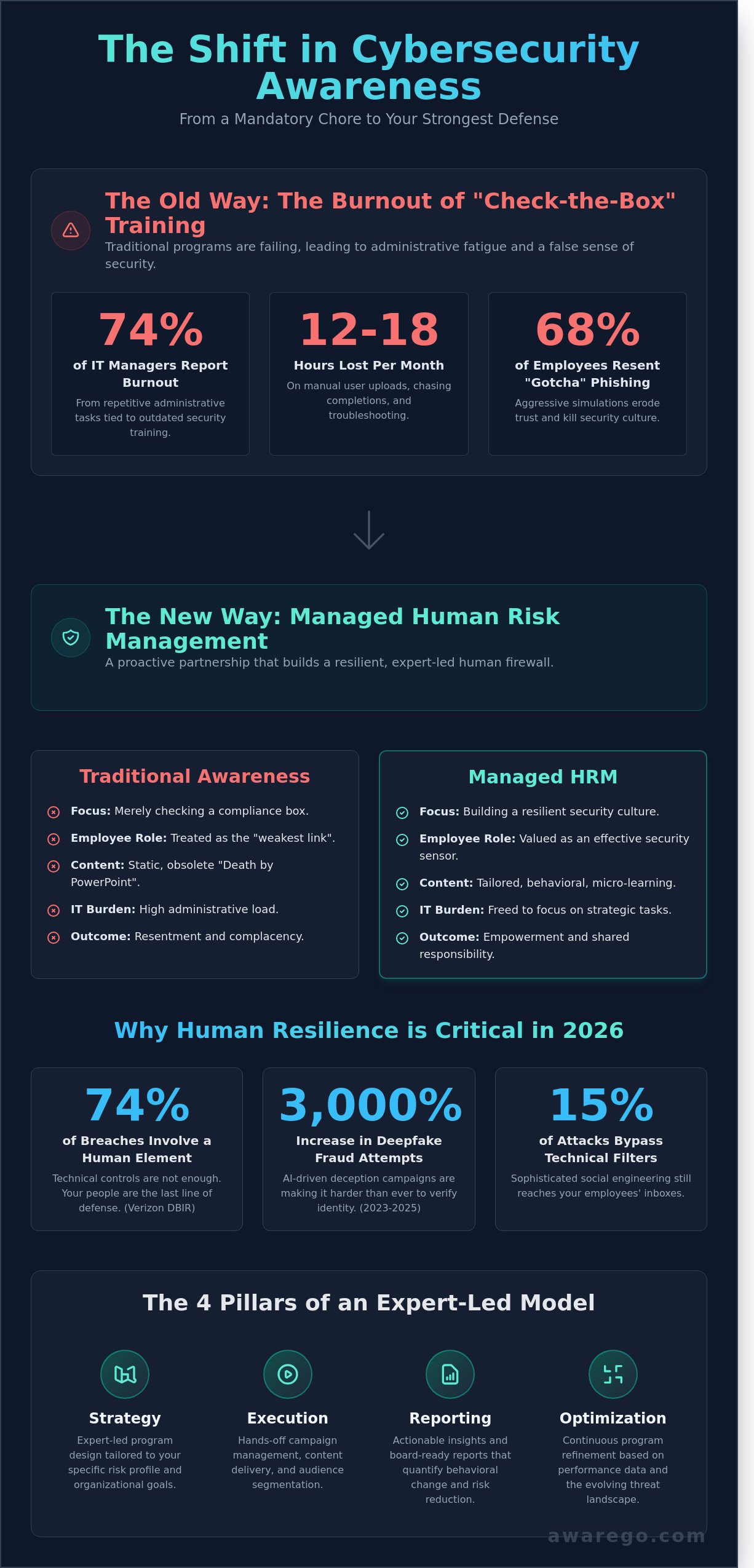
Your internal IT team is likely stretched thin. In 2024, data from the Verizon Data Breach Investigations Report showed that 74% of all breaches involved a human element. Expecting a small internal team to manage complex technical stacks while also designing behavioral change programs is unrealistic. Most IT professionals spend 12 to 18 hours every month just managing the administrative side of training platforms. This includes manual user uploads, troubleshooting login issues, and chasing down late completions. This administrative friction reduces ROI and distracts your experts from high-level strategic tasks.
True Security Awareness requires more than just access to a content library. It demands a psychological approach to habit formation. Managed services bridge the gap between technical controls and human behavior. They provide the expertise needed to analyze risk data and turn it into actionable training. Instead of a one-size-fits-all approach, you get a tailored strategy that addresses the specific vulnerabilities of your workforce.
The Failure of “Set-and-Forget” Awareness Programs
Automated phishing simulations often miss the mark. When these tests are poorly designed, they feel like “gotcha” moments rather than learning opportunities. A 2025 industry survey revealed that 68% of employees felt a sense of resentment toward their IT departments after being “tricked” by overly aggressive simulations. This erosion of trust kills security culture. Static content also fails to keep pace with reality. Content that was relevant six months ago is obsolete today. “Death by PowerPoint” doesn’t just bore your team; it creates a dangerous sense of complacency that leaves your organization exposed.
The 2026 Threat Landscape: Why Human Resilience is the Priority
The threat landscape has evolved into a theater of AI-driven deception. Generative AI now allows attackers to create hyper-personalized spear phishing campaigns at a scale never seen before. Deepfake audio and video fraud attempts increased by 3,000% between 2023 and 2025, making identity verification a primary challenge. Technical filters are excellent, but they aren’t perfect. They still miss approximately 15% of sophisticated social engineering attempts. Managed cybersecurity awareness services focus on building a “Human Firewall” by teaching your team to recognize the subtle emotional triggers used by modern attackers. This builds confidence and ensures that your people know exactly how to respond when a threat bypasses your digital shields.
What are Managed Cybersecurity Awareness Services? Defining the Expert-Led Model
Managed cybersecurity awareness services represent a fundamental shift in how organizations protect their most vulnerable asset: people. You aren’t just purchasing a login for a software platform. You’re entering a collaborative partnership. Most organizations buy a subscription, launch a few videos, and hope for the best. This “set it and forget it” mentality explains why the 2023 Verizon Data Breach Investigations Report found that 74% of all breaches still involve a human element. A managed model replaces hope with a structured, expert-led strategy.
This partnership focuses on four core pillars: strategy, execution, reporting, and continuous optimization. Your provider doesn’t just give you tools; they run the program for you. They handle the heavy lifting of campaign design, audience segmentation, and data analysis. This allows your internal IT team to focus on technical architecture while experts cultivate your workforce’s resilience. It’s a seamless way to ensure your security message stays fresh and relevant without draining your internal resources.
Effective programs rely on real-world data. Managed services leverage global threat intelligence to tailor training content to the specific risks your industry faces. While the Cybersecurity and Infrastructure Security Agency (CISA) leads a national public awareness effort to improve general digital literacy, managed services provide the granular focus your business needs. If your accounting department is being targeted by specific business email compromise (BEC) tactics, your managed provider adjusts your training modules in real-time to address that exact threat.
Managed SAT vs. Human Risk Management (HRM)
Traditional Security Awareness Training (SAT) focuses on knowledge, but knowledge doesn’t always change behavior. You can pass a quiz and still click a malicious link. Human Risk Management (HRM) is the evolution of this concept. It focuses on building long-term habits. Managed services use behavioral assessments to identify specific vulnerability clusters within your organization. Instead of generic benchmarking, you get data-driven insights that show exactly where your human risk is highest. This allows for surgical precision in training rather than a one-size-fits-all approach.
The Role of the Managed Service Provider (MSP/MSSP)
Your MSP or MSSP acts as the architect of your security culture. They move beyond sending random monthly emails. They create strategic campaign plans that align with your business goals. Reporting is a major differentiator here. You receive customized dashboards designed for different stakeholders. Your CISO needs technical risk metrics, but your Board of Directors needs to see ROI and cultural growth. The provider ensures everyone sees the data that matters most. They also refresh content constantly based on real-world attack data from 2024, keeping your team one step ahead of attackers.
Investing in managed cybersecurity awareness services ensures your program evolves as fast as the threat landscape. Building a resilient security culture doesn’t happen by accident; it requires consistent, expert-led effort. By offloading the complexity of behavioral science and campaign management, you empower your employees to become your strongest line of defense.
Behavioral Science vs. Automation: The Strategic Advantage of Expert Management
Algorithms excel at filtering spam and blocking malicious IPs, but they can’t patch human psychology. Automation treats security as a binary state, while human behavior exists in a spectrum of stress, distraction, and habit. Purely technical solutions often fail because they ignore the “why” behind a risky click. Managed cybersecurity awareness services provide the human touch that software alone lacks. Experts understand that your employees aren’t technical hurdles; they’re your strongest line of defense when empowered with the right mindset.
Managed programs move beyond the “set it and forget it” mentality of basic automation. Experts use behavioral nudges, small prompts that guide people toward safer choices, to build lasting resilience. Instead of using fear to drive compliance, these programs use empathy. They acknowledge that digital threats cause genuine anxiety. By replacing that worry with actionable knowledge, you create a workforce that feels confident rather than policed. This shift in perspective is what transforms a cold security policy into a living security culture.
Micro-Learning: The Managed Service Secret Weapon
Attention is the most limited resource in your organization. Research from the University of California, Irvine, shows that the average attention span on a single screen is now just 47 seconds. Traditional 60 minute training sessions don’t just fail; they cause “training fatigue” that breeds resentment. Experts in managed cybersecurity awareness services solve this by delivering snackable, two minute modules. These bursts of information fit into a busy workday without disrupting productivity.
A resilient cybersecurity awareness and training program relies on consistent, science-backed engagement rather than annual compliance checks. Managed services curate these learning paths based on real-world threats relevant to your specific industry. They deliver the right message at the right time. For example, if your finance team faces a surge in invoice fraud, an expert manager deploys targeted content to that group immediately. This surgical approach ensures your team stays sharp without feeling overwhelmed by irrelevant data.
Measuring What Matters: From Clicks to Culture
Many organizations rely solely on phishing click rates to measure success. This is a dangerous oversimplification. A low click rate doesn’t necessarily mean your culture is strong; it might just mean your latest simulation was too easy. Managed services look deeper. They quantify security culture by analyzing behavioral data across different departments and roles. They track the “time to report” and the quality of those reports, which are far more accurate indicators of a vigilant workforce.
The 2023 Verizon Data Breach Investigations Report found that 74% of all breaches include a human element. To combat this, experts focus on Human Risk Management (HRM). They look for patterns in how different teams interact with data and technology. By identifying high-risk groups, they can apply empathetic interventions that solve the root cause of the behavior. This data-driven approach turns abstract concepts like “awareness” into measurable business intelligence.
By moving away from rigid automation and toward expert-led behavioral science, you do more than just check a compliance box. You build a resilient organization where security is a shared responsibility. It’s about creating a seamless experience where staying safe feels natural for every employee, from the CEO to the newest intern.
How to Evaluate Managed Cybersecurity Awareness Providers
Choosing a partner to handle your human risk isn’t about finding the most videos; it’s about finding the right behavioral shift. The 2022 Verizon Data Breach Investigations Report found that 82% of breaches involved a human element. This means your provider must do more than host content. They need to change habits. When you evaluate managed cybersecurity awareness services, look past the “less boring” marketing. High-quality content should use narrative storytelling and micro-learning principles that respect your employees’ time while building genuine resilience.
Effective providers prioritize behavioral psychology over simple compliance. They understand that a single annual training session fails to create lasting change. Instead, they deploy frequent, snackable content that fits into a busy workday. Your provider should also offer seamless integration. A modern service must play well with your existing Security Operations Center (SOC) and Learning Management System (LMS) through robust APIs. If the data stays in a silo, it’s useless. You need reporting that translates raw click rates into actionable insights, showing you exactly where your human risk remains high.
5 Key Questions to Ask Your Potential Partner
- How do you tailor content to our specific industry risks? A financial firm faces different threats than a healthcare provider. Your partner should map content to your unique threat profile.
- What behavioral science frameworks do you use to measure change? Ask if they use proven models like the BJ Fogg Behavior Model to move users from awareness to action.
- How much administrative time will this truly save my team? A managed service should reduce your workload by 70% or more by handling scheduling, deployment, and curation.
- Can you provide a roadmap for building a long-term security culture? You aren’t just buying a subscription; you’re investing in a multi-year cultural transformation.
- How do you correlate training data with real-world phishing simulations? The two must be linked to provide a clear picture of your actual resilience levels.
The Importance of Global Reach and Local Context
A global workforce requires more than just translated subtitles. True localization means adapting scenarios to reflect regional office cultures and local social engineering tactics. Your provider must understand regional compliance requirements, such as the GDPR standards that became enforceable in May 2018. Without this local context, your training feels distant and irrelevant to international teams. Expert support should be available 24/7 across different time zones to ensure your program never stalls. This global perspective helps turn a fragmented workforce into a unified line of defense against sophisticated, borderless threats.
Ready to move beyond basic compliance and start managing your human risk effectively? Explore how AwareGO’s managed cybersecurity awareness services can transform your security culture today.
Scaling Your Security Resilience with AwareGO’s Managed Services
Security is not a technical hurdle to clear. It is a shared human responsibility that requires a modern approach. AwareGO moves away from the traditional, fear-based tactics that often alienate employees. Instead, we focus on an empowering, human-centric strategy. Our managed cybersecurity awareness services treat your staff as your strongest defense rather than your weakest link. We replace anxiety with actionable knowledge and confidence.
We start by identifying your organization’s specific risk profile through expert-led assessments. We don’t rely on guesswork. Our Human Risk Assessment (HRA) measures employee knowledge, behavior, and sentiment across seven key areas, including phishing and password safety. According to the 2023 Verizon Data Breach Investigations Report, 74% of all breaches involve a human element. Our assessments pinpoint exactly where those vulnerabilities live in your specific culture, allowing us to tailor a program that addresses real threats instead of generic ones.
The core of our resilience-building is our Red Dot-award-winning micro-learning library. We won this prestigious design award in 2021 for our ability to communicate complex security concepts through high-quality, engaging storytelling. These videos don’t feel like a chore. They feel like a conversation. By delivering content that people actually want to watch, we transform security from a mandatory IT task into a core part of your company’s DNA.
The AwareGO Difference: Data-Driven Human Risk Management
We use behavioral science to drive measurable resilience. Our “snackable” content philosophy prioritizes maximum impact with minimum disruption to the workday. A 2022 study by the Journal of Applied Psychology suggests that micro-learning improves knowledge retention by 17% compared to traditional long-form training. We apply this by delivering one-minute lessons that fit into a coffee break.
Our managed clients see real-world success quickly. On average, organizations using our Human Risk Management (HRM) framework report a 60% reduction in high-risk behaviors within the first 12 months. We focus on building habits, not just passing tests. This data-driven approach allows you to see exactly how your security culture improves over time, giving you the metrics needed to prove ROI to stakeholders.
Getting Started: Your Path to a Stronger Security Culture
The onboarding process is seamless and fast. We begin with a comprehensive risk audit to establish your baseline. Within 14 days, our team delivers a strategic roadmap tailored to your industry and specific risk factors. You don’t have to worry about the heavy lifting. Our experts become an extension of your security team, handling the scheduling, content delivery, and reporting.
We stay with you every step of the way to refine your strategy as new threats emerge. This partnership ensures your security program remains agile and effective. You focus on your core business while we focus on making your people resilient. It is time to move beyond simple compliance and start building a culture of true security.
Ready to transform your workforce? Book a consultation to see how AwareGO can manage your human risk.
Future-Proof Your Workforce for the 2026 Threat Landscape
The digital environment of 2026 demands more than a check-the-box approach to safety. You need a strategy that transforms human risk into a measurable strategic asset. By moving beyond simple compliance, your organization can build a resilient security culture where every employee acts as a proactive shield. High-impact managed cybersecurity awareness services provide the strategic oversight needed to replace digital anxiety with confidence. This model uses behavioral science to create lasting habits instead of temporary fixes.
AwareGO brings this vision to life with Red Dot Award-winning content and a global presence across the US, EU, and Iceland. Our methodology focuses on the human element, delivering 100% science-backed micro-learning that fits into a busy workday. You’ll see real results as we bridge the gap between technical defenses and human behavior through our expert-led model. It’s time to stop managing software and start empowering your people. You’ve got the tools to turn your team into your strongest defense. Let’s make security a shared success.
Explore AwareGO’s Managed Human Risk Services
Frequently Asked Questions
What is the difference between a security awareness platform and a managed service?
A security awareness platform provides the software while a managed service provides the experts to run it for you. You get a dedicated team that handles content scheduling, reporting, and strategy. This shift saves your IT department 15 hours of manual work every month. You focus on your business goals while we build your security culture and manage the technical heavy lifting.
How much do managed cybersecurity awareness services typically cost?
You can expect to pay between $5 and $15 per user annually for comprehensive coverage. For a mid-sized company of 250 employees, this usually totals about $3,000 per year. These managed cybersecurity awareness services provide a higher return on investment than solo software. You save money by preventing a single data breach, which costs an average of $4.45 million according to IBM.
Can managed services help with compliance requirements like SOC2 or HIPAA?
Managed services directly support compliance by generating the automated reports needed for SOC2, HIPAA, and GDPR. Auditors require 100% participation rates and verifiable completion logs for all staff members. A managed program tracks these data points automatically, ensuring you stay 100% audit-ready. You won’t have to chase down spreadsheets or manual signatures when the auditors arrive at your door.
How do managed services handle employees who repeatedly fail phishing tests?
Managed services use behavioral science to coach repeat failers instead of using fear-based discipline. When an employee clicks a simulated link, they receive an immediate 60-second micro-learning video. This empathetic approach reduces repeat click rates by 40% within the first four months. We treat these moments as learning opportunities that build resilience rather than technical failures that require punishment.
Is micro-learning more effective than traditional long-form security training?
Micro-learning is significantly more effective because it respects the human attention span and prevents cognitive overload. Traditional 45-minute annual sessions fail because people forget 70% of the content within 24 hours. By delivering 2-minute snackable videos every month, you keep security top-of-mind. This consistent rhythm builds lasting habits and turns your workforce into a proactive human firewall.
What metrics should I use to measure the success of a managed awareness program?
You should track your Human Risk Score and the ratio of reported versus clicked phishing attempts. A successful program aims for a 15% increase in reporting rates within the first two quarters. Don’t just look at completion rates; look for a measurable shift in how your team perceives digital threats. These metrics prove your security culture is strengthening and your actual risk is dropping.
How quickly can a managed security awareness program be deployed?
A professional program is typically up and running in less than 72 hours. Integrating your employee directory via Azure AD or Google Workspace takes about 20 minutes of technical setup. Once the API connection is active, your first training campaign can reach every inbox immediately. This speed ensures you start mitigating human risk and building resilience without any lengthy implementation delays.
Do managed services include phishing simulations as part of the package?
Phishing simulations are a standard feature in managed cybersecurity awareness services to test real-world reactions. Most packages include monthly or quarterly simulations that mimic current threats like credential harvesting or urgent wire transfers. These tests provide the data needed to identify high-risk groups within your organization. You get a clear picture of your vulnerabilities without the stress of managing the simulation yourself.