
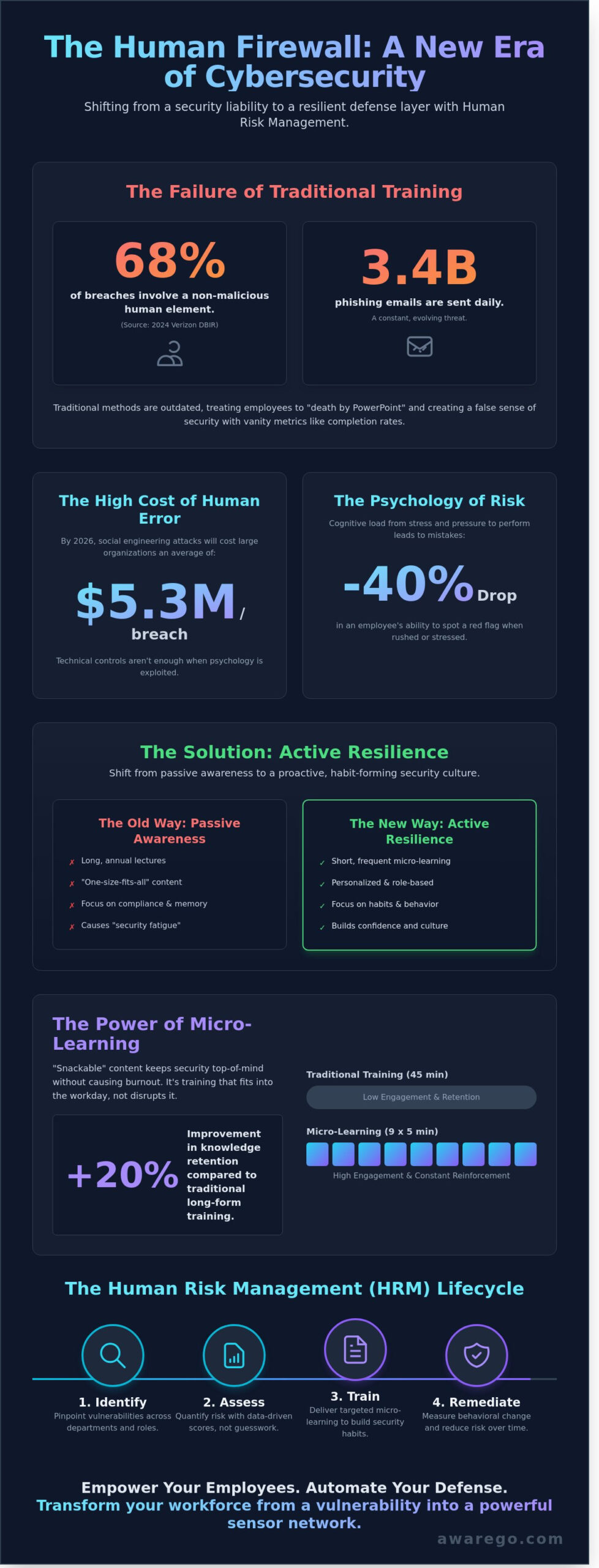
What if your employees weren’t your biggest vulnerability, but your most reliable firewall? In 2024, the Verizon Data Breach Investigations Report found that 68% of breaches involved a non-malicious human element; this proves that traditional methods are falling short. You’ve likely seen the fallout firsthand through the 3.4 billion phishing emails sent daily and a workforce that treats compliance like a chore. Effective cybersecurity awareness training for enterprises must evolve beyond the annual “death by PowerPoint” to address the psychological roots of risk. It’s time to stop blaming your team and start empowering them.
You already know that boring training videos don’t change habits, and proving ROI to the board feels like an uphill battle. We promise to show you how to transform your workforce from a security liability into a resilient defense layer using data-driven Human Risk Management. This guide previews the 2026 strategy for building a measurable security culture that integrates seamlessly with your existing enterprise tech stack.
Key Takeaways
- Shift your focus from basic compliance to a data-driven Human Risk Management (HRM) framework that identifies and remediates actual vulnerabilities.
- Discover how cinematic micro-learning content drives higher engagement and builds lasting security habits compared to traditional, long-form training.
- Learn the essential features of modern cybersecurity awareness training for enterprises that allow you to scale your defense strategy globally.
- Explore how to automate training workflows and integrate seamlessly with your existing HRIS or LMS to reduce administrative overhead and maximize ROI.
- Transform your organizational culture by empowering employees to act as a proactive, resilient defense layer rather than a security liability.
Why Traditional Cybersecurity Awareness Training Falls Short for Large Organizations
Traditional training often feels like a chore. It is a yearly hurdle designed for auditors rather than for people. This “compliance trap” creates a false sense of safety for leadership. You might have a 100% completion rate on your annual modules, but your risk remains high. Ticking a box doesn’t stop a spear-phishing attack that targets a specific executive. In fact, the 2024 Verizon Data Breach Investigations Report found that 68% of breaches involved a non-privileged human element. If your cybersecurity awareness training for enterprises is just a long video once a year, you are leaving the door wide open.
Employees get bored quickly. They suffer from “security fatigue.” When you force a staff member to sit through a 45-minute lecture filled with technical jargon, they don’t learn. They just wait for the video to end so they can return to their actual work. This lack of engagement is a major liability. You also cannot treat every department the same way. A developer managing cloud infrastructure faces different risks than an HR recruiter reviewing hundreds of external PDFs. Traditional programs ignore these nuances. They also fail to provide leadership with real data. Completion rates are a vanity metric. You need to see behavioral changes and risk scores to make informed decisions.
The High Cost of the “Human Element” in 2026
By 2026, social engineering attacks will cost large organizations an average of $5.3 million per successful breach according to industry projections. Technical controls like firewalls and filters catch many threats, but they cannot stop a clever psychological trick. Humans are your final layer of defense. People often bypass security rules because they are under pressure to perform. They choose speed over safety. Cognitive load plays a massive role here. When an employee is stressed or rushed, their ability to spot a red flag drops by 40%. Understanding these psychological triggers is the only way to build a real defense.
From Passive Awareness to Active Resilience
Knowing the rules is different from following them. Many employees understand basic security awareness concepts but fail to apply them during a busy workday. You must move toward “active resilience.” This means turning security into a habit rather than a memory test. A strong security culture is a living asset that protects your brand every day. It transforms your workforce from a vulnerability into a powerful sensor network.
To get there, frequency and snackability are your best tools. Short, frequent lessons keep security top-of-mind without causing burnout. Research shows that micro-learning improves knowledge retention by up to 20% compared to traditional long-form sessions. This approach makes cybersecurity awareness training for enterprises feel like a supportive part of the day rather than an interruption. It builds confidence. It builds habits. Most importantly, it builds a culture where everyone takes responsibility for the organization’s safety.
The Evolution of Human Risk Management (HRM) in the Enterprise
Traditional security training often feels like a chore. You watch a long, dry video once a year and forget the content by lunch. Human Risk Management (HRM) changes that dynamic. It’s not just about awareness; it’s about measurable action. While cybersecurity awareness training for enterprises used to focus on simple compliance, HRM focuses on actual behavior. You move away from static lectures toward a dynamic, living lifecycle. This process involves four critical stages: identify, assess, train, and remediate. It’s a shift from hoping your employees are safe to knowing they are resilient.
We use behavioral science to understand why people click where they shouldn’t. It isn’t enough to tell someone not to click a link. You have to build a Strong Cybersecurity Culture that makes safe habits second nature. Data from the 2023 Verizon Data Breach Investigations Report shows that 74% of all breaches involve a human element. HRM replaces vague “feelings” about security with quantitative risk scores. You can see exactly which departments are vulnerable and why. This data allows you to predict risky digital behaviors before they lead to a breach. It turns human risk from a mystery into a manageable metric.
Modern HRM treats security as a shared human responsibility. Instead of acting as a strict enforcer, your security team becomes a supportive partner. You provide the tools and knowledge employees need to feel confident. This approach reduces anxiety around digital threats. When people feel empowered rather than blamed, they’re more likely to report suspicious activity. This shift in mindset is the foundation of a truly resilient enterprise.
Identifying Vulnerabilities Through Human Risk Assessments
Assessments are your diagnostic tool. They help you find high-risk groups within your organization without any guesswork. You might find that your finance team excels at spotting phishing but struggles with password hygiene. Benchmarking plays a vital role here. It lets you compare your security posture against industry standards. If your risk score is 62 but the industry average is 78, you know exactly where to focus your resources. Start by conducting an employee cybersecurity risk audit to see where your team stands today.
Remediation: Turning Data into Targeted Training
Data is only useful if you act on it. In a modern HRM framework, assessment results trigger specific micro-learning modules automatically. This approach reduces training noise significantly. You don’t waste time teaching a remote developer about physical office security. Instead, you give them exactly what they need based on their specific risk profile. This creates a continuous feedback loop that is essential for a global enterprise with 5,000 or more employees. It keeps your team sharp without draining their productivity. If you want to see how this works, you can explore our HRM platform to streamline your strategy.
Essential Features of an Enterprise-Grade Training Platform
Selecting the right cybersecurity awareness training for enterprises requires moving beyond basic compliance. You need a solution that manages human risk across diverse departments and time zones. A modern platform acts as a supportive partner, transforming your workforce into a proactive defense layer through behavioral science and high-quality production. It’s about creating a culture where security is a shared habit, not a chore. To achieve this, your platform must prioritize engagement and measurable outcomes over simple check-box exercises.
The Power of Micro-Learning and Storytelling
Hermann Ebbinghaus discovered the Forgetting Curve in 1885, revealing that humans lose 50% of new information within 20 minutes and 90% within a month. Traditional 30-minute slide decks fail because they overwhelm the brain. High-impact videos under 120 seconds combat this by delivering snackable content that fits into a busy workday. Scenario-based storytelling creates emotional resonance, making a phishing attempt feel like a real-world challenge rather than an abstract IT problem. This approach increases knowledge retention by 17% compared to long-form training, as shown in 2022 workplace learning studies.
Phishing Simulations: Testing Without the Frustration
Effective simulations educate; they don’t punish. When you run a campaign, the goal is to build confidence. Modern platforms now integrate vishing and smishing to provide a 360-degree view of the threat landscape. If an employee makes a mistake, they should receive just-in-time training. This immediate feedback loop turns a potential breach into a private, empathetic learning moment. Data from 2023 shows that organizations using this supportive model see a 40% reduction in click rates within the first six months of implementation.
Global enterprises require deep localization to be effective. A study by CSA Research found that 72% of employees feel more engaged when content is in their native language. Authentic localization goes beyond simple translation. It adapts cultural references, local office norms, and regional legal contexts. This ensures your message resonates in Tokyo as clearly as it does in London. Your cybersecurity awareness training for enterprises must feel local to every user to truly change behaviors across a global footprint.
Finally, your platform must provide robust reporting that speaks the language of the C-suite. Executives don’t just want to see completion percentages. They need dashboards that track specific metrics:
- Human Risk Scores: Quantifying the vulnerability of different departments or regions.
- Behavioral Trends: Tracking how reporting rates for suspicious emails improve over a 12-month period.
- ROI Analysis: Comparing the cost of training against the potential cost of a data breach, which averaged $4.45 million in 2023 according to IBM.
- Benchmarking: Seeing how your organization’s resilience compares to industry peers.
These features allow you to move from passive awareness to active Human Risk Management. By focusing on cinematic content and sophisticated data, you ensure that your cybersecurity awareness training for enterprises is an investment in your people. This human-centric approach reduces anxiety and builds a workforce that is ready to face modern threats with clarity and speed.
Implementing a Global Strategy: Scale, Integration, and ROI
Scaling cybersecurity awareness training for enterprises requires a shift from manual task management to an automated, ecosystem-based approach. You need a strategy that expands alongside your headcount without adding to your IT team’s workload. When you manage 10,000 or 50,000 employees, individual tracking becomes impossible without a robust tech stack. Integration is the bridge between simply having a program and building a resilient security culture.
Automation is the secret to making your strategy sustainable. By using APIs to connect your training platform with your HRIS, you can trigger onboarding modules the moment a new hire signs their contract. This eliminates manual entry and ensures no employee slips through the cracks. This type of automated workflow reduces administrative overhead by an average of 40% according to 2023 industry benchmarks. It allows your security team to focus on high-level threats while the system handles the day-to-day education.
Integration and Scalability for 10,000+ Employees
Licensing a SCORM Content Library for internal use is the most efficient way to maintain control over your data. It allows you to deliver high-quality micro-learning content directly through your existing Learning Management System (LMS). This keeps all employee records in a single source of truth. Cloud-based platforms are essential for the 60% of enterprise employees who now operate in hybrid or remote environments. You can manage permissions across global departments from a centralized dashboard. This ensures your marketing team in London and your engineers in Tokyo receive localized, relevant content that reflects their specific regional risks.
Customization adds the final layer of effectiveness for cybersecurity awareness training for enterprises. You can wrap training modules in your brand’s voice and include specific internal security policies. This makes security feel like a shared human responsibility rather than a generic technical hurdle. When employees see their own branding and specific office protocols, they engage more deeply with the material.
Proving Value to the Board
Proving value to the board means moving beyond simple completion rates. Executive leaders want to see how you’re reducing the organization’s human risk profile. Focus on the reporting rate as your primary KPI. This measures the “resilience gap,” which is the difference between how many people click a malicious link and how many report it to IT. In 2023, organizations using a Human Risk Management (HRM) approach saw reporting rates jump from 8% to 65% within the first twelve months of consistent training. This is a tangible shift in organizational defense.
The financial benefits extend to your insurance costs. Lowering your human risk score can lead to a 10% to 20% reduction in cyber insurance premiums. Many insurers now require proof of frequent, measurable training before they will even issue a policy. HRM data provides a granular audit trail that demonstrates proactive risk mitigation; this is essential for meeting the strict “security of processing” requirements under GDPR and the “logical access” controls of SOC2. By treating security as a continuous process rather than a check-the-box exercise, you turn human behavior into a measurable asset. For a comprehensive approach to measuring your organization’s security posture, consider implementing an employee cybersecurity risk audit framework that provides the behavioral insights your board demands.
Ready to see how Human Risk Management can transform your enterprise security? Explore our enterprise solutions and start building your security culture today.
Why AwareGO is the Strategic Choice for Enterprise Resilience
Security isn’t a technical problem. It’s a human one. Most legacy programs fail because they treat employees like the weakest link in a chain. We do things differently. AwareGO views your workforce as your strongest defense. We’ve built a philosophy that replaces fear with confidence. This isn’t just about meeting a compliance checklist; it’s about building a culture where everyone feels responsible for the digital front line. When you empower people, you create a layer of security that no firewall can replicate.
Our approach to cybersecurity awareness training for enterprises relies on the precision of behavioral science. We don’t believe in hour-long lectures that people forget by lunch. Instead, we use micro-learning sessions that last under three minutes. Research from the Journal of Applied Psychology indicates that this bite-sized delivery improves knowledge retention by 17% over traditional training methods. By delivering frequent, high-quality content, we help your team build lasting habits. These habits stick because they’re integrated into the flow of work, not forced upon it.
The AwareGO Difference: Engagement Meets Science
We’ve mastered the “cool expert” persona to ensure your team actually wants to participate. Our content is sleek, relatable, and human. This style removes the friction that usually accompanies mandatory training. When employees enjoy the content, they engage with it. This engagement feeds directly into our What Is Human Risk Management? (HRM) platform. We don’t just guess who is at risk. We use hard data to identify specific vulnerabilities across your departments. In 2024, our clients saw a 40% increase in proactive threat reporting by focusing on positive reinforcement rather than punishment.
Innovation is part of our DNA. We’re already preparing organizations for 2026 threat vectors, including sophisticated AI-driven deepfakes and automated social engineering. Our content library evolves as fast as the hackers do. We provide clear, actionable insights that help you stay ahead of the curve. You get a measurable look at your organization’s resilience through our Human Risk Assessment tools. This allows you to pivot your strategy based on real-time behavioral data. You’ll know exactly where your culture stands at any given moment.
Getting Started: Your Path to a Secure Culture
Onboarding shouldn’t be a headache for your IT department. We offer a streamlined, four-step process to get your enterprise up and running in days. You can choose a self-service SaaS subscription for full control or leverage our managed services. Managed services are ideal for teams with limited internal bandwidth. We handle the scheduling, reporting, and content curation for you. It’s a seamless way to implement cybersecurity awareness training for enterprises without adding to your team’s workload. Ready to transform your security culture? Book a demo of the AwareGO HRM platform today and see how we turn human risk into human resilience.
- Human-Centric: We treat your staff as partners in defense.
- Data-Driven: Every module is backed by behavioral psychology.
- Future-Proof: Content updated for 2026 threats like AI deepfakes.
- Flexible: Choose between full SaaS control or expert managed services.
Building resilience takes more than a single annual presentation. It requires a partner who understands that humans are the heart of every enterprise. We provide the tools, the science, and the stories that make security second nature. It’s time to move past old-school awareness and embrace modern risk management. Your team is ready to be your best defense; they just need the right partner to show them how.
Future-Proof Your Human Perimeter for 2026
The transition from passive compliance to active Human Risk Management (HRM) is no longer optional for global organizations. By 2026, the most resilient companies will prioritize behavioral science over generic slide decks to combat sophisticated social engineering. You’ve seen how traditional methods fail to scale. A data-driven approach allows you to measure real-world habit changes across your entire workforce. Integrating cybersecurity awareness training for enterprises into daily workflows ensures that security becomes a shared responsibility rather than a technical burden.
AwareGO provides the expertise you need to build this culture. We’re trusted by hundreds of global enterprises worldwide to deliver Red Dot-winning content quality that resonates with modern professionals. Our platform uses a data-backed behavioral science approach to identify specific vulnerabilities, helping teams reduce high-risk behaviors by 90% within the first year of implementation. You don’t have to manage these threats alone. We’re here to help you turn your employees into a proactive line of defense.
Secure your enterprise with AwareGO’s Human Risk Management platform and start building a safer digital environment today. Your team is ready to lead the way.
Frequently Asked Questions
How often should enterprise employees receive cybersecurity awareness training?
Monthly or bi-monthly micro-learning sessions are most effective for long-term retention. Research from the Aberdeen Group shows that consistent training frequency correlates with a 70% reduction in risk. Instead of a 60-minute annual marathon, use 3-minute monthly bursts to keep habits sharp. This approach ensures your team stays ahead of new threats without feeling overwhelmed by heavy content loads.
What is the difference between Security Awareness Training and Human Risk Management (HRM)?
Security Awareness Training focuses on knowledge transfer, while Human Risk Management (HRM) uses data to change behaviors and measure actual risk. Traditional training often checks a compliance box, but HRM identifies specific vulnerabilities through behavioral metrics. By focusing on HRM, you move from passive watching to active resilience. This shift helps enterprises reduce their human-related attack surface by up to 90% through targeted interventions.
Can AwareGO content be integrated into our existing Learning Management System (LMS)?
Yes, our content integrates seamlessly with any SCORM 1.2 or 2004 compliant LMS. We provide high-quality video content that works with 95% of corporate learning platforms used by Fortune 500 companies. You can launch our micro-learning modules directly within your current environment. This ensures your cybersecurity awareness training for enterprises remains centralized and easy for your IT team to manage alongside other corporate initiatives.
How do we measure the ROI of cybersecurity awareness training for enterprises?
You measure ROI by tracking the decrease in successful phishing clicks and the increase in reported incidents. IBM’s 2023 report notes the average cost of a data breach is $4.45 million. If your cybersecurity awareness training for enterprises reduces the likelihood of a breach by even 20%, you’ve saved nearly $900,000. Use our Human Risk Assessment to see real-time improvements in your organization’s security posture and cultural strength.
Does AwareGO support multi-language training for global organizations?
We offer content in over 30 languages to support your global workforce. Every module is localized, not just translated, to ensure cultural nuances are respected in different regions. This approach covers 99% of the primary languages spoken in international business hubs. You’ll ensure that every employee, whether in Tokyo or Berlin, receives the same high-standard training in their native tongue.
What happens if an employee fails a phishing simulation test?
Failing a test is a teachable moment rather than a cause for punishment. When an employee clicks a simulated link, they receive a 60-second micro-learning video explaining what they missed. Data shows that immediate feedback improves retention by 40% compared to delayed reviews. We focus on building confidence so your team feels empowered to report real threats instead of fearing mistakes.
Is micro-learning effective for high-stakes compliance requirements?
Micro-learning is significantly more effective than long-form training, as it matches the 18-minute average attention span of modern professionals. Studies by the Journal of Applied Psychology indicate that bite-sized learning improves knowledge transfer by 17%. It satisfies major compliance frameworks like SOC2 and ISO 27001 while ensuring employees actually remember the protocols. Your team stays compliant and capable without losing hours of productivity to boring slideshows.
How does behavioral science improve cybersecurity training outcomes?
Behavioral science uses psychological triggers to turn one-time actions into long-term habits. By applying the Fogg Behavior Model, we make security tasks easy to do and provide clear prompts. This method has been shown to increase positive security behaviors by 50% within the first six months. We don’t just tell you what to do; we design our content to nudge your brain toward safer choices automatically.