 Cybersecurity blog



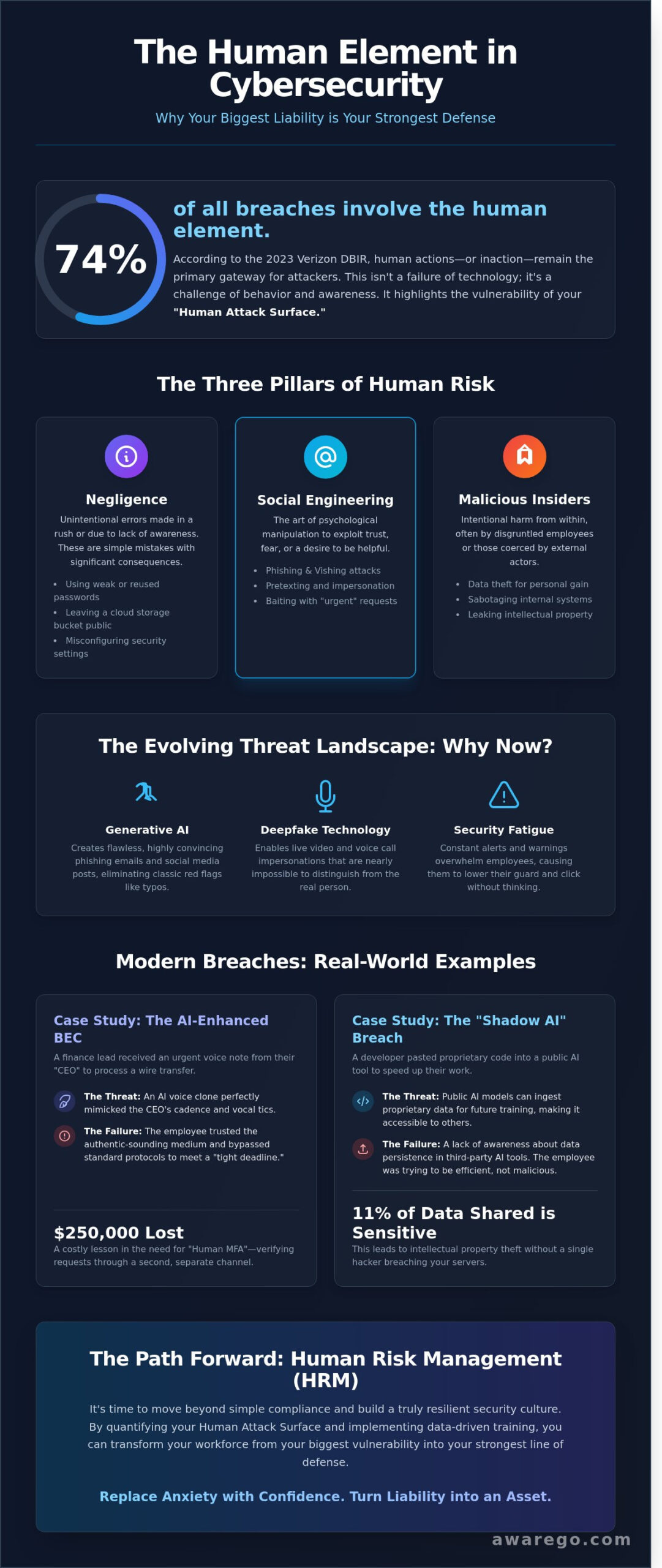
A staggering 74% of all cybersecurity incidents analyzed in the 2023 Verizon Data Breach Investigations Report involved the human element. This data confirms that human-related security breaches are not just technical glitches; they are behavioral challenges that technology alone cannot solve. You likely feel the weight of this reality every time a new phishing campaign hits your organization, wondering if this is the day your training fails. It’s exhausting to manage a risk that feels so unpredictable and difficult to quantify to your leadership team.
This guide changes the narrative by moving beyond simple compliance toward active Human Risk Management. You’ll learn why these vulnerabilities remain the top choice for hackers and how to transform your workforce into a proactive security asset. We’ll explore the behavioral psychology of modern attacks, provide specific examples to share with your team, and outline a measurable strategy to build a resilient security culture by 2026. It’s time to replace anxiety with confidence and turn your biggest liability into your strongest defense.
Key Takeaways
- Learn to distinguish between technical exploits and human actions to identify exactly where your organization’s digital perimeter is most vulnerable.
- Explore the psychology of error to understand why even your smartest employees can be manipulated by high-pressure digital tactics.
- Analyze the anatomy of modern attacks to see how social engineering bypasses expensive technology through psychological pressure and persuasion.
- Move from gut feelings to data-driven Human Risk Management (HRM) to quantify and mitigate human-related security breaches effectively.
- Build a resilient security culture using micro-learning strategies that transform your workforce from a liability into your strongest security asset.
What Are Human-Related Security Breaches?
Cybersecurity isn’t just about firewalls and encryption. It’s about people. Human-related security breaches occur when a person’s action, or sometimes their lack of action, opens a door for unauthorized access. While a technical exploit might target an unpatched server, these breaches target human psychology. You might see a thief bypass a high-tech lock simply because someone left the back door propped open for some fresh air. Understanding human-related security breaches requires looking past the code and focusing on behavior.
By 2026, data suggests that over 70% of breaches still involve the “human element.” This isn’t a failure of technology; it’s a reflection of our “Human Attack Surface.” This metric measures how vulnerable your team is to manipulation or mistakes. It helps you treat security as a measurable habit rather than a vague hope. When you quantify this surface, you move from reactive fixes to proactive resilience, turning your workforce into a documented security asset.
The Three Pillars of Human Risk
Human risk isn’t a monolith. It generally falls into three categories that define how your security culture performs under pressure:
- Negligence: These are “I was in a rush” moments. Think of an IT admin who leaves a cloud bucket public or an employee who uses the same password for ten different accounts.
- Social Engineering: This is the art of psychological manipulation. Attackers use phishing or vishing to exploit your natural desire to be helpful or your fear of authority.
- Malicious Insiders: Sometimes the threat is intentional. This includes disgruntled employees or those coerced by external actors to cause harm or steal data.
Why 2026 Is the Year of the Human Target
The threat landscape has evolved rapidly. Generative AI now creates phishing emails that lack the classic typos or awkward phrasing of the past. It’s harder than ever to spot a fake. Deepfake technology has moved human-related security breaches into the realm of live video and voice calls. Beyond the tech, security fatigue is real. When your team is overwhelmed by constant alerts, they’re more likely to click without thinking. Building resilience is about managing this exhaustion before it turns into a vulnerability.
Modern Examples of Human-Related Security Breaches
You can spend millions on the most advanced firewalls, yet a single human interaction can still bypass your entire digital defense. It’s a reality where psychology often outweighs technology. Today’s attackers have mastered a three step anatomy: the hook, the pressure, and the payload. The hook grabs your attention with a relatable context. The pressure creates a sense of urgency that shuts down critical thinking. Finally, the payload delivers the damage, whether it’s a stolen password or a wire transfer. We’ve seen a massive shift from broad “spray and pray” emails to high value Whaling. These targeted attacks focus on specific executives, making human-related security breaches more surgical and harder to detect than ever before.
Case Study: The AI-Enhanced Business Email Compromise (BEC)
In early 2026, a mid-sized firm lost $250,000 when a finance lead received a voice note from the “CEO.” The AI clone sounded perfect; it captured the executive’s specific cadence and vocal tics. Because the request sounded so authentic, the employee bypassed standard wire transfer protocols to meet a “tight deadline.” They trusted the medium instead of the process. This failure shows why your organization needs a strong security culture where “human MFA” is the norm. Verifying a request through a second, separate channel is now your most vital habit to prevent human-related security breaches.
The “Shadow AI” Breach: Data Leakage via LLMs
Human risk isn’t always about malicious intent. Sometimes, it’s just about being efficient. In 2024, a senior developer pasted proprietary algorithms into a public AI tool to speed up code optimization. They didn’t realize the model would ingest that data for future training. A 2023 Cyberhaven report revealed that 11% of data shared with AI tools by employees is sensitive proprietary information. This “Shadow AI” breach results in intellectual property theft without a single hacker ever touching your server. It’s a failure of awareness regarding data persistence in third-party models. You must treat AI interactions with the same caution as any external communication.
The Psychology of Error: Why We Click
Stop blaming the user. It’s time to understand the biology behind human-related security breaches. Daniel Kahneman’s research into System 1 and System 2 thinking explains why smart people make mistakes. System 1 is fast, instinctive, and emotional. System 2 is slower, more deliberative, and logical. Hackers don’t attack your firewall; they attack System 1.
They use cognitive load to force errors. By flooding you with tasks during high-stress periods, they ensure your brain stays in System 1. A 2023 report from Stanford University revealed that 88% of all data breaches are caused by employee mistakes. These errors peak when cognitive resources are low, such as at the end of a long shift or during a busy holiday season. Hackers wait for these moments to strike when your mental defenses are down.
The Fight-or-Flight Response in Phishing
Phishing emails are designed to trigger your amygdala. When you see a notification claiming your payroll account will be locked in 60 minutes, your brain enters a fight-or-flight state. This biological response bypasses critical thinking. Authority bias makes this worse. You’re significantly more likely to click a link if the sender appears to be your CEO or a senior IT manager. This isn’t a lack of intelligence; it’s a programmed response to hierarchy. Additionally, the bystander effect can paralyze a workforce. If 500 people receive the same suspicious email, many will assume someone else has already flagged it to the security team.
Why “Once-a-Year” Training Is a Security Risk
The Ebbinghaus Forgetting Curve proves that humans lose roughly 70% of new information within just 24 hours. By the end of a month, 90% of that “annual security seminar” is forgotten. Relying on yearly training creates a massive gap in your human-related security breaches prevention strategy. It treats security as a compliance checkbox rather than a behavioral shift. To build true resilience, you need to move toward Human Risk Management (HRM) that uses frequent, snackable content. This approach builds a security culture where safe choices become automatic. Security is a habit, not an annual event.
Quantifying and Mapping Your Human Risk
Stop relying on guesswork. You can’t manage what you don’t measure. Moving from a gut feeling to data-driven Human Risk Management (HRM) is the only way to build a resilient security culture. Most organizations focus on knowledge, but knowledge alone doesn’t stop human-related security breaches. Behavior does. Data from 2023 shows that while 90% of employees can pass a basic security quiz, their actual behavior in real-world simulations remains a vulnerability. You need a Human Risk Assessment to set a baseline and benchmark your progress against industry standards like the 2023 Verizon Data Breach Investigations Report, which found that 74% of all breaches include a human element.
Step 1: Conduct a Human Risk Audit
Start by identifying where your vulnerabilities live. You should focus on high-risk departments like Finance, HR, and DevOps because these roles hold the highest levels of access. Analyze your incident data from the last 12 months to find patterns in human error. Use phishing simulations to establish a real-world Click Rate baseline. This data provides a clear picture of your current resilience level. It moves the conversation from “we think we’re safe” to “we know where our gaps are.”
Step 2: Segment Your Workforce
Generic training is the fastest way to make your team tune out. A one-size-fits-all approach leads to disengagement because it ignores the unique challenges different roles face. Instead, create Risk Profiles for different employee groups. A developer managing AWS instances needs different micro-learning content than a sales professional active on LinkedIn. By tailoring your approach to specific vulnerabilities, you turn security into a relevant, daily habit. This targeted strategy significantly reduces the likelihood of human-related security breaches by addressing the specific risks inherent to each job function.
Ready to see where your organization stands? Start your Human Risk Assessment today and turn your data into a proactive defense.
Building a Resilient Culture with Human Risk Management (HRM)
Traditional security measures often fail because they ignore the person behind the screen. Human Risk Management (HRM) changes the narrative by focusing on behavior rather than just compliance. In 2023, the Verizon Data Breach Investigations Report found that 74% of all human-related security breaches involved human error, privilege misuse, or social engineering. HRM is the only way to systematically address the root causes of human-related security breaches before they escalate into full-scale crises. AwareGO treats your team as partners, not problems. We replace fear with confidence by helping you understand why mistakes happen and how to prevent them through measurable habit changes.
An effective HRM strategy fosters a “Reporting Culture.” When an employee clicks a suspicious link, their first instinct shouldn’t be fear of punishment. It should be to report it immediately. Organizations that encourage this transparency reduce the average lifecycle of a breach by up to 108 days, significantly cutting remediation costs. By empowering your first line of defense, you transform potential victims into active defenders. This shift in mindset provides a massive ROI by reducing the financial impact of successful attacks by nearly $1.5 million on average.
The Power of Micro-Learning
Attention spans are shorter than ever. A 60-minute webinar once a year doesn’t change behavior; it causes fatigue. AwareGO uses Security Awareness Videos that are just 1 minute long. These bite-sized lessons use “Nudge” theory to keep security top-of-mind without disrupting the workday. Research shows that frequent, short training sessions improve retention rates by 20% compared to traditional long-form methods. It’s about building small habits that lead to big results through consistent, low-stress engagement.
Transforming Employees into “Human Firewalls”
We want your team to move past “don’t click” and toward “think, then act.” This shift occurs when you celebrate “The Catch.” When someone flags a phishing attempt, reward them. This positive reinforcement builds a resilient security culture where everyone feels responsible for the company’s safety. Data shows that companies with highly trained staff identify breaches 27% faster than those without. You can turn your workforce into a proactive defense layer starting right now. Start your Human Risk Assessment with AwareGO today and see where your culture stands.
Turn Your Human Risk Into Your Greatest Defense
Technology alone won’t stop the next wave of cyber threats. By 2026, the most resilient organizations will move beyond passive training to embrace active Human Risk Management (HRM). You’ve seen how psychological triggers lead to human-related security breaches, but you also have the power to change that narrative. Since 74% of all breaches involve a human element according to the 2023 Verizon DBIR, your team represents both your biggest vulnerability and your strongest shield.
It’s time to stop viewing security as a technical hurdle and start seeing it as a shared responsibility. AwareGO helps you quantify this shift with benchmarking tools used by global enterprises to reduce real-world risk. Our platform relies on award-winning behavioral science content to replace anxiety with confidence. You can build a measurable security culture that survives long after the latest phishing simulation ends. Don’t just tick a compliance box; create a workplace where every person knows how to protect themselves and the company.
Secure your human element with AwareGO’s Human Risk Management platform and start measuring your progress today. You’ve got this, and we’re here to help you lead the way.
Frequently Asked Questions
What is the most common cause of human-related security breaches?
Phishing remains the primary driver of human-related security breaches, accounting for 36% of all data breaches according to the 2024 Verizon Data Breach Investigations Report. These attacks trick your team into handing over credentials or clicking malicious links. While tech filters catch many threats, a single lapse in judgment can bypass your entire firewall. Building a strong security culture is your best defense against these social engineering tactics.
How much do human-related data breaches cost companies on average in 2026?
Industry projections indicate that the average cost of a data breach will reach $5.13 million by 2026. This figure reflects a 15% increase from 2023 data provided by IBM and the Ponemon Institute. These costs include legal fees, regulatory fines, and the long-term loss of customer trust. Investing in Human Risk Management (HRM) helps you avoid these steep financial penalties by addressing the root cause before a crisis occurs.
Can technology alone stop human-related security breaches?
Technology cannot stop every breach because 74% of security incidents still involve a human element such as error or privilege misuse. Firewalls and encryption provide a strong perimeter, but they don’t account for a tired employee clicking a clever spoofed email. You need to combine technical controls with behavioral science to create true resilience. Your people are your final layer of defense, not just a weak link in the chain.
What is the difference between human error and an insider threat?
Human error is an accidental mistake, like a developer leaving a database exposed, while an insider threat involves intentional harm or data theft. The 2023 Cost of Insider Threats Global Report found that 55% of incidents stem from negligence rather than malice. Whether it’s a simple typo or a disgruntled worker, both risks require different management strategies. Focus on empathy for errors and strict monitoring for intentional threats.
How often should employees receive security awareness training?
You should provide security training at least once a month using micro-learning modules to keep habits fresh. Research shows that employee retention of security knowledge drops by 80% after just one month without reinforcement. Frequent, bite-sized lessons fit into a busy workday without causing fatigue. This consistent rhythm transforms security from a yearly checkbox into a core part of your organizational culture and daily operations.
Is phishing the only type of human-related security risk?
No, human risk includes misdelivery of sensitive data, weak password hygiene, and physical security lapses like tailgating. In 2023, misdelivery accounted for 9% of internal errors in the healthcare sector alone. Your team might also use unauthorized apps that bypass company security protocols. Addressing these diverse behaviors requires a comprehensive HRM strategy that looks beyond the inbox to understand how your people actually work.
How can I measure the “Human Risk” in my organization?
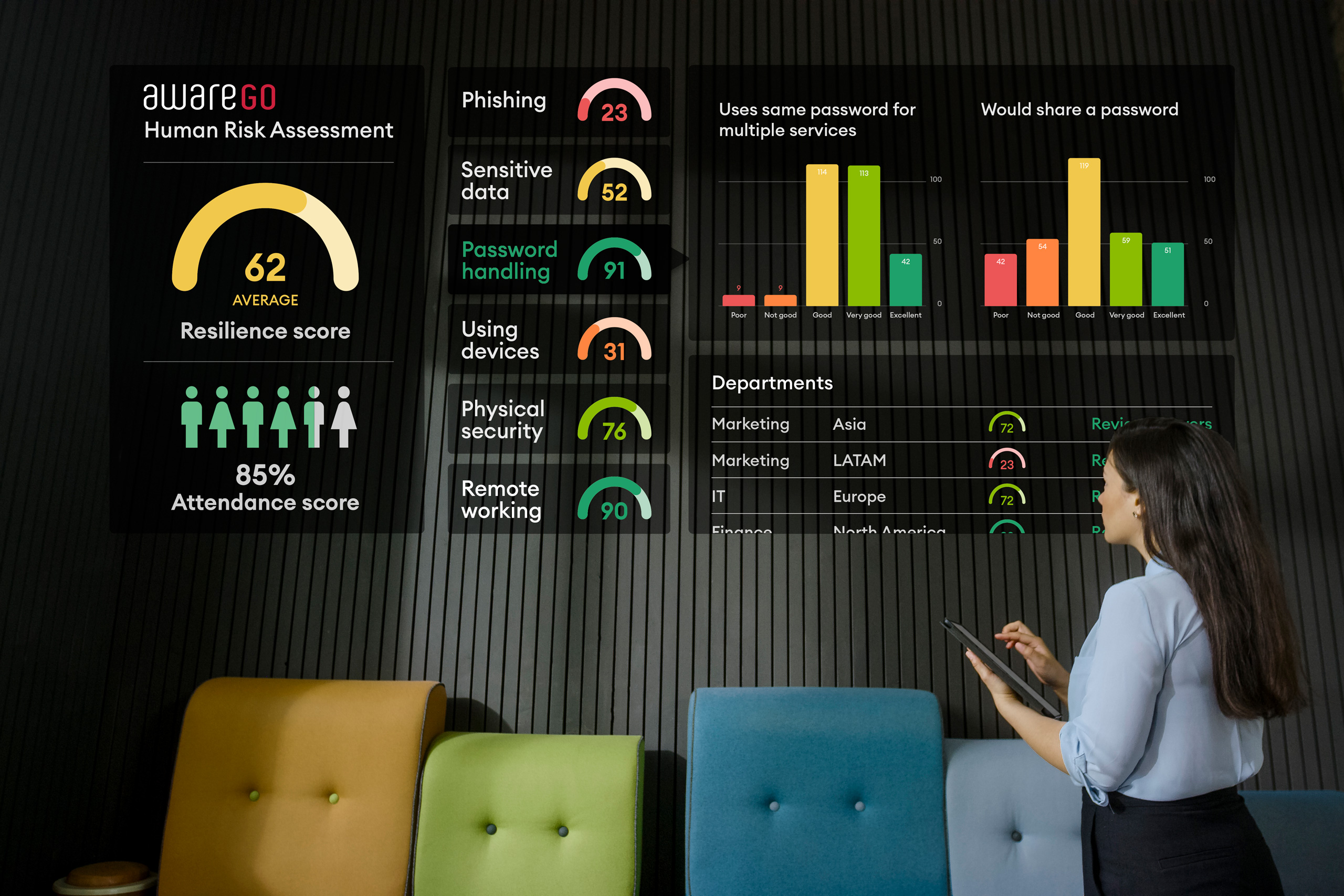
You can measure human risk by tracking behavioral metrics like phishing simulation click rates, time to report incidents, and security knowledge scores. AwareGO’s Human Risk Assessment provides a data-driven map of your organization’s vulnerabilities across different departments. Instead of guessing, you get a clear percentage of your risk level. This allows you to tailor your training to the specific habits and needs of your unique workforce.
What should I do if an employee causes a security breach?
You must immediately trigger your incident response plan and focus on containment while maintaining a no-blame culture. Punishing an employee for an honest mistake makes others hide future errors, which increases your risk. Instead, use the incident as a measurable learning opportunity to improve your processes. Conduct a post-mortem to understand the behavioral trigger and update your training to prevent similar human-related security breaches in the future.