
By 2026, the traditional 60 minute annual compliance video won’t just be boring; it’ll be a documented liability. You’ve likely felt the frustration of seeing phishing click rates stay stuck at 10% or higher, even after your team completes their mandatory modules. It’s clear that your employees are exhausted by technical jargon and long sessions that don’t reflect their daily reality. You want a workforce that acts as a proactive defense line, yet current methods often feel like a hurdle rather than a help.
We’re here to change that narrative by focusing on a resilient cybersecurity culture built on behavioral science. In this article, you’ll learn how to replace passive awareness with micro-learning habits that can reduce human risk by up to 70% within the first year of implementation. We’ll explore how to integrate security into every workflow without adding to the noise or causing burnout. This guide provides a clear roadmap to transform your organization into a proactive community where staying safe is second nature and every improvement is backed by concrete data.
Key Takeaways
- Shift your focus from technical defenses to human resilience by understanding how collective values define your digital safety in 2026.
- Bridge the gap between awareness and action by applying the psychological principles of Human Risk Management to your security strategy.
- Move beyond “check-the-box” compliance to establish a proactive cybersecurity culture that serves as your organization’s true ceiling of protection.
- Learn to measure behavioral baselines and secure executive buy-in by framing security as a strategic business enabler rather than a hurdle.
- Discover how story-driven micro-learning eliminates training fatigue and transforms security habits into a seamless part of the daily workflow.
What is Cybersecurity Culture and Why Does it Matter in 2026?
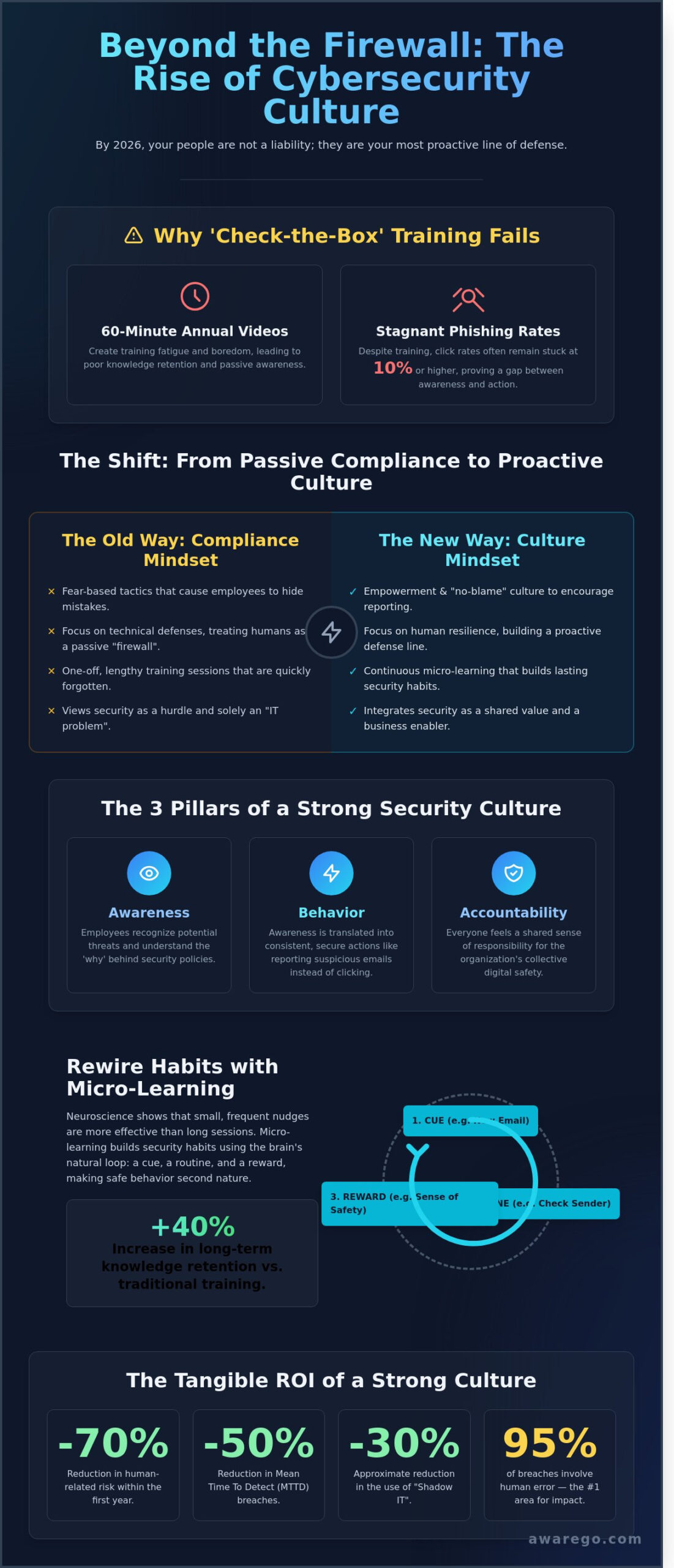
Cybersecurity culture isn’t a static policy sitting in a digital folder. It’s the living pulse of your organization. It defines the collective values, attitudes, and daily behaviors your team practices regarding digital safety. By 2026, technical defenses alone are no longer enough. AI-powered social engineering and sophisticated deepfakes now bypass traditional perimeters with ease. You need to move beyond the “Human Firewall” concept. While a firewall is a passive barrier, true cyber resilience is proactive. It’s about your team’s ability to anticipate, withstand, and recover from threats. Hybrid work has permanently blurred the lines of the office. Security must now be a portable habit that travels with your employees wherever they log in.
The Anatomy of a Strong Security Culture
A robust information security culture stands on three essential pillars: Awareness, Behavior, and Accountability. Awareness means your team recognizes the threat. Behavior is the actual habit of clicking “report” instead of a suspicious link. Accountability ensures everyone feels responsible for the collective safety. You should steer clear of fear-based tactics. When people are afraid, they hide their mistakes, which increases your risk. Empowerment and transparency are your best tools. A strong cybersecurity culture acts as a silent fail-safe. It protects your data even when a technical control fails or a software patch is missing.
The Financial and Operational ROI of Culture
Focusing on the human element is a smart business move. The World Economic Forum reports that 95% of all cybersecurity breaches involve human error. Addressing this through Human Risk Management (HRM) provides a clear return on investment. A mature cybersecurity culture reduces the use of “shadow IT” by approximately 30% as employees learn to value secure, approved workflows. It also slashes incident response times. When your staff feels confident reporting a suspicious email immediately, you stop a breach before it spreads. This maturity directly impacts your bottom line. Many insurance providers now offer lower premiums to organizations that can prove they have a measurable, active security culture in place.
The Behavioral Science Behind Security Habits
Human Risk Management (HRM) isn’t a technical checklist; it’s a psychological discipline. You can’t patch a human brain like you patch a server. Understanding why people act the way they do is the first step toward a true cybersecurity culture. Knowing a risk exists doesn’t mean you’ll avoid it. Research shows that while 90% of employees understand phishing risks, many still click malicious links when they’re stressed. This happens because of cognitive load. When your brain is juggling 15 tasks, it switches to “fast thinking,” making you prone to errors you’d never make on a quiet Sunday morning.
Social proof also plays a massive role in office norms. If your team sees leadership bypassing protocols, they’ll follow suit. NIST emphasizes that Creating a Culture of Security requires more than just rules; it requires shared values. When security becomes a “we” problem instead of an “IT” problem, resilience grows. You can start assessing these dynamics by exploring how Human Risk Management platforms transform raw data into behavioral change.
How Micro-Habits Replace Large-Scale Errors
Neuroscience tells us that habits are built on a loop: a cue, a routine, and a reward. A 60-minute annual training session doesn’t create a loop; it creates boredom. Small, frequent nudges work better. These micro-habits reduce the mental energy needed to stay safe. By implementing frictionless security, you remove the “workarounds” employees create when tools are too hard to use. A 2023 study found that organizations using micro-learning saw a 40% increase in long-term knowledge retention compared to traditional methods.
Psychological Safety in Reporting Threats
A “no-blame” culture is your fastest detection tool. If an employee is afraid of being fired for clicking a link, they’ll hide it. That silence gives attackers days or weeks of undetected access. You must overcome the digital bystander effect, where people assume someone else already reported the suspicious email. Instead of punishing failures, reward “good catches.” Companies that celebrate reporting see a 50% reduction in mean time to detect (MTTD) breaches. It’s about building confidence, not fear.
Compliance vs. Culture: Addressing the #1 Security Misconception
Compliance keeps the auditors happy. It doesn’t keep the hackers out. Think of compliance as the floor of your security efforts. It’s the bare minimum you need to stay in business. Your cybersecurity culture is the ceiling. It represents the height of your organization’s resilience. Many leaders fall into the “Check-the-Box” trap. They pass a yearly audit and assume they’re safe. This is a dangerous illusion. A 2023 Verizon report found that 74% of all breaches involved a human element, proving that meeting regulatory standards isn’t enough to stop modern threats.
Rigid, overly complex policies often backfire. When security measures make it harder for people to do their jobs, they find workarounds. This creates shadow behavior. Employees might use personal accounts or unapproved SaaS tools just to meet a deadline. You can’t fix this with stricter rules. You fix it by understanding What is Cybersecurity Culture and how it influences daily habits. Critics often argue that culture is too subjective to audit. This isn’t true anymore. By tracking behavioral metrics and employee sentiment, you turn “soft” culture into hard, actionable data.
The Limitations of Annual Awareness Training
Annual training is where retention goes to die. The Ebbinghaus Forgetting Curve shows that humans forget 70% of new information within 24 hours. By day 30, that loss reaches 90%. Mandated, hour-long sessions often feel like a punishment. They build resentment rather than resilience. There’s a massive disconnect between passing a simple quiz and identifying a sophisticated spear-phishing attempt during a busy afternoon. Real security requires constant, bite-sized reinforcement that fits into the flow of work.
Moving to Human Risk Management (HRM)
It’s time to shift from passive awareness to active Human Risk Management (HRM). Unlike traditional training, HRM focuses on behavioral monitoring and risk assessment. It doesn’t ignore your existing frameworks. Instead, it makes them more effective. HRM provides the human-centric data needed to satisfy ISO 27001 or NIST requirements while actually reducing your attack surface. You can explore the specifics in this guide on What Is Human Risk Management? A Practical Guide. This approach turns your workforce into a proactive defense layer rather than a liability.
How to Build and Measure a Cybersecurity Culture
Building a resilient cybersecurity culture isn’t a weekend project. It’s a strategic shift that moves your team from passive compliance to active defense. You can’t simply tell people to be more careful; you have to design an environment where secure choices are the easiest choices to make.
- Step 1: Conduct a Human Risk Assessment. You can’t fix what you haven’t measured. Use a behavioral assessment to identify your baseline. The 2024 Verizon Data Breach Investigations Report found that 68% of breaches involve a human element, so knowing your specific risk areas is vital.
- Step 2: Secure executive buy-in. Frame security as a business enabler rather than a cost center. When the C-suite sees that a 25% reduction in human risk protects the company’s reputation, they’ll move from “signing off” to “leading the charge.”
- Step 3: Implement micro-learning. Ditch the annual 60 minute training session. Use 1 to 3 minute modules that fit into the daily workflow. This snackable content keeps security top of mind without causing cognitive overload.
- Step 4: Use positive phishing simulations. Treat simulations as coaching opportunities. If an employee clicks, offer a “just in time” learning moment instead of a “gotcha” reprimand. This builds trust rather than anxiety.
- Step 5: Measure and reward. Track your progress and celebrate the wins. When a department hits a reporting milestone, recognize them publicly to reinforce the desired behavior.
Leadership’s Role in Modeling Behavior
Security culture starts at the top. If your executives ignore MFA prompts or share passwords, your employees will too. Leaders should lead by example by reporting their own mistakes or sharing stories of suspicious emails they’ve received. You should also identify “Security Champions” in non-technical roles like HR or Marketing. These peers act as internal influencers, making security feel like a shared human responsibility rather than a set of IT rules.
Measuring the “Unmeasurable”: Culture KPIs
You can track the evolution of your cybersecurity culture using a Maturity Model. Move beyond simple click rates and focus on the Mean Time to Report (MTTR). A 2023 SANS Institute study highlights that high maturity organizations prioritize how quickly employees report threats over how many people clicked a link. Use sentiment surveys to ask employees if they feel empowered to act. If they find security tasks “easy” rather than “burdensome,” your culture is trending toward instinctive habit.
Ready to transform your workforce into a proactive defense layer? Explore how AwareGO manages human risk through science-based training.
Leveraging Micro-Learning to Sustain Your Security Culture
Building a resilient cybersecurity culture doesn’t happen during a single four-hour seminar once a year. It’s the result of small, consistent actions repeated over time. AwareGO replaces long, boring slide decks with high-quality, story-driven micro-content. These one-minute videos fit into a busy workday without causing the training fatigue that affects 60% of modern workforces. When training is bite-sized and frequent, knowledge retention rates jump by 20% compared to traditional long-form modules. It’s about creating habits, not just checking boxes.
Our philosophy focuses on Human Risk Management (HRM). We use data-driven insights to identify where your team is most vulnerable. If 15% of your marketing department struggles with phishing links, you can deploy targeted training specifically for them. This personalized approach ensures that your cybersecurity culture stays relevant to the actual risks your employees face every day.
Engagement: The Secret Ingredient
Employees in 2026 expect high production values in everything they consume. If your training looks like it was made in 2005, your team will tune out immediately. AwareGO uses cinematic quality to make abstract threats like social engineering feel personal and urgent. Storytelling anchors knowledge in the brain. It transforms a dry policy into a relatable scenario that sticks. You can explore The Best Security Awareness Videos for Engagement to see how this narrative approach changes behavior.
Getting Started with AwareGO
You don’t need to overhaul your infrastructure to begin. Our platform integrates seamlessly into Slack, Microsoft Teams, or your existing LMS via SCORM. This accessibility ensures security stays top-of-mind where your team already works. We provide the tools to benchmark your human risk against global industry standards. This lets you see exactly how your organization compares to others in your sector.
- Fast Deployment: Launch your first campaign in under 10 minutes.
- Seamless Integration: Works with the tools your team uses every day.
- Measurable Growth: Track improvements in security behavior over time.
A resilient culture is built one minute at a time, not through a yearly checklist. It’s time to move beyond compliance and start focusing on real human resilience. Quantify your human risk and start building your culture today.
Lead the Shift to Human-Centric Resilience
The landscape of 2026 demands more than a checked box on a compliance form. You’ve seen how the human element remains at the center of 68% of all data breaches according to the 2024 Verizon DBIR. Real security happens when you bridge the gap between knowing and doing. By 2026, successful organizations will treat cybersecurity culture as a measurable asset rather than a vague concept. You can move beyond annual slide decks and embrace habits that actually stick. It’s about shifting from passive awareness to active Human Risk Management.
Focus on the science of why people click. Use cinematic stories to make threats feel real. When you measure your progress against global benchmarks from over 2,000 organizations, you gain the clarity needed to manage human risk effectively. You’re not just training employees; you’re empowering a global team of defenders. It’s time to replace anxiety with actionable confidence.
Transform your security culture with AwareGO’s micro-learning platform. Our behavioral science-backed content and cinematic micro-learning videos provide the global benchmarking for human risk you need to stay ahead. You’ve got the tools to build a resilient future; let’s start building it today.
Frequently Asked Questions
How is cybersecurity culture different from security awareness?
Security awareness focuses on knowledge, while a strong cybersecurity culture is built on shared values and actual behaviors. Awareness tells your team what a phishing link looks like. Culture ensures they feel empowered to report it immediately without fear of retribution. One is a simple checkbox; the other is a living habit that defines how your organization breathes. The 2023 SANS report shows 69% of leaders now prioritize behavior change over simple awareness.
Can you really measure an organization’s security culture?
You can measure culture by tracking behavioral metrics rather than just training completion rates. Tools like the Human Risk Management (HRM) framework allow you to quantify attitudes, cognition, and compliance across your teams. By 2026, 40% of large enterprises will use these data-driven assessments to move beyond surface-level training. This approach turns abstract feelings into actionable data points you can improve. It’s about evidence, not guesswork.
How often should employees receive security training to maintain culture?
Your employees should engage with security content at least once a month through short, three-minute micro-learning modules. Research from the 1885 Ebbinghaus study proves humans forget 90% of new information within 30 days without reinforcement. Frequent, snackable updates keep security top-of-mind. This cadence builds a lasting cybersecurity culture by turning learning into a seamless part of the weekly workflow. It’s about consistency, not intensity.
What is the biggest obstacle to a strong cybersecurity culture?
Friction between security protocols and productivity is the biggest hurdle your organization faces. A 2023 Gartner report revealed that 75% of employees bypass security controls if they perceive them as an obstacle to their job. When security feels like a burden, people find workarounds. You must simplify these processes to ensure that doing the right thing is also the easiest thing for your busy staff.
Does gamification actually help in building security habits?
Gamification works because it transforms passive observation into active participation. A 2022 TalentLMS survey found that 89% of employees feel more productive when their tasks are gamified. By using leaderboards and badges, you tap into natural human psychology. This creates a positive feedback loop that turns boring compliance tasks into rewarding habits. It makes your team your strongest defense while keeping them engaged and motivated throughout the year.
How do we fix a “blame culture” in our IT department?
You fix a blame culture by shifting the focus from “who did it” to “how do we fix it.” Start by implementing a no-fault reporting policy where employees are praised for flagging mistakes. Data from the 2023 State of Cybersecurity report shows that high-trust organizations recover 50% faster from incidents. When your IT department stops acting like the police, employees become willing partners in your defense strategy.
What role does HR play in cybersecurity culture?
HR is essential because they own the onboarding and performance management processes where your culture begins. As of 2024, 60% of Chief Security Officers collaborate with HR to align security goals with company values. They help you integrate security expectations into job descriptions and performance reviews. This ensures that protecting the company is recognized as a core professional responsibility for every single hire you bring on.