 Cybersecurity blog



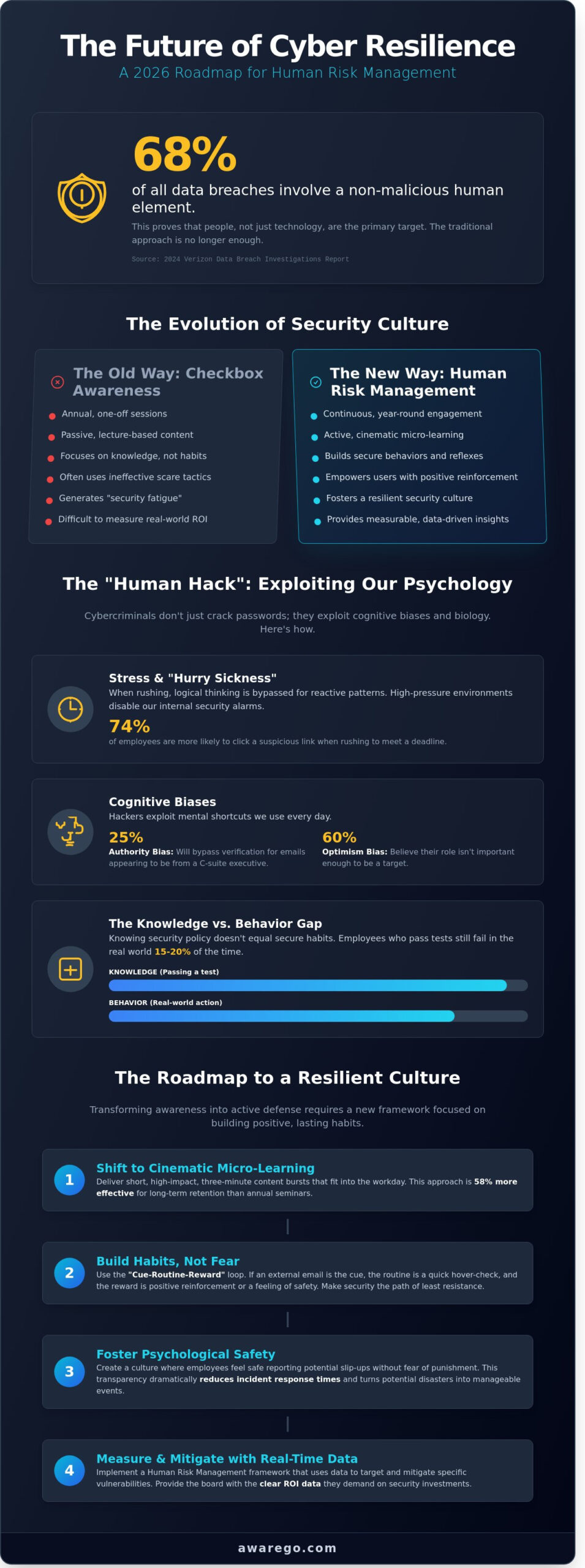
The 2024 Verizon Data Breach Investigations Report reveals that 68% of security incidents still involve a non-malicious human element. You’ve likely felt the frustration of running annual training sessions only to see the same risky behaviors repeat themselves. It’s difficult to foster genuine engagement when security feels like a technical hurdle rather than a shared responsibility. You deserve a way to prove that your cyber awareness initiatives are doing more than just satisfying a compliance auditor.
We’re going to show you how to evolve from passive education to active Human Risk Management (HRM). You’ll learn to build a measurable, behavioral-driven security culture that integrates seamlessly into the workday without causing fatigue. This article previews the future of resilience in 2026, offering a clear roadmap to reduce human risk while finally providing the ROI data your board demands.
Key Takeaways
- Move beyond the “checkbox” approach and discover how modern cyber awareness integrates knowledge and behavior to create a resilient defense.
- Uncover the behavioral science behind the “Human Hack” to understand how cognitive biases and stress drive security lapses.
- Transition from annual compliance to a year-round security culture that empowers your team to own their digital safety.
- Learn how to implement a Human Risk Management framework that uses real-time data to target and mitigate specific vulnerabilities.
- Discover the power of cinematic micro-learning to turn passive training into high-impact habits that protect your entire enterprise.
What is Cyber Awareness in the Modern Enterprise?
In 2026, cyber awareness isn’t a slide deck you click through once a year to satisfy an auditor. It’s the vital intersection of knowledge, attitude, and behavior. We define it as a state of constant readiness where every person in your organization understands their role in the digital defense line. The traditional checkbox approach to training has officially failed. It failed because static content can’t keep pace with generative AI threats that create perfect, typo-free phishing lures in seconds. You can’t fight real-time threats with last year’s information.
Modern enterprises are moving toward Human Risk Management (HRM). This shift treats security as a behavioral science rather than a technical hurdle. You aren’t just teaching people to spot a bad link; you’re building a culture where security is a shared reflex. AI-driven threats have changed the baseline. Hackers now use deepfake audio and personalized social engineering that bypasses traditional technical filters. This means your employees need more than just cyber awareness; they need the confidence to question everything that feels slightly off.
The Evolution of the Human Element
Security has moved beyond the simple “don’t click” mantra. It’s now about understanding the psychological manipulation behind social engineering. Hackers use urgency and authority to bypass logic. The 2024 Verizon Data Breach Investigations Report found that 68% of breaches involved a human element, proving that people remain the primary target. You need to foster psychological safety within your teams. When an employee feels safe reporting a potential slip-up without fear of punishment, incident response times drop. This transparency turns a potential disaster into a manageable event.
Knowledge vs. Behavior: The Critical Gap
There is a massive difference between knowing a policy and practicing a habit. Industry data shows that employees who pass traditional security tests still fail real-world phishing simulations 15% to 20% of the time. Knowing the answer on a multiple-choice quiz doesn’t translate to a split-second decision under pressure. This is where micro-learning changes the game. By delivering bite-sized, engaging content frequently, you bridge the gap between theory and action. You create habits that stick, transforming cyber awareness from a passive concept into a resilient, active defense that protects your organization every day.
The Behavioral Science Behind Human Cyber Risk
Cybercriminals don’t just target your firewall; they target your biology. This is the “human hack.” Social engineering works because it exploits the shortcuts your brain takes to process information. Instead of trying to crack a 256-bit encryption, attackers use cognitive biases to trick you into opening the door yourself. It’s a psychological game where the prize is your network access.
Stress plays a massive role in these lapses. When you’re overwhelmed by “hurry sickness,” your brain switches from logical thinking to fast, reactive patterns. A 2024 study on workplace behavior found that 74% of employees are more likely to click a suspicious link when they’re rushing to meet a deadline. High-pressure environments effectively disable your internal alarm system. Traditional cyber awareness often fails here because it relies on logic, but stress isn’t logical.
Scare tactics are equally ineffective. When security training uses fear-based messaging, it triggers a cortisol spike. This often leads to “security fatigue” or a freeze response where employees simply stop engaging with security protocols to avoid the anxiety they cause. Building a resilient security culture requires a shift toward positive reinforcement. Empowered employees who feel like capable guardians are significantly more effective than those who are simply afraid of making a mistake.
Cognitive Biases and Security
Authority bias is a primary driver in Business Email Compromise (BEC). When an email looks like it’s from a C-suite executive, 25% of employees will bypass standard verification steps to show they’re responsive. This is often paired with optimism bias, where 60% of staff believe their specific role isn’t important enough to be a target. Finally, decision fatigue from constant MFA prompts leads to “push fatigue,” where users approve login requests just to make the notifications stop.
Habit Formation in Digital Safety
To change behavior, you have to change habits using the “cue-routine-reward” loop. If the cue is receiving an external email, the routine should be a quick hover-check of the sender address, followed by the reward of a “safe sender” badge or positive feedback. Security must become the path of least resistance. If a secure process takes three extra steps, people will find a workaround. This is why cyber awareness in 2026 relies on micro-learning. Short, three-minute bursts of content are 58% more effective at long-term retention than annual seminars because they fit into the natural flow of your workday without causing cognitive overload.
Beyond Compliance: Building a Year-Round Security Culture
Cybersecurity Awareness Month shouldn’t be your finish line. It’s a launchpad. Many organizations treat October like a box to check, but by 2026, 75% of global enterprises will have shifted toward a human risk management model that operates 365 days a year. Static compliance training often fails because it focuses on information instead of transformation. You need to move beyond “knowing” what a threat is and start building the habits that stop them.
Real cyber awareness isn’t a technical hurdle. It’s a shared human responsibility. When you treat security as a continuous conversation, you reduce the anxiety surrounding digital threats and replace it with confidence. This shift turns your workforce from a perceived weakness into your strongest defensive layer. It’s about moving from passive knowledge to active resilience.
The Components of a Resilient Culture
A healthy cybersecurity culture begins with leadership buy-in. It’s not just an IT problem; it’s a core business value. Data from 2024 suggests that companies where executives actively participate in training see a 40% reduction in high-risk behaviors. You must also foster open communication. A “no-blame” reporting policy is essential. When an employee feels safe reporting a mistake, they provide your security team with the early warning needed to prevent a full-scale breach. Every person in the office becomes a security champion.
Continuous Engagement Strategies
Modern engagement requires a snackable approach to learning. You can’t expect employees to remember a 60-minute video from six months ago. Instead, use phishing simulations as supportive teaching moments rather than traps. If someone clicks, provide immediate, empathetic feedback that explains the “why” behind the risk. This builds trust instead of resentment.
- Gamification: Professional audiences respond well to healthy competition. Implementing leaderboards can increase training completion rates by 60% compared to traditional methods.
- Role-Based Content: A developer faces different risks than a finance manager. Tailoring your cyber awareness content ensures it’s relevant to their specific daily tasks.
- Micro-learning: Short, punchy videos that take under three minutes are more effective for long-term retention than long-form seminars.
By integrating these strategies, you create a dynamic environment where security is just part of how you do business. This is the difference between simple compliance and true behavioral resilience. You’re not just checking a box; you’re protecting your people and your future.
Implementing a Human Risk Management Framework
Moving from passive cyber awareness to active resilience requires a structured, four step approach. You need to treat human behavior with the same analytical rigor as your technical firewall. This shift ensures that your security culture stays ahead of evolving threats like AI-driven social engineering. By focusing on habits rather than just knowledge, you turn your workforce into a proactive defense layer.
- Step 1: Assess. Use real time data to identify where your team is most vulnerable. This isn’t about guessing; it’s about seeing who struggles with password hygiene or sensitive data handling.
- Step 2: Deploy. Send targeted, bite sized training to the people who need it most. You should avoid the “one size fits all” annual seminar that employees often forget within a week.
- Step 3: Measure. Track how often employees report suspicious emails rather than just how many finished a video. Behavior is the only metric that truly reflects your risk posture.
- Step 4: Optimize. Use high quality human risk management software to automate these cycles and keep your defenses sharp.
Quantifying Human Risk
You can’t manage what you don’t measure. The 2023 Verizon Data Breach Investigations Report found that 74% of all breaches involved a human element. To lower this number, you must track the Mean Time to Report (MTTR). This metric tells you how quickly your team spots and flags a threat. Conducting a regular Employee Cybersecurity Risk Audit allows you to benchmark your progress against industry peers. Organizations that use behavioral assessments often see a 40% reduction in high risk behaviors within the first six months of implementation.
Remediation and Adaptive Training
Effective training feels like a helpful conversation, not a lecture. By automating training triggers, you can deliver “Just-in-Time” learning the moment a risky action occurs. If an employee clicks a simulated phishing link, they receive a 60 second lesson immediately. This creates a powerful learning moment while the context is still fresh in their mind. You should personalize the journey for every role. A developer dealing with API keys needs different cyber awareness insights than a sales representative handling customer PII. This tailored approach turns every employee into a confident guardian of your digital assets.
Ready to see how your team measures up? Start your human risk assessment today and build a more resilient workforce.
Transforming Awareness into Resilience with AwareGO
Traditional training often fails because it treats people like checkboxes. AwareGO flips the script. We focus on Human Risk Management (HRM) to turn your workforce into a proactive defense layer. By 2026, the standard for cyber awareness isn’t just knowing what a phishing link looks like. It’s about building reflexive habits that stop threats before they escalate. We help you move from passive knowledge to active resilience.
Our micro-learning approach delivers cinematic, 60 to 90 second videos that feel like high end entertainment rather than a dry lecture. These stories resonate because they mirror real life workplace dynamics. When content is this engaging, retention rates climb. You don’t need to pull your team away for an hour. You only need two minutes of their focus to drive lasting behavioral change. This snackable format fits perfectly into the modern professional’s workflow.
The AwareGO Methodology
We build every piece of content on proven behavioral science principles. This ensures your team doesn’t just watch; they learn and adapt. You can deploy these lessons through our cloud platform or integrate them into your existing LMS using our SCORM content library. This flexibility allows you to maintain a consistent security culture across global offices without technical friction. Our platform provides the data you need to make informed decisions.
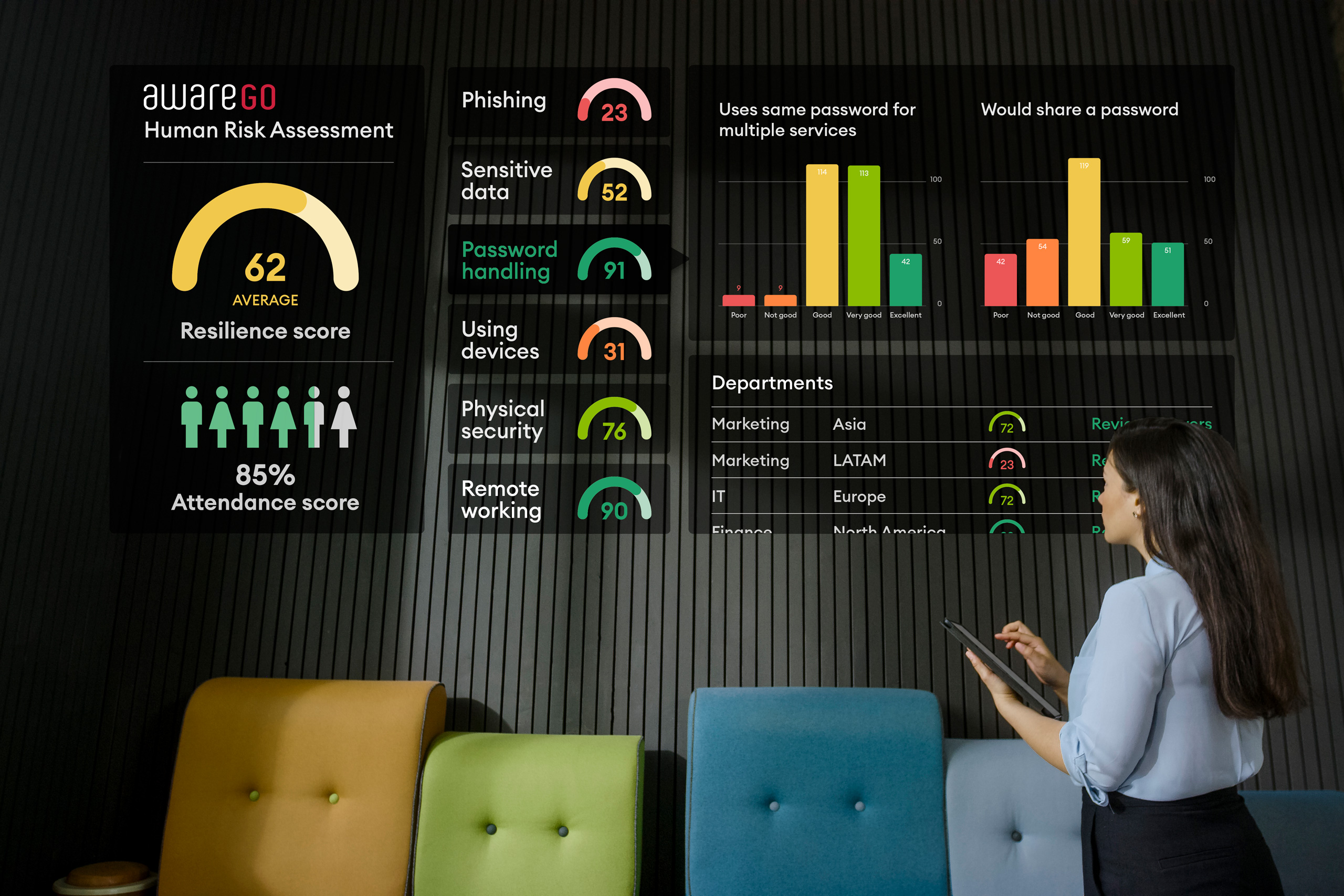
- Real-time Risk Dashboards: CISOs gain visibility into specific vulnerabilities, moving beyond simple completion rates to actual risk scores.
- Data-Driven Insights: Connect your security stack with HRM data to identify which departments or roles need extra support.
- Behavioral ROI: Track how training correlates with a reduction in actual security incidents over time.
Next Steps for Your Organization
Building resilience starts with a clear picture of your current environment. Don’t guess where your weaknesses are. A human risk assessment provides a baseline of your organization’s actual security posture. In 2025, organizations that implemented targeted behavioral pilots reported a 40% decrease in simulated phishing click rates within the first 90 days. This measurable improvement proves that a human centric approach works.
Start your journey by booking a comprehensive assessment or launching a pilot program to see the impact firsthand. You’ll see immediate results through measurable habit shifts and increased employee confidence. Join a growing community of forward thinking leaders who prioritize people in their security strategy. It’s time to move past basic cyber awareness and embrace a future where every employee is a resilient asset to your digital defense.
Securing the Future Through Human Resilience
The digital landscape of 2026 demands more than check-the-box compliance. It requires a shift toward Human Risk Management that treats your team as a strategic asset rather than a vulnerability. By applying behavioral science and fostering a year-round security culture, you replace workplace anxiety with actionable confidence. True cyber awareness today means moving past passive knowledge into the realm of measurable, daily habit change. You can’t rely on annual seminars when threats evolve by the hour.
Global enterprises currently trust AwareGO to secure millions of employees across every continent. Our platform delivers cinematic micro-learning content that consistently achieves engagement rates above 90%, far surpassing the industry average for traditional training. This data-driven approach allows you to identify specific risk areas and address them with surgical precision. You aren’t just fulfilling a mandate; you’re building a sustainable defense that scales with your business. It’s time to move beyond the fear of the next breach and focus on the strength of your people.
Discover how AwareGO transforms human risk into human resilience.
You have the power to create a workplace where security feels natural and every employee stays vigilant. We’re here to help you turn that vision into a reality.
Frequently Asked Questions
What is the difference between security awareness and human risk management?
Security awareness focuses on what your employees know, while human risk management (HRM) focuses on how they actually behave. HRM uses behavioral data to identify specific risks and intervene before a breach happens. Gartner predicted that 40% of large enterprises would adopt HRM by 2025 to move beyond simple training. This approach shifts your strategy from a passive check-the-box exercise to a proactive security culture.
How often should employees receive cyber awareness training?
You should deliver cyber awareness training at least once a month through short, manageable micro-learning modules. The Ebbinghaus Forgetting Curve demonstrates that humans forget 70% of new information within 24 hours if it isn’t reinforced. Monthly touchpoints keep security habits fresh without causing digital fatigue. This regular cadence ensures that your team stays prepared for evolving threats without interrupting their daily workflow.
Does phishing simulation actually reduce the risk of real attacks?
Phishing simulations reduce the likelihood of a successful breach by training the brain to recognize subtle red flags in a safe environment. Data shows that consistent simulation can drop an organization’s click rate from 30% to less than 5% within 12 months. These exercises turn a potential point of failure into a strong line of defense. They empower your team to report suspicious activity rather than falling victim to it.
Why is micro-learning more effective than traditional long-form training?
Micro-learning works because it aligns with the human brain’s natural processing limits and shorter attention spans. Traditional 60 minute sessions often lead to cognitive overload and very low retention rates. A 2024 study found that bite-sized content improves knowledge retention by 17% compared to long-form training. It allows your employees to master a single, actionable concept in three minutes or less during their normal workday.
How can we measure the ROI of a cyber awareness program?
You measure ROI by comparing the cost of your program against the potential savings from avoided incidents and reduced IT workload. IBM’s 2023 report states the average data breach costs $4.45 million. If your training prevents just one incident, the program pays for itself immediately. You can also track the 50% reduction in IT help desk time spent on manual email triage and password resets.
What are the most common social engineering attacks in 2026?
In 2026, the most frequent threats involve AI-driven deepfake audio and sophisticated QR code phishing, also known as quishing. Attackers now use generative AI to clone executive voices with 95% accuracy to authorize fraudulent wire transfers. We also see a massive rise in malicious codes embedded in physical mail or digital documents. These tactics exploit human trust and the seamless nature of modern workplace technology.
Can cyber awareness training help with regulatory compliance (GDPR, SOC2)?
Continuous cyber awareness training is a core requirement for maintaining GDPR, SOC2, and ISO 27001 certifications. GDPR Article 32 specifically mandates that organizations implement regular testing and evaluation of their security measures. By documenting your training completion rates and simulation results, you provide auditors with concrete evidence of your commitment to data protection. It transforms compliance from a hurdle into a clear competitive advantage.
What should I do if an employee fails a phishing test multiple times?
You should treat repeat failures as an opportunity for empathetic, targeted coaching rather than punishment. A 2025 behavioral study found that fear-based discipline actually increases the likelihood of future errors and hidden risks. Instead, provide the employee with a tailored learning path that focuses on their specific struggle. This supportive approach builds confidence and strengthens your overall security culture without creating resentment in the workplace.