 Cybersecurity blog



Your annual security awareness training is making you less secure. It’s a bold claim, but the data supports it. You invest in programs, employees click through hours of content, and yet a 2023 Cofense report reveals 1 in 10 people will still click a malicious link. The old model isn’t working.
You’re not alone in this frustration. It’s a familiar cycle of compliance-driven training that creates fatigue, not genuine resilience. This guide will break that cycle for good. We’ll provide the strategic framework for how to build a human firewall that transforms your people from your biggest risk into your strongest asset. You’ll learn to use behavioral science to foster a positive security culture where employees feel empowered, not blamed.
Get ready to explore a modern approach to Human Risk Management that delivers what you really need: a resilient workforce and data-backed reports showing a measurable reduction in human risk.
Key Takeaways
- Move beyond compliance-based training and build a resilient security culture where your employees actively defend against threats.
- Discover why traditional, long-form training creates fatigue and how continuous micro-learning builds lasting security habits.
- Learn the strategic framework for how to build a human firewall, starting with a human risk assessment to find your baseline.
- Turn your team from a potential liability into a strategic asset by empowering them with the confidence to spot and report threats.
What is a Human Firewall? Redefining the Last Line of Defense
Your security stack is powerful. Your technical firewalls are state-of-the-art. So why do you still feel vulnerable? Because your biggest asset is also your most targeted attack surface: your people.
For years, a human firewall was seen as a simple concept. It was an organizational layer where employees were trained to spot and stop cyber threats. But this definition is failing modern businesses. It implies a passive wall waiting for an attack. It’s time for an upgrade.
A human firewall is a proactive, habit-based defense layer built from your employees’ collective security instincts. It’s not about compliance checklists. It’s about building resilience. It’s about transforming your team from a potential liability into your most active and intelligent defense network.
Why Technical Firewalls Aren’t Enough in 2026
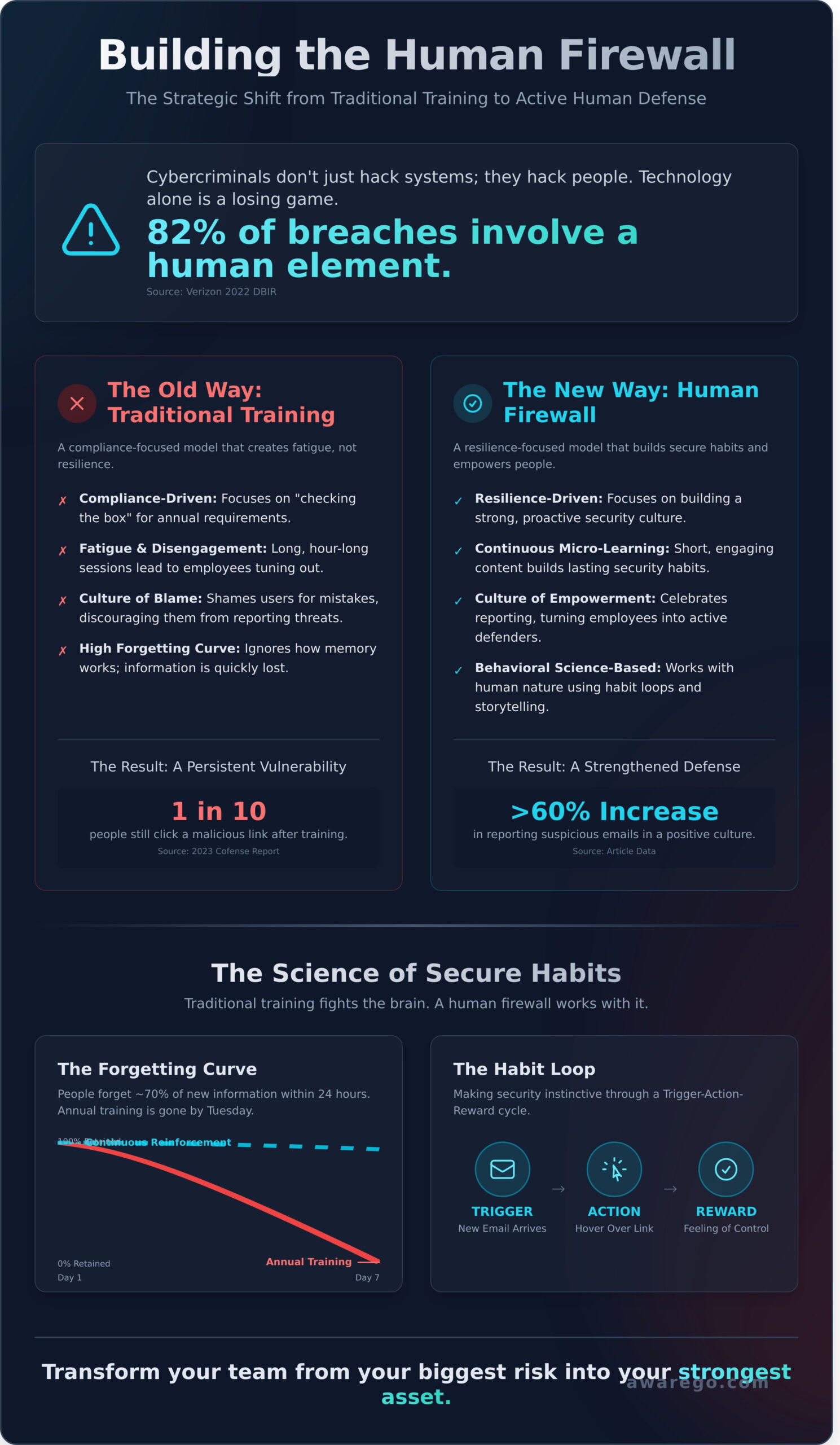
Technology alone is a losing game. Cybercriminals know this. They don’t hack systems; they hack people. Social engineering attacks, from a simple pretexting phone call to a sophisticated phishing email, walk right past your digital defenses because they exploit human trust. With the rise of AI-driven spear phishing and deepfake voice cloning, these attacks are becoming indistinguishable from reality, a challenge that technology firms like IntellifyAi are tackling with intelligent automation. The data doesn’t lie: Verizon’s 2022 DBIR found that 82% of breaches involved a human element.
This reality demands a new strategy. Instead of just building higher technical walls, you need to secure every layer, starting with your digital front door. A professionally developed website from a creative agency like Insight Multimedia is a critical first defense. The next layer is to equip the people inside your organization. This is where the human firewall integrates into a modern Zero Trust architecture. In a model that demands you “never trust, always verify,” your employees become a critical verification point. They are the distributed sensors who can spot the anomalies that algorithms miss. This requires moving beyond traditional Security Awareness programs, which often focus on annual, check-the-box training. The goal now is to embed secure habits into daily workflows, creating a culture of vigilance.
The Psychology of Defense: Empowerment vs. Blame
Spend five minutes on any IT forum and you’ll see the “Reddit Critique” in action. A culture of blame, where users are shamed for clicking a link, destroys security from the inside out. It discourages reporting, fosters resentment, and makes people hide their mistakes. The old mindset of “users are the problem” is not only wrong; it’s dangerous.
The modern approach flips the script: your employees are the solution. When you create a positive security culture—where reporting a suspected phish is celebrated, not punished—you empower your team. Organizations that adopt this mindset see reporting rates for suspicious emails increase by over 60%. They build a feedback loop where your security team gains real-time threat intelligence directly from the front lines. This cultural shift is the foundation for understanding how to build a human firewall that actually works.
The Behavioral Science Behind a Strong Human Firewall
Your technical defenses are powerful, but they don’t think, feel, or get stressed. Your people do. That’s why understanding how people make decisions is the most critical step in human risk management. The secret to how to build a human firewall isn’t about forcing compliance; it’s about shaping secure instincts. It’s about working with human nature, not against it.
Traditional security training often fails because it ignores basic cognitive principles. Hour-long videos and dense manuals lead to “training fatigue,” where employees tune out completely. Worse, this approach clashes with a well-documented psychological phenomenon: the Ebbinghaus forgetting curve. Research shows people forget roughly 70% of new information within 24 hours. That annual training session? It’s mostly forgotten by Tuesday.
Cognitive Load and Security Decisions
When your brain is overloaded, it defaults to what’s easy. This “fast thinking” is a survival instinct, but it’s a huge security liability. A stressed employee rushing to clear their inbox isn’t analyzing email headers; they’re clicking. According to Verizon’s 2023 Data Breach Investigations Report, 74% of all breaches involve the human element. Designing training that works with the brain’s limits means replacing information dumps with storytelling that creates emotional resonance. A relatable story about a CEO scam is remembered long after a list of security policies is forgotten.
Habit Formation: Making Security Instinctive
You can’t rely on conscious effort alone. You need to build subconscious security habits. This is where the habit loop-Trigger, Action, Reward-comes in. A new email (Trigger) should automatically prompt the user to hover over the link (Action), which provides a feeling of control and safety (Reward). This positive reinforcement is key. It’s why effective phishing simulations provide immediate feedback. An instant “You spotted it!” message is a powerful reward that solidifies the correct behavior, transitioning employees from simply knowing what to do to actually doing it, every time.
This habit-forming approach is central to how to build a human firewall that works. It relies on frequent, positive reinforcement delivered through snackable content. Instead of a yearly lecture, think of short, two-minute videos and real-time “nudges” that guide better decisions in the moment. This methodology, core to any modern NIST security awareness and training program, respects employee time and bypasses the forgetting curve. It makes security a continuous, low-friction part of the daily workflow. This is why engaging, scenario-based micro-learning proves so effective; it speaks the brain’s language, turning awareness into automatic, resilient behavior.
Human Firewall vs. Traditional Security Awareness Training
For years, security awareness training (SAT) was a simple checkbox. You ran an annual course, your employees passed a quiz, and you reported 100% completion. But this compliance-first model doesn’t build a real defense. A human firewall is not a one-time project; it’s a strategic asset built on continuous learning and measurable behavioral change. The difference is fundamental.
Traditional SAT relies on long-form, annual training sessions. This approach ignores a basic principle of human memory: the Ebbinghaus forgetting curve. Studies show people forget up to 90% of what they learn within a month without reinforcement. Your team isn’t wired to retain an hour of security policy they only hear once a year. A human firewall, however, is built with continuous micro-learning. Short, engaging, and frequent content keeps security top-of-mind and builds lasting habits.
This same evolution applies to phishing simulations. The old way was a punitive “gotcha” test designed to catch employees making mistakes. This breeds fear and resentment, not resilience. The modern approach transforms simulations into powerful learning opportunities. When an employee clicks, they receive immediate, context-specific micro-training. This positive reinforcement is effective. A 2022 report from Cofense found that 74% of employees who receive this kind of instant training are less likely to click a real malicious link in the future.
The Limitations of Compliance-Based Training
Passing a quiz is not a shield. The gap between knowing the right answer and doing the right thing under pressure is massive. In fact, a 2023 Stanford University study found zero correlation between an employee’s security knowledge score and their real-world susceptibility to phishing. Legacy training programs don’t just fail to close this gap; they often widen it by boring users into disengagement, creating a false sense of security for everyone.
Human Risk Management (HRM): The Modern Standard
This is where Human Risk Management (HRM) changes the game. HRM is the data-driven evolution of security awareness, shifting the focus from completion rates to quantifiable risk reduction. It uses behavioral data to identify high-risk groups and tailor interventions where they’re needed most. Instead of a blanket approach, you get targeted, effective training. It’s the core of a modern security strategy, a true Human Risk Management Pillar.
Ultimately, understanding how to build a human firewall requires a new set of metrics. You stop asking, “Did everyone complete the training?” and start asking, “Have we reduced our click-rate on phishing simulations by 45% this quarter?” It’s a move from qualitative, feel-good numbers to the hard, quantitative data of human risk. This strategic shift is what separates a compliant workforce from a resilient one.
The 5-Step Framework to Build Your Human Firewall
Building a human firewall isn’t a one-time project; it’s a continuous cycle of assessment, training, and reinforcement. It’s about creating secure habits, not just checking a compliance box. This proven 5-step framework moves your organization from passive awareness to active human risk management. This is your blueprint for how to build a human firewall that is both resilient and engaged.
Step 1: Assess Your Baseline. You can’t protect against risks you don’t understand. Before you train, you need a clear picture of your current security posture. This initial discovery phase sets the foundation for your entire program.
Assessing Your Current Security Posture
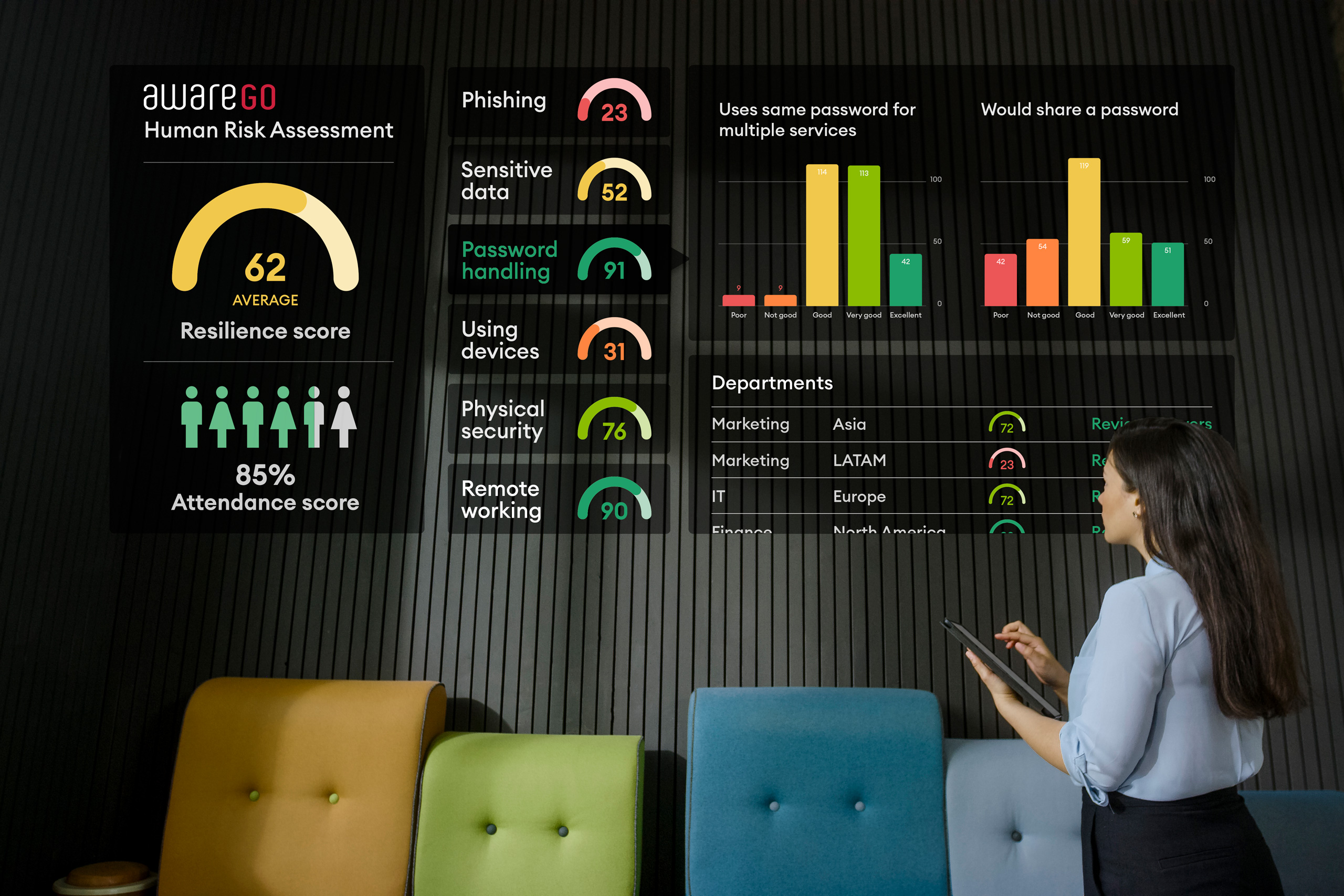
Start with a comprehensive Employee Cybersecurity Risk Audit to quantify your specific vulnerabilities. This data-driven approach identifies “Human Risk Hotspots”-departments or roles, like finance or executive leadership, that are disproportionately targeted by cybercriminals. Instead of generic goals, you can set realistic KPIs, such as “reduce credential compromise risk by 30% in Q3” or “increase phishing reporting rates by 50% within six months.”
Step 2: Deploy Targeted Micro-Learning. The era of hour-long, generic security seminars is over. Your people are busy. Effective training respects their time and targets their specific risk profiles identified in Step 1. If your finance team shows a high risk for invoice fraud, they receive content focused on that exact threat.
Creating Engaging Security Content
Engagement drives retention. The power of high-quality, two-minute Security Awareness Videos lies in their ability to deliver critical knowledge quickly. Scenario-based learning makes abstract threats feel tangible, showing employees the real-world consequences of clicking a malicious link. For global organizations, ensure your content is accessible with localized subtitles and culturally relevant examples to build an inclusive security culture.
Step 3: Simulate Real-World Threats. Knowledge is one thing; behavior is another. Implement high-frequency, low-stress phishing simulations to build practical skills. These aren’t “gotcha” tests. They are safe opportunities to practice identifying and reporting threats, building the muscle memory needed to react correctly when a real attack, which over 75% of organizations faced in 2023, hits their inbox.
Step 4: Gamify the Experience. A positive security culture thrives on reinforcement, not fear. Use gamification elements like leaderboards, badges, and team-based challenges to make security training engaging and collaborative. Celebrate employees who consistently report suspicious emails. This transforms security from a chore into a shared responsibility where everyone is motivated to protect the team.
Step 5: Measure, Benchmark, and Iterate. Your human firewall is a dynamic defense that requires constant tuning. Use behavioral data to track progress, identify areas for improvement, and demonstrate the program’s value to leadership.
Measuring Success and ROI
Move beyond vanity metrics like click rates. Instead, track meaningful data like reporting rates and “mean time to report.” These metrics show your team is actively participating in your defense. Using tools for Benchmarking Human Risks allows you to show the board exactly how you stack up against your industry peers. Considering the average data breach cost $4.45 million in 2023, preventing just one ransomware attack delivers an ROI that speaks for itself.
Ready to see your organization’s human risk baseline? Get your free Human Risk Assessment now.
Scaling Your Firewall with AwareGO’s HRM Platform
You’ve learned the principles, the psychology, and the practical steps. But the real challenge is implementation at scale. Manually managing continuous training, tracking behavioral changes, and measuring risk reduction across an entire enterprise is nearly impossible. This is where technology becomes your most powerful ally in turning theory into a resilient reality.
AwareGO’s Human Risk Management (HRM) platform automates the entire habit-building process. We replace outdated, hour-long annual training with a continuous stream of engaging, two-minute micro-learning modules. Our cloud-based system uses data to identify specific human risks within your organization, from individual employees to entire departments, and then delivers targeted training to address those vulnerabilities directly. This isn’t just about awareness; it’s a data-driven strategy to measurably reduce human risk in real time.
Your security tools shouldn’t create more work. That’s why our platform integrates seamlessly with your existing tech stack. You can deploy our award-winning content through any SCORM-compliant Learning Management System (LMS) or use our powerful API to connect with your HR and business intelligence platforms. This creates a single, unified view of your human risk posture, making it simple to:
- Identify your most vulnerable employees and departments.
- Track behavioral improvements with clear, actionable metrics.
- Demonstrate a tangible return on investment to leadership.
Ultimately, this approach transforms security from an IT headache into a shared organizational value. When employees feel empowered instead of policed, they become active participants in the company’s defense. You’re not just checking a compliance box. You’re building a genuine security culture that strengthens your entire organization from the inside out.
Why Global Enterprises Choose AwareGO
We believe people are the solution, not the problem. Our human-centric, empathetic approach removes fear from the equation and replaces it with confidence. That’s why Fortune 500 companies trust our platform to reduce human-related security incidents, with clients reporting up to a 60% decrease in successful phishing attempts. We’re the cool expert in the room, making security training so engaging that your employees will actually look forward to it.
Ready to Strengthen Your Human Firewall?
The journey of how to build a human firewall is a strategic shift from passive awareness to active risk management. It’s about equipping your team with the knowledge and habits to become your strongest line of defense. Don’t just tell them what to do. Give them the tools to do it effectively, every single day. Empower your team to protect your organization and its most valuable assets.
Start your journey with AwareGO’s Human Risk Management platform today.
Your Strongest Defense Is Human
Cybersecurity isn’t just about technology; it’s about people. You now know that a human firewall is more than a passive defense. It’s an active, resilient part of your security culture, built on the principles of behavioral science, not fear. The path forward isn’t about more training, it’s about the right kind of engagement. This guide gives you the framework for how to build a human firewall that transforms your employees from a potential risk into your greatest security asset.
Ready to put that framework into action? AwareGO has focused on behavioral science in security since our founding in 2008. We help global enterprises manage human risk at scale with our award-winning micro-learning content library. Don’t guess where your vulnerabilities are. Measure them with precision.
Take the first step toward a stronger, more aware organization. Build your human firewall with AwareGO’s free Human Risk Assessment and start turning human risk into human resilience. Your team is ready.
Frequently Asked Questions
Is the term “human firewall” still relevant in 2026?
Yes, the concept of a human firewall is more relevant than ever. Cybercriminals increasingly target people, not just systems. The 2023 Verizon DBIR report showed that 74% of all breaches involved the human element. As technology evolves, so do the social engineering tactics aimed at your team. A strong human firewall, built on a foundation of positive security habits, remains your most dynamic defense against these constantly changing threats.
How long does it take to build a functioning human firewall?
You can see measurable improvements in security behaviors within the first 90 days. For example, organizations using continuous, bite-sized training see an average 50% reduction in clicks on phishing simulations in the first six months. Building a lasting security culture is an ongoing process, not a one-time project. The key to knowing how to build a human firewall effectively is consistent reinforcement that embeds secure habits into your team’s daily workflow.
Can a human firewall really stop zero-day attacks?
A human firewall cannot directly stop a zero-day exploit, but it can absolutely stop the delivery method. According to a 2022 Cofense report, over 90% of malware, including many zero-day threats, is delivered via email. Your team can be trained to spot and report the suspicious emails or links that carry these unknown threats. This prevents the attack from ever reaching its target, neutralizing it before your technical defenses are even tested.
What is the difference between a human firewall and security awareness?
Security awareness is knowing the risks, while a human firewall is acting on that knowledge to prevent them. Awareness is the “what”; the human firewall is the “do.” It represents the critical shift from passive knowledge to active, secure habits. This is the core of Human Risk Management (HRM). It’s about transforming your team from a potential vulnerability into your most powerful and proactive security asset.
How do you measure the strength of a human firewall?
You measure a human firewall’s strength through key behavioral metrics, not just quiz scores. Track data points like phishing simulation click-through rates, incident reporting times, and the adoption of security tools. A strong firewall might show a click rate below 5% and an 80% increase in employees proactively reporting suspicious emails. This data gives you a clear, actionable view of your human risk posture and shows where to focus your training.
What happens if an employee “breaks” the human firewall?
A “break” is a learning opportunity, not a reason for blame. The immediate response is to follow your incident response plan to contain any potential threat. Afterward, the focus shifts to understanding why it happened without assigning fault. Use the data to provide targeted, supportive micro-training to reinforce the correct behavior. This approach builds resilience and strengthens your collective defense instead of creating a culture of fear.
How often should employees receive training to maintain the firewall?
Effective training is frequent, short, and continuous, not a once-a-year event. Research shows we forget nearly 70% of new information within 24 hours. To combat this, we recommend monthly or even weekly micro-learning sessions lasting just one to two minutes. This approach keeps security top-of-mind and builds lasting habits, making your human firewall stronger over time without causing training fatigue.
Is a human firewall necessary if we have strong AI-driven technical controls?
Yes, a human firewall is essential, even with advanced AI security. Gartner predicts that by 2025, cybercriminals will use generative AI to create sophisticated social engineering attacks that are designed to evade detection. Your AI tools are a critical layer, but they can’t stop an employee from being manipulated into willingly handing over credentials. Understanding how to build a human firewall creates the final, most adaptable line of defense against these advanced, human-focused threats.