 Cybersecurity blog



What if your phishing simulations were something your employees actually thanked you for? Most traditional tests feel like digital traps, creating a “gotcha” culture that breeds resentment and anxiety. You’ve likely felt the friction when high click rates lead to leadership pressure or HR concerns about morale. Learning how to run a phishing test shouldn’t be about trickery. It’s about human risk management and building a resilient security culture where everyone feels empowered to speak up. We’re moving away from fear and toward a partnership between IT and the rest of the team.
We agree that your people are your greatest asset, not your weakest link. This guide promises to teach you how to design and launch tests that strengthen trust while providing the data you need to justify your security spend. We’ll show you how to improve incident reporting rates by 40% using our proven 2023 framework. You’ll get a clear roadmap for your first test, from choosing realistic templates to analyzing behavioral results. Let’s transform your simulations into a seamless part of a modern, human-centric security strategy.
Key Takeaways
- Shift your strategy from setting traps to building resilience by focusing on human behavior rather than punishment.
- Master how to run a phishing test using a proven five-step framework designed to strengthen your security culture in 2026.
- Leverage AI-driven patterns and behavioral psychology to move beyond basic templates and simulate modern, sophisticated threats.
- Identify the “Golden Metric” of reporting rates to transform your simulation data into a proactive Human Risk Management strategy.
- Learn how to use seamless micro-learning to instantly turn a clicked link into a positive, habit-forming teaching moment.
Why Run a Phishing Test? Shifting from Traps to Resilience
Phishing isn’t a technical bug. It’s a human challenge. A phishing test is a controlled, benign simulation of a real cyberattack designed to see how your team reacts to pressure. You aren’t trying to “catch” employees in a trap or punish them for clicking a link. Instead, you’re identifying vulnerabilities in human behavior before a real threat actor finds them first. Understanding how to run a phishing test effectively means shifting your focus from fear to resilience.
The threat landscape is changing fast. By 2026, AI-driven spear phishing will likely make traditional, poorly written scam emails a thing of the past. Threat actors already use large language models to create perfectly phrased, hyper-personalized messages. Simulated phishing allows your staff to practice their detection skills in a safe environment where a mistake results in a learning moment, not a multi-million dollar data breach.
The Purpose of Phishing Simulations
You can’t manage what you don’t measure. Simulations help you establish a clear baseline for organizational risk. According to the 2024 Verizon Data Breach Investigations Report, 68% of breaches involve a human element. Regular testing helps you identify “phish-prone” tendencies across different groups. This data allows you to:
- Identify which departments, like Finance or HR, need specialized training.
- Provide a safe space for employees to spot “red flags” without real-world consequences.
- Deliver micro-learning content exactly when and where it’s needed most.
Compliance vs. Habit Formation
Many organizations run tests just to check a box for insurance or regulatory requirements. This “compliance-only” approach fails because it doesn’t change behavior. Moving toward Human Risk Management (HRM) means looking at security as a continuous habit rather than a yearly event. You want your team to report suspicious emails instinctively. When you learn how to run a phishing test as part of a broader strategy, you move beyond mere awareness into true cultural change.
Security culture is the collective habits that protect an organization.
Static training is forgettable. Real resilience comes from frequent, snackable interactions that build confidence. By treating your employees as your strongest line of defense, you turn them into active participants in your security strategy. This human-centric approach reduces anxiety and replaces it with actionable knowledge.
5 Steps to Run a Successful Phishing Test in 2026
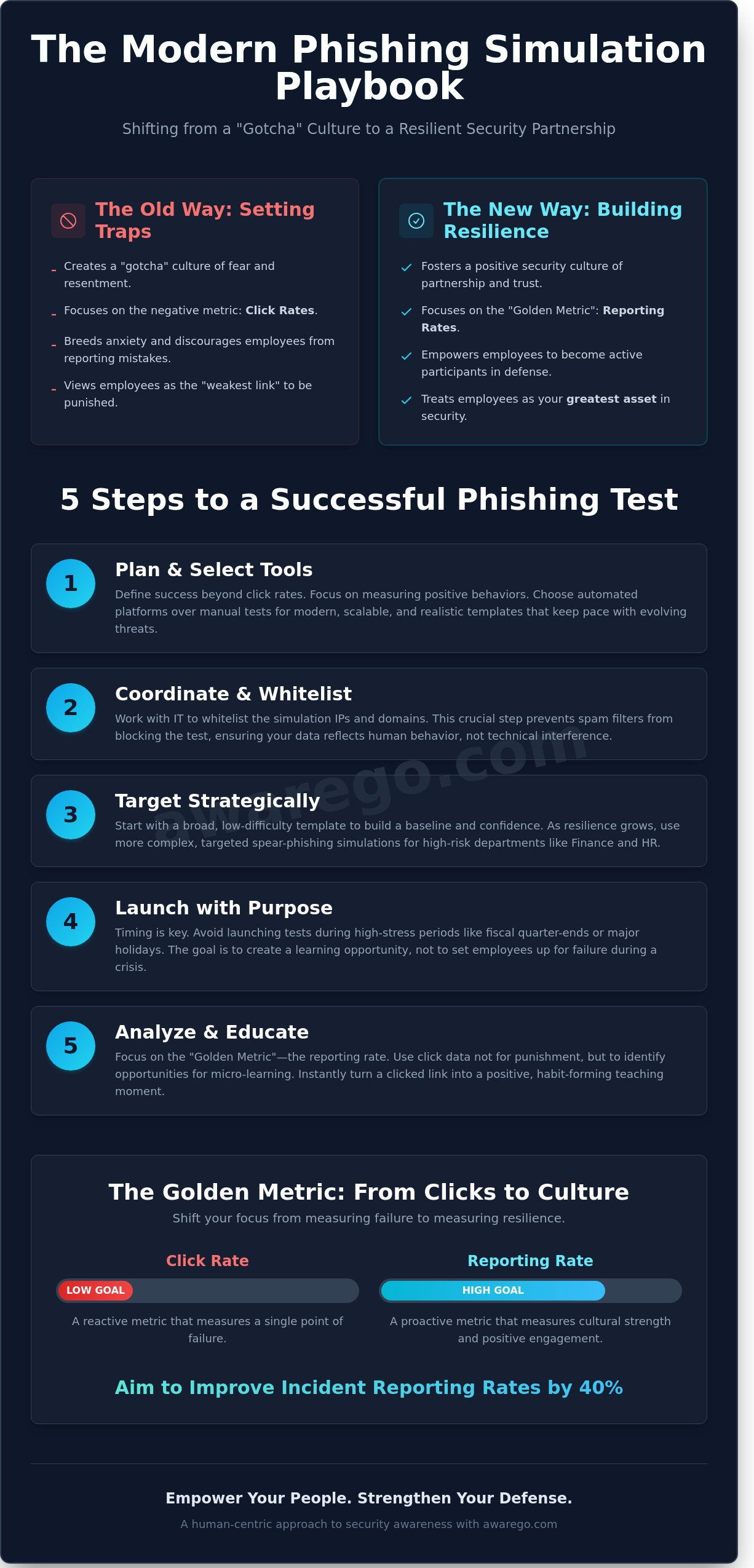
Phishing simulations aren’t about tricking your colleagues. They’re about building a resilient security culture where everyone feels empowered to spot a threat. Understanding how to run a phishing test effectively starts with your data and ends with a more confident workforce. It’s a shift from passive compliance to active Human Risk Management (HRM).
Step 1 & 2: Planning and Tool Selection
You have two main paths: manual internal tests or automated SaaS platforms. Manual tests often drain IT resources and lack the scale needed for modern teams. Automated platforms provide localized, realistic templates that keep pace with 2026’s evolving threats. When you define success, don’t chase a 0% click rate. This goal is unrealistic and often means your tests are too easy to provide any real data. Instead, focus on your report rate and time-to-report metrics.
Coordination is key. Your IT team must whitelist the simulation IPs before you begin. This prevents your spam filters from blocking the test and ensures your data reflects human behavior rather than technical interference. Following established Phishing Simulation Program Guidelines helps you structure these goals around behavioral science rather than just “catching” people. You want to measure habits, not just clicks.
Step 3 & 4: Targeting and Launching
Start your journey with a broad, low-difficulty template. This builds a baseline of confidence across the organization. As your team grows more resilient, you can increase the complexity. For high-value targets in finance or HR, use spear-phishing simulations. These departments handle 90% of sensitive financial data, making them prime targets for sophisticated business email compromise (BEC) attacks.
Timing influences your results. Avoid launching tests during high-stress periods like the end of a fiscal quarter or major holidays. You want employees to engage with the training, not feel like they’re being set up to fail during a crisis. Once you master how to run a phishing test with the right timing, you’ll see a 40% improvement in reporting accuracy within the first six months.
Step 5: Analysis and Constructive Feedback
The “fail” is actually a teachable moment. If an employee clicks a link, provide immediate, empathetic feedback. A short, engaging video or a simple graphic explaining the red flags they missed works best. This approach reduces anxiety and reinforces the idea that security is a shared responsibility. You can track your organization’s security culture by monitoring how quickly users report the simulation. Real-time engagement data allows you to pivot your training strategy and address specific risks before they become actual breaches.
Designing Effective Templates: Beyond the “Nigerian Prince”
Modern attackers don’t rely on misspelled pleas from royalty. They use precision. Understanding how to run a phishing test effectively means moving toward high-fidelity simulations. Attackers exploit three core psychological drivers: urgency, curiosity, and fear. A 2023 report from SlashNext highlighted a 1,265% increase in AI-driven phishing attacks. You should use AI-generated patterns in your templates to mirror this sophistication. This helps your team recognize the subtle linguistic cues and perfect branding that define modern threats.
Effective testing isn’t just about scares. Positive triggers, such as fake HR benefits updates or internal employee satisfaction surveys, are incredibly effective. These scenarios test the “human” in human risk management without creating a culture of constant anxiety. You must balance realism with fairness. If a simulation feels like a “gotcha” moment, you risk losing employee trust. Aim for a supportive partnership where employees feel empowered to spot the bait rather than punished for missing it.
Common Social Engineering Techniques
- Credential harvesting: Simulate fake login pages for Microsoft 365 or Slack. Research shows these account for roughly 45% of all phishing attempts.
- Malicious attachments: Use safe “tracking” files. These documents notify your dashboard when opened but contain no actual malware, allowing you to measure risk safely.
- Link-based attacks: Test if your team hovers over URLs before clicking. This simple habit can prevent the majority of successful credential thefts.
Localized and Scenario-Based Content
Templates must reflect the specific software and language your employees use every day. If your office communicates via Microsoft Teams, a Slack-based simulation will feel irrelevant and out of place. Context is everything. A 2024 study found that localized, department-specific phishing simulations are 3 times more likely to be clicked than generic global campaigns. This is why your templates must be granular and reflect actual workplace dynamics.
Integrate seasonal events to keep your simulation library fresh. Tax-related lures often see a 22% spike in engagement during the first quarter of the year. When an employee clicks a simulated link, offer immediate, bite-sized education. Linking to Security Awareness Videos ensures the lesson sticks without disrupting their entire workday. This approach transforms a potential vulnerability into a measurable increase in your organization’s security culture.
Analyzing the Data: From Clicks to Human Risk Management
Data without context is just noise. When you’re learning how to run a phishing test, the metrics you track will determine whether your program actually improves security or just creates frustration. You aren’t just looking for a “fail” or “pass” grade. You’re looking for behavioral trends that help you build a more resilient culture.
Start by benchmarking your results against 2023 industry standards. For example, the average click rate for organizations without regular training often sits near 30%. Your goal is to see that number drop below 5% over 12 months. When you report these numbers to leadership, focus on risk reduction rather than naming individuals. Presenting data through the lens of Human Risk Management (HRM) shows how you’re protecting the company’s bottom line without creating a culture of fear.
The Reporting Rate: Your Most Important KPI
A high reporting rate is significantly more valuable than a low click rate. While the click rate measures vulnerability, the reporting rate measures your active defense. If 10% of your staff clicks but 60% reports the email, your “human firewall” is working. Encourage employees to use the “Report Phish” button in Outlook or Gmail during every simulation. A reporting culture turns every employee into a sensor, providing your IT team with real-time threat intelligence.
Remediation and Micro-Learning
The best time to teach someone is the moment they make a mistake. This is the “Teachable Moment.” Instead of a stern warning, deliver a 60-second micro-learning video immediately after a click. This immediate feedback loop is empathetic and effective. It treats the error as a learning opportunity rather than a disciplinary issue. To track how these moments translate into long-term growth, you can use Employee Cybersecurity Risk Audits to quantify improvement across different departments.
- Identify Serial Clickers: Look for the 3% to 5% of employees who consistently fail tests. They often need more support, not more punishment.
- Analyze Root Causes: Are people clicking because they’re rushed, or is the phishing template too relevant to their specific job role?
- Structure Follow-ups: Keep training supportive. Use positive reinforcement for those who report successfully to boost morale.
By shifting your focus from catching people to empowering them, you’ll see a 40% higher engagement rate in your security initiatives. Ready to see where your team stands? Start your human risk assessment today.
How AwareGO Simplifies Phishing Simulations
Learning how to run a phishing test shouldn’t feel like you’re setting a trap for your colleagues. Traditional methods often rely on fear or trickery, which can damage internal trust and discourage people from reporting real threats. AwareGO changes this dynamic by using behavioral science to create simulations that mirror actual modern risks. Our approach focuses on building a resilient security culture where every employee feels empowered to act as a defender. We treat security as a shared human responsibility, not just a technical checklist.
The AwareGO Difference: Human-Centric Design
Our platform avoids the “gotcha” trap through empathetic, engaging content that people actually want to watch. Instead of long, boring seminars, we use micro-learning videos that are usually under one minute long. When an employee clicks a simulated phishing link, they don’t get a reprimand; they get an instant, helpful lesson. This immediate feedback loop is proven to change habits more effectively than annual training. IT teams can automate these campaigns entirely, reducing their manual workload by up to 80%. This allows you to scale from small local teams to global enterprises with localized content in over 30 languages.
Getting Started with Your First Test
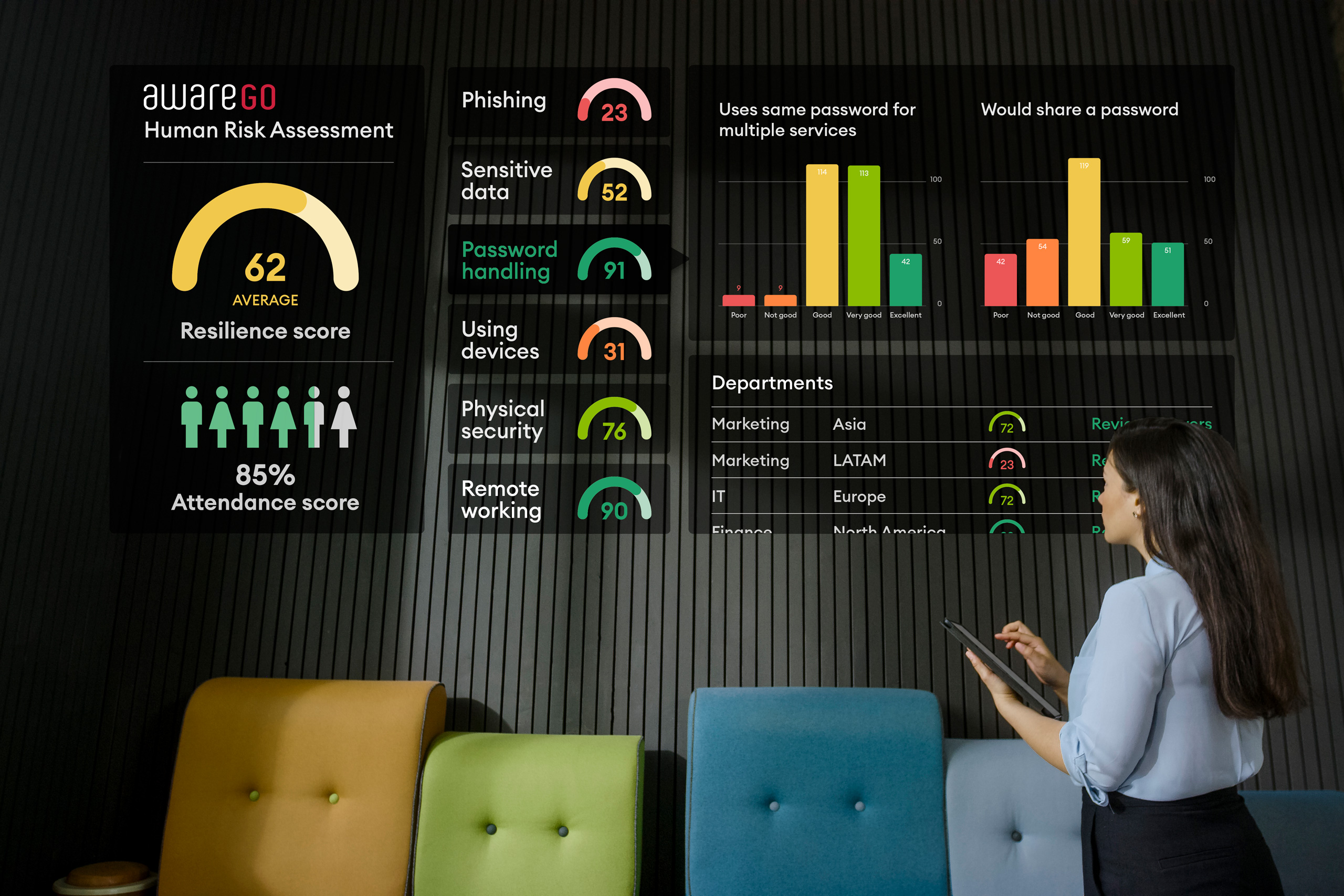
You don’t need a degree in cybersecurity to master how to run a phishing test with our tools. Most users set up their first simulation in under 10 minutes using our pre-built templates. These templates cover everything from credential harvesting to sophisticated spear-phishing scenarios. If your organization already uses an existing LMS, you can access our full SCORM library for deep integration. Our data-driven dashboards then map human risk across your entire organization, showing you exactly where resilience is growing and where more support is needed. Our dashboards don’t just show click rates; they provide a Human Risk Score that correlates with actual behavioral trends. This allows you to identify high-risk departments without singling out individuals in a negative way. It turns abstract human behavior into measurable, actionable data. Book a demo to see our Human Risk Management platform in action and start building a stronger security culture today.
Turn Human Vulnerability into Your Strongest Defense
Securing your organization starts with understanding the humans behind the screens. Mastering how to run a phishing test in 2026 requires more than just sending a fake email; it demands a strategy rooted in behavioral science and empathy. You’ve seen that shifting from “gotcha” traps to supportive micro-learning creates a lasting security culture that sticks. Data proves that this human-centric approach can reduce human-related breaches by up to 90% across your workforce. AwareGO simplifies this transition by providing tools trusted by global enterprises to measure and mitigate human risk effectively. You don’t need complex jargon or fear-based tactics to protect your company. You need actionable knowledge that fits seamlessly into your team’s busy workday. It’s about building habits that protect everyone. By focusing on Human Risk Management (HRM) instead of simple compliance, you empower your employees to become a proactive shield. You’re not just running a simulation; you’re investing in your people. It’s time to replace digital anxiety with the confidence of a resilient workforce. You’ve got the tools to make it happen.
Start Managing Your Human Risk with AwareGO
Frequently Asked Questions
How often should we run a phishing test for employees?
You should run a phishing test at least once per month to keep security habits fresh. Understanding how to run a phishing test involves setting a consistent schedule that builds lasting habits. Organizations that test monthly see a 40 percent reduction in click rates compared to those that only test once a year. This consistent rhythm builds a stronger security culture and turns awareness into a reflex. It helps you stay ahead of evolving threats without overwhelming your team’s daily schedule.
Is it legal to phish your own employees?
It is legal to phish your own employees, provided you follow local labor laws and privacy regulations like GDPR or CCPA. Over 70 percent of enterprises include these simulations in their standard acceptable use policies to ensure transparency. You should focus on education rather than entrapment. Working with your legal department ensures your program remains compliant while effectively reducing human risk across the entire organization. This strategy protects the company while respecting individual privacy rights.
What happens if an employee fails a phishing test multiple times?
Employees who fail multiple tests should receive targeted micro-learning sessions rather than disciplinary action. Data from 2023 shows that 90 percent of repeat clickers improve after receiving two minutes of just-in-time training. Focus on building resilience through empathy and support. If a specific user fails three times in a quarter, a one-on-one conversation can help identify the behavioral gaps that lead to these errors. This approach strengthens your security culture without creating a climate of fear.
Should we tell employees before we run a phishing simulation?
You should not announce the specific timing of a test, but you must inform employees that a simulation program exists. Transparency about the program’s goals reduces anxiety and builds trust. When you learn how to run a phishing test effectively, you balance the element of surprise with clear communication about why these exercises matter. A 2023 survey found that 65 percent of employees feel more confident when they know training is part of a regular safety program.
How do we measure the ROI of a phishing simulation program?
Measure ROI by tracking the decrease in your Phish-Prone Percentage and the increase in employee reporting rates. A 2022 study found that every dollar spent on security awareness training yields a 37-fold return on investment. You can also calculate the potential cost of a data breach, which averaged 4.45 million dollars in 2023, against the cost of your simulation platform. These metrics prove the value of proactive Human Risk Management and justify your security budget.
Can we run phishing tests through SMS or phone calls (Smishing/Vishing)?
You can and should include Smishing and Vishing in your testing because mobile attacks increased by 22 percent in 2023. These simulations prepare your team for multi-channel threats that bypass traditional email filters. Use short, realistic scenarios to teach employees how to verify identity over the phone or via text. Expanding your program beyond email creates a more comprehensive shield against modern social engineering tactics. This holistic approach ensures no communication channel remains a vulnerable entry point.
What is a good “Phish-Prone” percentage for my industry?
A good Phish-Prone Percentage is below 5 percent for the top 500 global enterprises, though the initial baseline often sits around 30 percent. If your organization reaches this 5 percent threshold, you are significantly more resilient than the average business. Aim for continuous improvement rather than perfection. Consistently monitoring this number allows you to adjust your training strategy based on the specific human risk factors present in your unique workplace. This data-driven approach keeps your security culture healthy and measurable.
How do I handle an employee who gets angry about a phishing test?
Handle an angry employee by validating their feelings and explaining that the test is a safety net, not a trap. Remind them that the 2023 Verizon DBIR shows 82 percent of data breaches involve a human element, making these simulations a vital part of protecting their own digital identity. Shift the focus from getting caught to getting better. This empathetic approach turns a moment of frustration into a valuable opportunity for growth and cultural alignment. It ensures that security remains a shared responsibility.