 Cybersecurity blog



Is your security training budget working? It’s a tough question to answer when you can’t measure the return. You see insurance premiums rise and know that human behavior is the biggest variable in your security posture, but where do you focus your efforts? Guesswork won’t cut it anymore. The future of a strong defense lies in a data-driven human risk assessment, a powerful tool that transforms ambiguity into clarity. It’s about replacing anxiety with confidence and building a truly resilient security culture from the inside out.
This strategic guide will show you exactly how to get there. We’ll walk you through the steps to quantify, analyze, and mitigate the human element of your cybersecurity. You will learn how to generate a clear risk score for your entire organization, identify high-risk departments with precision, and use actionable data to justify your training budget. Forget one-size-fits-all approaches. It’s time to make targeted, effective decisions that reduce successful phishing attacks and empower your people to become your strongest defense.
Key Takeaways
- Discover how a data-driven human risk assessment identifies the specific behaviors that put your organization at risk.
- Learn to calculate a tangible “Human Risk Index” to clearly communicate your security posture to the board.
- Find out why traditional “gotcha” tactics fail and what to do instead to build a positive security culture.
- See how to transform assessment data into engaging, micro-learning journeys that effectively remediate high-risk habits.
What is a Human Risk Assessment in Cybersecurity?
Your firewalls are strong. Your software is patched. But what about your people? A human risk assessment is a systematic process designed to identify, analyze, and evaluate the security risks posed by human behavior. It’s not a technical vulnerability scan that looks for flaws in your code. Instead, it looks for gaps in human knowledge, risky habits, and cultural factors that expose your organization to threats.
At its core, any risk assessment aims to quantify potential threats. While you can learn the fundamentals of What is a Risk Assessment? from established frameworks, applying this to people requires a different lens. By 2026, the human element isn’t just a factor in cybersecurity-it’s the primary attack vector. Attackers don’t just hack systems; they hack people. This is where Human Risk Management (HRM) becomes essential, shifting the focus from technology alone to building a resilient, security-aware culture.
The Core Components of a Human Risk Audit
A true human risk assessment moves beyond simple phishing tests. It digs deeper into the “why” behind employee actions, measuring three critical areas:
- Behavioral Data: Analyzing how employees actually interact with simulated threats, genuine emails, and daily security prompts. This provides real-world data on security habits.
- Knowledge Gaps: Pinpointing specific areas where security training hasn’t translated into practical knowledge. Do your people understand data handling policies? Can they spot a sophisticated spear-phishing attempt?
- Psychological Factors: Understanding how stress, urgency, and fatigue impact decision-making. An employee clicking a malicious link isn’t necessarily negligent; they might be overwhelmed.
Why “Check-the-Box” Awareness is Not an Assessment
For years, organizations relied on annual compliance training. You made everyone watch a video, take a quiz, and then checked the box. But a 100% completion rate on a quiz doesn’t mean you have a 0% risk of a breach. This outdated model fails to change real-world habits. Modern security demands a shift toward continuous, data-driven assessment that measures real behavior and builds lasting security reflexes, not just temporary awareness.
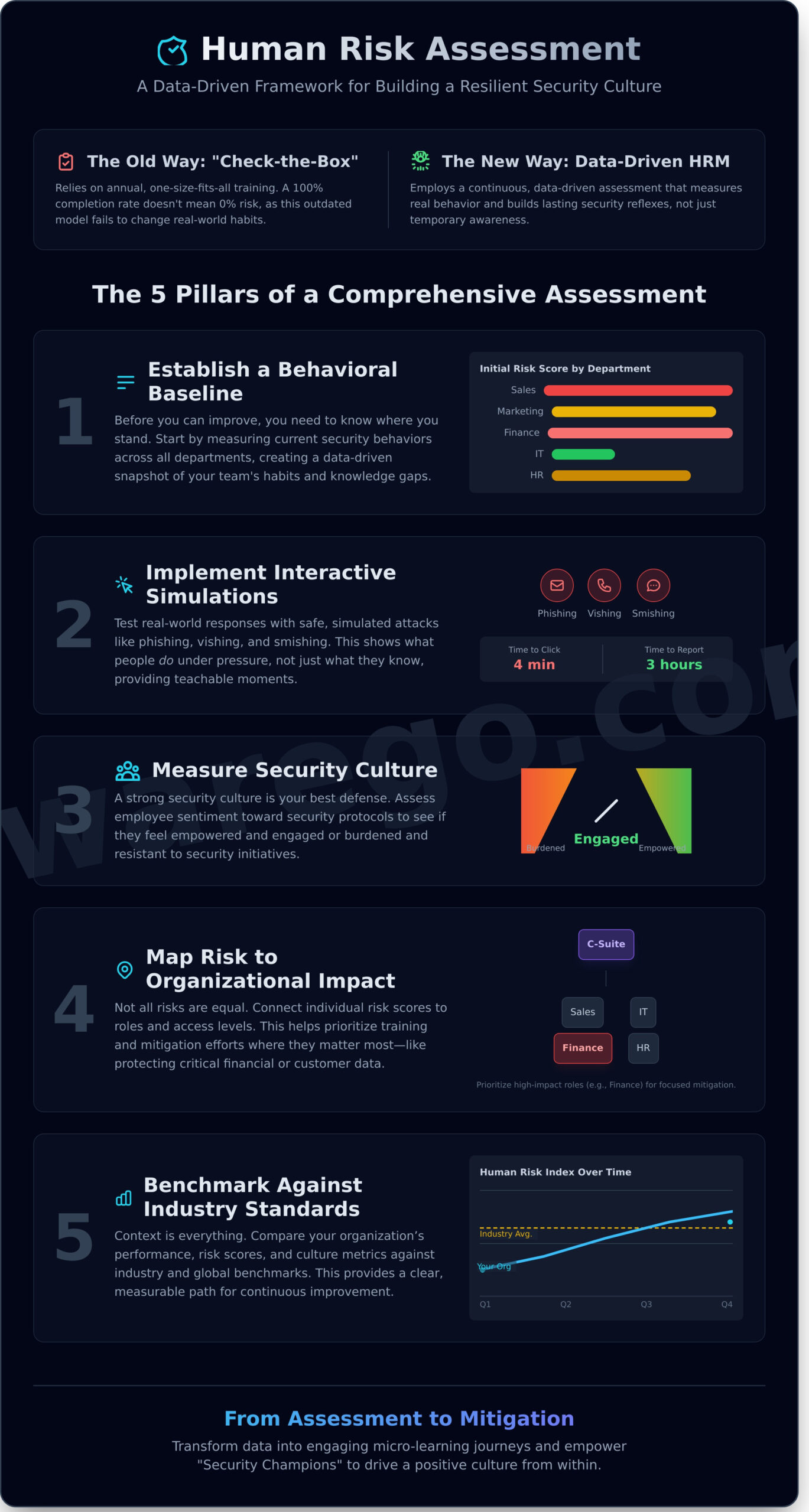
The 5 Pillars of a Comprehensive Human Risk Assessment
A successful human risk assessment isn’t a checklist; it’s a dynamic framework. It replaces guesswork with data, giving you a clear picture of your organization’s resilience. Think of it as building a strong foundation with five essential pillars. This structure helps you move from passive awareness to active Human Risk Management (HRM).
Here’s how we break it down:
- Step 1: Establish a Behavioral Baseline. Before you can improve, you need to know where you stand. We start by measuring current security behaviors across all departments, creating a data-driven snapshot of your team’s habits.
- Step 2: Implement Interactive Simulations. We test real-world responses with safe, simulated attacks. This shows you what your people do under pressure, not just what they know in theory.
- Step 3: Measure Security Culture. A strong security culture is your best defense. We assess employee sentiment toward security protocols to see if they feel empowered and engaged or burdened and resistant.
- Step 4: Map Risk to Organizational Impact. Not all risks are equal. We connect individual risk scores to roles and access levels, helping you prioritize efforts where they matter most-like protecting critical financial or customer data.
- Step 5: Benchmark Against Industry Standards. Context is everything. We compare your organization’s performance against industry and global benchmarks, giving you a clear, measurable path for improvement.
Simulated Phishing and Social Engineering Tests
Effective phishing tests are about education, not punishment. We create realistic but safe scenarios that offer immediate, teachable moments. By measuring key metrics like “Time to Click” versus “Time to Report,” you gain insight into employee reflexes. Varying attack vectors-from email phishing to vishing (voice) and smishing (SMS)-ensures your team is prepared for threats from any direction.
Evaluating Security Knowledge vs. Security Habits
Knowing the rules isn’t the same as having good security habits. A modern human risk assessment focuses on situational judgment, testing how employees react in realistic scenarios, not just rote memorization. We use continuous micro-learning modules to reinforce good behaviors and identify “Security Champions”-enthusiastic employees who can help drive a positive security culture from within their own teams.
Quantifying the Unquantifiable: Metrics That Matter
Your people are not a binary problem. So why measure their security behavior with a simple pass or fail? A modern human risk assessment moves beyond click rates to provide a dynamic, nuanced score that truly reflects your organization’s resilience.
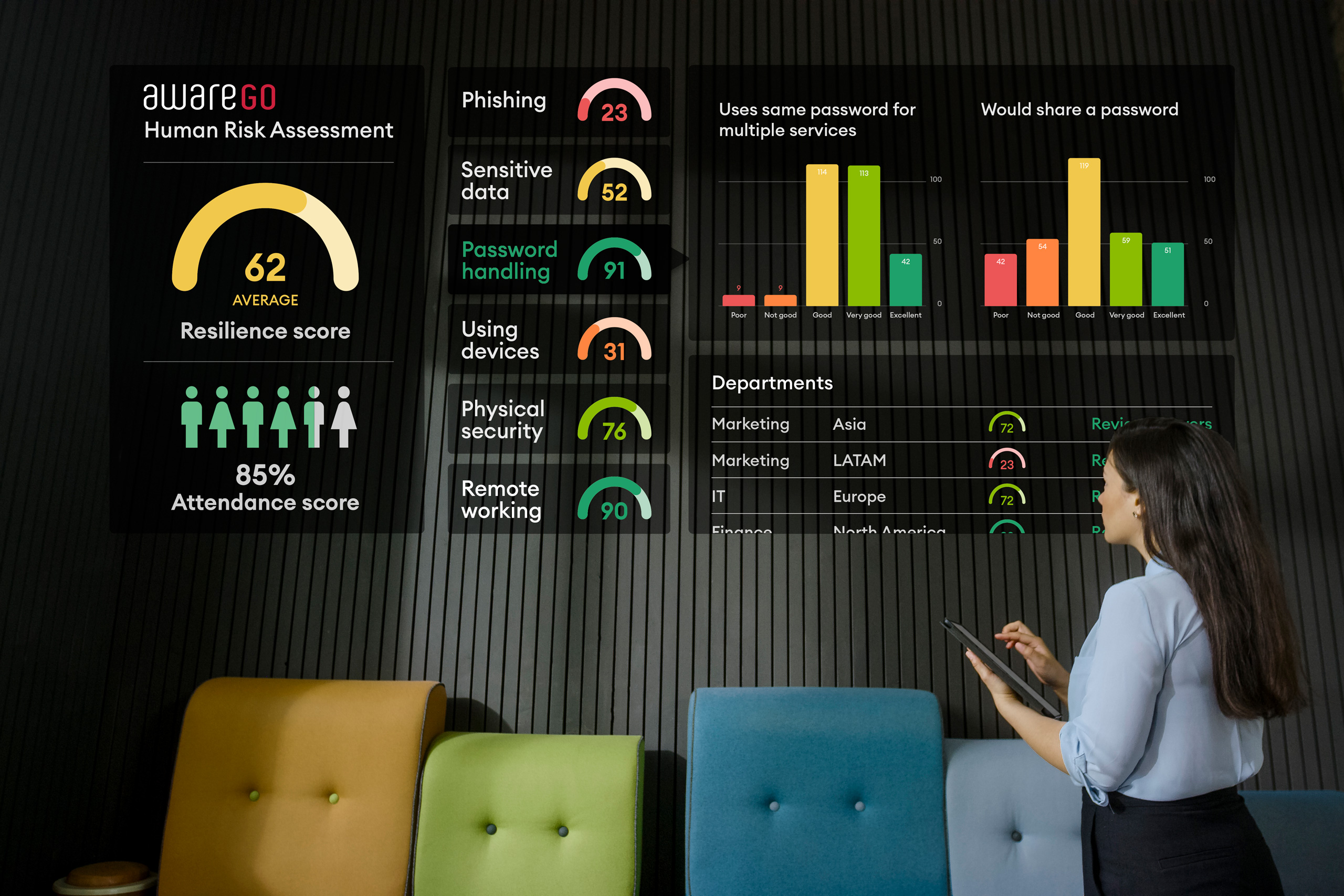
To give your board the clarity it needs, you need a Human Risk Index. This is a consolidated score that tells a clear story about your security posture. It’s calculated by combining key data points, such as:
- Phishing simulation failures and successes
- Security training engagement and completion rates
- Threat reporting frequency (your Resilience Rate)
- Role-based and departmental risk weighting
This isn’t just a number; it’s a narrative. Frequent, bite-sized assessments provide a continuous stream of data, showing risk trends over time. When you integrate this human-centric data with your SIEM and SOC tools, your technical defenses get smarter. A suspicious login attempt from a high-risk user suddenly has critical context, allowing for a faster, more accurate response.
Departmental vs. Individual Risk Profiling
Not all employees represent the same level of risk. Your finance and HR teams handle sensitive data, making their risk profiles inherently higher. Using an Employee Cybersecurity Risk Audit helps you identify and weight these high-privilege users without being invasive. The focus is on the role, not the person. This crucial distinction allows you to balance risk visibility with employee trust, building a culture of shared responsibility instead of one of surveillance.
Benchmarking Your Human Risk
How do you know if your efforts are effective? Context is everything. Benchmarking Human Risks against your industry peers provides an objective measure of your performance. This data is a powerful tool for justifying security spend and demonstrating progress. A key metric to track is your Resilience Rate-the percentage of employees who actively report potential threats. This positive indicator proves your team is becoming a proactive defense layer, not just a potential liability.
Common Pitfalls: Why Traditional Assessments Fail
A human risk assessment should empower your team, not punish them. Yet, many traditional approaches do exactly that. They rely on outdated methods that create fear, ignore the dynamic nature of threats, and ultimately fail to build a resilient security culture. The result? Wasted resources and a workforce that sees security as a burden.
These outdated strategies often fail because they are built on flawed foundations, such as:
- Over-reliance on “gotcha” tactics that destroy employee morale.
- Lack of actionable follow-up after the assessment is complete.
- Failing to account for “Security Fatigue” in the workforce.
- Ignoring the unique cultural context of your organization.
The “Fear Factor” vs. Empowered Resilience
Fear-based messaging and punitive phishing tests backfire. They create anxiety and make employees less likely to report actual incidents for fear of blame. An empathetic security framework treats your people as the first line of defense, not the weakest link. It builds trust and encourages proactive reporting, turning potential victims into active defenders. Negative reinforcement simply doesn’t build positive security habits.
Static Assessments in a Dynamic Threat Landscape
The threat landscape moves at lightning speed. An assessment from six months ago is irrelevant against today’s AI-driven phishing and sophisticated social engineering attacks. A static, annual check-box exercise leaves you vulnerable. You need an “always-on” assessment loop that provides continuous insight and adapts to the realities of modern remote and hybrid work environments.
A successful human risk assessment is more than a test; it’s the start of a conversation. Without clear, actionable follow-up-like targeted micro-learning that addresses specific knowledge gaps-the data is useless. It must connect directly to a solution that helps employees improve, making your entire organization stronger. By moving away from fear and embracing a continuous, data-driven approach, you can turn human risk into human resilience. See how AwareGO helps you build a security culture that is engaging, effective, and deeply integrated into the way your people work.
From Assessment to Mitigation: The AwareGO Approach
A good human risk assessment identifies your vulnerabilities. A great one shows you exactly how to fix them. At AwareGO, we bridge the gap between data and action. Our platform transforms assessment results into personalized micro-learning journeys for every employee, turning insights into measurable improvements in your security posture.
We target high-risk behaviors with our award-winning, one-minute animated videos. They are engaging, memorable, and proven to build better security habits. Whether you have 50 employees or 50,000, our Human Risk Management (HRM) platform scales to meet your needs. This continuous improvement cycle delivers a clear return on investment by reducing security incidents and lowering your incident response costs.
Automating the Remediation Loop
Our platform closes the loop between mistake and learning. When an employee clicks a simulated phishing link or fails an assessment question, relevant micro-training is triggered instantly. This automated process removes the manual burden from your IT team and delivers education at the most teachable moment. For seamless integration, you can also access our full SCORM Content Library for your existing LMS.
Fostering a Long-Term Security Culture
Our goal is to transform human risk into human resilience. Security isn’t a one-time training event; it’s a continuous practice. By regularly assessing and reinforcing positive behaviors, you build a sustainable security culture where your people become your strongest defense. Ready to see how data-driven training can empower your team? Start your first Human Risk Assessment today.
Transform Your People into Your Strongest Defense
Your firewall and antivirus are only part of the story. The modern threat landscape demands a deeper understanding of your biggest asset: your people. As we’ve explored, traditional, check-the-box training often fails because it ignores the “why” behind human behavior. A strategic human risk assessment moves beyond simple awareness, giving you the measurable data needed to build a truly resilient security culture.
Stop guessing and start measuring. See why global enterprises trust AwareGO to secure over 1 million users. Our award-winning, behavioral science-backed methodology provides the clarity you need to protect your organization from the inside out.
Quantify your team’s vulnerability with AwareGO’s Human Risk Assessment.
Empower your team. Secure your future.
Frequently Asked Questions
What is the primary goal of a human risk assessment?
The primary goal is to understand and measure the human element of your cyber defenses. It’s not about finding fault; it’s about identifying specific behaviors and knowledge gaps that create vulnerabilities. This data empowers you to create targeted, effective training that builds a stronger security culture. It helps turn your employees from a potential liability into your most powerful security asset. This same principle of proactive risk assessment is crucial for personal health, and if you’re interested in learning about preventive screenings, you can check out Health Screen Test.
How often should a company conduct a human risk assessment?
Think of it as a continuous process, not a one-time event. We recommend starting with a baseline assessment and then conducting them quarterly. The threat landscape changes constantly, and so do your teams. Regular check-ins allow you to track progress, adapt your training to new risks like AI-powered scams, and maintain a constant state of security readiness. This keeps your security culture dynamic and resilient.
Is human risk assessment the same as a phishing test?
No, a phishing test is just one piece of a much larger puzzle. While valuable, phishing simulations only test one threat vector. A comprehensive human risk assessment evaluates a wider range of behaviors, such as password hygiene, data handling, and physical security. It gives you a complete, 360-degree view of your human-related vulnerabilities, providing a much richer and more actionable set of data.
How do you calculate a human risk score?
A human risk score is calculated by aggregating data from multiple sources. This includes results from knowledge assessments, phishing simulations, and reported security incidents. Each factor is weighted based on its potential impact-for example, falling for a ransomware link carries more weight than a weak password. This data is then combined into a single, measurable score that quantifies your organization’s human risk level.
Can human risk assessment help with insurance compliance?
Absolutely. Cyber insurance providers increasingly demand proactive security measures. A continuous program of human risk assessment demonstrates due diligence and a mature security posture. It shows you are actively identifying, measuring, and mitigating human-related threats. This data-driven approach can help you secure better policy terms, lower your premiums, and streamline the entire compliance process with tangible proof of your efforts.
What are the most common human risks in cybersecurity today?
Phishing remains a top threat, but it’s evolving. We are seeing a rise in sophisticated Business Email Compromise (BEC) scams and AI-powered voice phishing (vishing). Other common risks include poor password hygiene, mishandling of sensitive data, and falling for pretexting attacks where criminals impersonate trusted figures like your CEO. These attacks all prey on human psychology, often using technical tricks that are surprisingly public, as seen on sites like reisinformatica.com.
How do you ensure employee privacy during an assessment?
Protecting privacy is fundamental. The goal is to uplift your security culture, not to single people out. Assessments should focus on aggregate, departmental, or role-based data to identify trends without exposing individuals. Any personalized feedback should be delivered constructively and privately. A trustworthy framework makes it clear that the data is used to help and support employees, which builds confidence in the program.
What is the difference between human risk management and security awareness?
Security awareness is the “what”-making people aware of threats. It’s often a passive first step. Human Risk Management (HRM) is the “how”-an active, continuous cycle. HRM uses data from assessments to identify specific risks, delivers targeted training to change behaviors, and then measures the impact. It moves beyond simple awareness to create a resilient security culture built on measurable improvement and good habits.