 Cybersecurity blog


What if your most expensive security tool isn’t a firewall, but the collective habits of your workforce? Even with massive investments in tech, the 2024 Verizon Data Breach Investigations Report found that 68% of breaches still involve a human element. You’ve likely seen this play out when phishing click rates stay high despite your team’s best efforts with traditional training videos. This disconnect is exactly why modern human risk management software has become essential. It moves your strategy beyond passive compliance toward active, behavioral resilience.
You’re right to feel frustrated when engagement stays low and you can’t prove the ROI of your security budget to leadership. We believe security is a shared human responsibility, not a technical hurdle to clear. This guide shows you how to transform your security culture by quantifying human behavior and automating risk remediation. You’ll learn how to replace “check-the-box” exercises with a measurable posture that saves your team time and actually changes how your employees work every day.
Key Takeaways
- Move beyond basic awareness to understand why building behavioral resilience is the essential mandate for the 2026 threat landscape.
- Master a strategic framework for choosing human risk management software that prioritizes behavioral science and seamless integration over marketing hype.
- Learn how to replace “training fatigue” with a vibrant security culture using snackable micro-learning that feels more like Netflix than a textbook.
- Identify and mitigate high-risk behaviors using real-time signals and empathetic insights that respect employee privacy while strengthening your defense.
- Discover the data-driven methods that can reduce human-related security incidents by 70%, turning your team into your most powerful security asset.
Beyond Awareness: Why Human Risk Management Software is the 2026 Mandate
The cybersecurity world has shifted. You can’t rely on technical firewalls alone to protect your most sensitive data. In 2026, the focus has moved entirely to the person behind the screen. Human Risk Management (HRM) is the strategic framework used to identify, assess, and mitigate risks stemming from human behavior. It moves beyond simple awareness. It applies proven risk management principles to your workforce. This approach treats security as a living habit rather than a yearly chore. Modern human risk management software provides the granular data you need to turn your employees into your strongest defense. It’s about empowering your team with confidence.
The Failure of ‘Check-the-Box’ Compliance
Traditional Security Awareness Training (SAT) often feels like a burden. You assign a 45 minute video. Your team watches it on 2x speed while answering emails. They pass a quiz, and you check a box for your auditors. This process is fundamentally broken. Research from the Ebbinghaus Forgetting Curve shows that humans forget 70% of new information within 24 hours if it isn’t reinforced. High completion rates are a vanity metric. They don’t prove your organization is safe. In 2026, the mandate is behavioral change. You must transition from passive awareness to active risk mitigation. This requires moving away from annual events and toward continuous, bite-sized learning that builds lasting resilience. Security shouldn’t be a test you pass once a year; it should be a culture you live every day.
The 2026 Threat Landscape: Humans as the Primary Target
The threats your organization faces have evolved rapidly. Generative AI has removed the obvious spelling errors and awkward phrasing that once made phishing easy to spot. Deepfake audio and video are now common tools for sophisticated social engineering. According to the 2024 Verizon Data Breach Investigations Report, 68% of breaches involved a non-malicious human element. By 2026, this percentage is expected to rise as AI-driven vishing and smishing become indistinguishable from genuine communications. Your technical filters will catch many of these attempts, but they won’t catch them all. Your employees are the final gatekeepers of your network. They need more than a warning. They need the psychological tools to pause and verify when a “CEO” requests an urgent wire transfer over a video call.
Regulatory bodies are responding to these sophisticated tactics with stricter requirements. The NIST Cybersecurity Framework (CSF) 2.0, updated in February 2024, introduced the “Govern” function. This update highlights that security culture and human risk are now board-level responsibilities. Similarly, GDPR mandates “appropriate technical and organizational measures” to protect data. In 2026, a simple spreadsheet of training logs is no longer sufficient for compliance. You need human risk management software that demonstrates measurable progress in reducing risky behaviors. Effective HRM helps you meet these standards by providing:
- Real-time behavioral analytics that identify high-risk groups.
- Personalized micro-learning paths based on specific user vulnerabilities.
- Automated reporting that translates human behavior into financial risk metrics.
- Seamless integration with existing security stacks for a holistic view of your posture.
Choosing an HRM approach means you are choosing to invest in your people. It’s a shift from seeing employees as a liability to seeing them as an asset. When you provide the right tools, you reduce anxiety and replace it with actionable knowledge. This is how you build a sustainable security culture that survives the 2026 threat landscape.
The Anatomy of Modern HRM: Combining Behavioral Science with Real-Time Signals
Modern human risk management software doesn’t just watch people. It understands them. It moves away from the old “set it and forget it” training models that have failed for decades. Instead, it uses real-time signals to create a dynamic, living picture of your security culture. You get the visibility you need without turning the office into a surveillance state. By focusing on anonymized behavior patterns rather than private data, you identify which departments face the highest pressure from attackers without compromising trust.
This shift toward a strategic, human-centric approach is reflected in the NIST Cybersecurity Framework 2.0, which introduced the “Govern” function to elevate human risk to a leadership priority. This update acknowledges that security isn’t just a technical hurdle. It’s an organizational responsibility that starts with how people make decisions. Effective HRM software bridges the gap between those high-level policies and the daily actions of your workforce.
Behavioral Science: The Engine of HRM
Traditional training fails because it’s boring, long, and poorly timed. We use “Nudge” theory to deliver help exactly when it’s needed. Think of it as a friendly tap on the shoulder. When you deliver micro-content that stays under 3 minutes, your team sees 3x higher retention rates compared to annual hour-long sessions. This isn’t a guess; it’s how the human brain processes information. We trade fear-based messaging for positive reinforcement. You don’t want your employees to feel scared or anxious when they see an email from IT. You want them to feel capable and alert. Positive reinforcement builds resilience, while fear-based tactics often lead to “security fatigue,” where employees simply tune out the message entirely.
Data-Driven Risk Scoring
How do you turn a vague feeling about “culture” into a hard, actionable metric? You integrate data signals. Your human risk management software should pull information from your existing tech stack. This includes signals from:
- Endpoint Detection and Response (EDR): Identifying who frequently interacts with blocked or suspicious files.
- Email Security Gateways: Tracking who reports real threats versus who clicks on simulated ones.
- Identity and Access Management (IAM): Seeing where multi-factor authentication is being bypassed or ignored.
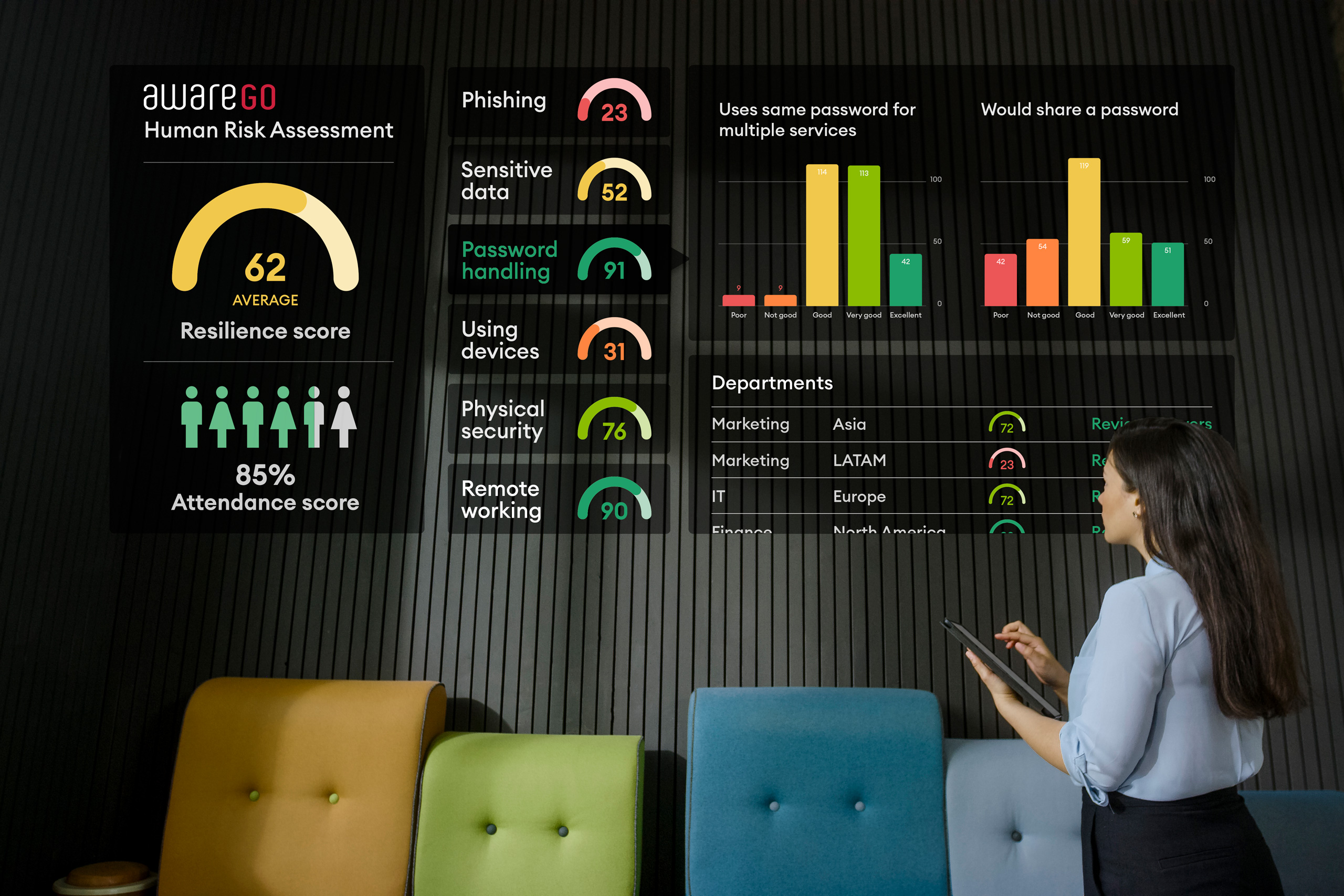
This creates a real-time risk score for different cohorts. If a specific “Repeat Clicker” interacts with three phishing simulations in a 6-month period, they aren’t a problem to be punished. They are a person who needs a different kind of support. You can benchmark these scores against industry standards to see exactly where you stand compared to your peers. This data lets you move from a “you failed” mindset to a “let’s help you improve” partnership. It’s about building lasting habits, not just checking compliance boxes for an auditor. If you’re ready to see how these signals look in a live environment, you can explore our platform’s dashboard to see how we quantify these behaviors. By moving from punishment to remediation, you transform your employees from your greatest vulnerability into your strongest line of defense.
Compliance vs. Culture: Solving the Engagement Gap
Compliance often feels like a chore. You tick a box, file a report, and hope for the best. But hope isn’t a strategy. The SANS Institute 2023 Security Awareness Report found that 69% of professionals in this field spend less than half their time on actual engagement. This is where training fatigue starts. When you bombard your team with long, boring videos once a year, they don’t learn; they tune out. More content isn’t the answer. Better content is. Effective human risk management software focuses on the quality of interactions rather than the quantity of slides.
Our approach replaces fear with confidence. We don’t want your employees to feel anxious every time they open an inbox. We want them to feel prepared. By using short, punchy micro-learning modules, we fit security into the cracks of the workday. This isn’t just about passing a test. It’s about building a collective resilience that protects your data 24/7. It’s about making security a natural part of the conversation. When training is easy to digest, it actually gets done.
Building a Sustainable Security Culture
Security belongs to everyone, not just the IT department. To make this shift, we use scenario-based storytelling. It makes abstract threats feel real. For example, the FBI’s Internet Crime Complaint Center reported that Business Email Compromise (BEC) cost organizations $2.9 billion in 2023. We show your team exactly how these social engineering tactics work in a real office setting. This makes the risk tangible. You can find deeper insights on this in our pillar post about how to build a strong cybersecurity culture.
Overcoming Employee Resistance
Punitive phishing simulations destroy trust. A 2022 study by researchers at the University of Michigan highlighted that high-pressure, deceptive simulations can lead to employee burnout and resentment. You need a culture of reporting, not a culture of fear. If someone makes a mistake, they should feel safe flagging it immediately. This speed is what stops a minor incident from becoming a total breach. Our human risk management software creates this safety net by emphasizing learning over punishment.
Leadership must lead the charge. When executives participate in gamified challenges and share their own security stories, it sets a tone of transparency. Use the platform to recognize your “Security Champions.” These are the people who consistently report threats and help their peers navigate digital risks. This recognition creates a positive feedback loop. It encourages others to stay vigilant. When leadership celebrates these wins, security stops being a technical hurdle. It becomes a badge of honor.
Gamification and storytelling turn what used to be a “mandatory task” into a rewarding experience. We use relatable characters and high-stakes plots to keep users coming back. Instead of clicking “next” as fast as possible, your team starts to look forward to the next episode. This is how you close the engagement gap for good. You move from a workforce that is simply compliant to one that is actively protective. That is the true power of a human-centric security strategy.
Choosing the Right HRM Platform: A Framework for CISOs
Selecting the right human risk management software is a strategic decision that goes far beyond a simple procurement checklist. You’re looking for a partner to help build organizational resilience. A modern HRM platform must integrate seamlessly with your existing tech stack. If it doesn’t talk to M365, Slack, or your HRIS, it creates a data silo that slows your team down. You need deep analytics that reveal behavioral trends rather than just completion rates. These insights allow you to move from reactive patching to proactive risk mitigation.
Many vendors claim to be “AI-native” to grab your attention. Often, this is just marketing fluff layered over basic automation. True AI in HRM should analyze user behavior patterns to deliver personalized content. It should predict which departments are most vulnerable based on real-world interactions. If the AI doesn’t reduce your admin workload or improve employee engagement, it isn’t adding value. Look for tools that use machine learning to adapt training frequency based on individual risk scores. This ensures you’re not over-training low-risk groups while providing extra support to those who need it.
Think about your deployment model carefully. Cloud-based SaaS offers agility and instant updates. SCORM integration is useful if you have a legacy LMS; however, it often limits the interactive features and tracking capabilities of modern HRM tools. Consider the Total Cost of Ownership (TCO). A 2023 study showed that security leaders spend 40% of their time on administrative overhead for training. Your platform should automate these tasks to free up your team for high-level strategy. You also need to factor in employee productivity. Replacing a 60-minute annual session with 3-minute micro-learning modules can save a company of 1,000 people over 900 hours of productive time annually.
The HRM Evaluation Checklist
A robust platform must provide a clear employee cybersecurity risk audit framework. This helps you identify high-risk individuals before a breach occurs. According to the 2023 Verizon DBIR, 74% of all breaches include a human element. Your software must address this head-on. Ensure the content is available in multiple languages for your global workforce. Research shows that localized training increases retention by 30% because it resonates more deeply with the user’s cultural context.
Technical vs. Human-Centric Features
High-quality video content outperforms interactive slide decks in every engagement metric. Humans are wired for stories. When you use cinematic micro-learning, you build a lasting security culture. Automated campaign management is another non-negotiable feature. It ensures consistent messaging without manual intervention from your IT team. To see how different providers handle these human-centric elements, you can explore our AwareGO vs. Knowbe4 comparison. Choosing a human risk management software that prioritizes the user experience will always yield better long-term results.
Ready to see how a human-centric approach transforms your security posture? Book your personalized demo today to start building a more resilient workforce.
AwareGO: Bridging the Gap Between Psychology and Cyber Resilience
Traditional security training fails because it ignores how the human brain actually processes information. Most employees view annual compliance sessions as a chore to be endured, not a skill to be mastered. AwareGO changes this dynamic by applying behavioral science to every interaction. Our data shows that consistent micro-learning reduces human risk by 70 percent, transforming vulnerable employees into your strongest line of defense. We don’t just teach people what to do; we influence the subconscious habits that dictate how they act when a real threat hits their inbox.
Modern human risk management software must do more than just deliver content; it must change how people feel about security. By focusing on the “why” behind human error, we help organizations move past the culture of blame. We treat your staff as partners in resilience. This shift in perspective creates a sustainable security culture where people feel empowered to report suspicious activity rather than hiding their mistakes out of fear. It’s about building a shield made of informed, confident individuals who understand their role in the bigger picture.
The AwareGO Content Philosophy
We believe that if content isn’t engaging, it isn’t effective. Our production team creates high-impact, story-driven videos that feel more like a Netflix series than a dry textbook. Each module lasts between one and three minutes, delivering a concentrated burst of knowledge that fits into a busy workday. We use relatable scenarios and professional actors to make abstract digital dangers feel tangible and manageable. This narrative approach ensures that the lesson sticks long after the video ends.
- Story-First Approach: We use cinematic storytelling to create emotional resonance, which is proven to improve memory retention.
- Behavioral Nudges: Our platform uses psychological triggers to reinforce positive habits at the exact moment they’re needed most.
- Habit Formation: By delivering frequent, bite-sized updates, we ensure that security stays top-of-mind without causing training fatigue.
AwareGO sets the global benchmark for 2026 by delivering a micro-learning experience that seamlessly blends cognitive psychology with world-class storytelling to eliminate the friction between employee productivity and organizational safety.
Seamless Integration and Managed Services
Your security stack is already complex, so your human risk management software shouldn’t add to the burden. AwareGO is built for flexibility. Our robust API and extensive SCORM library allow you to integrate our content into your existing Learning Management System (LMS) or HR infrastructure within minutes. You don’t need to overhaul your current processes to start seeing results. We meet you where your team already works, ensuring a frictionless rollout across global offices.
For organizations that need a more hands-on approach, our Managed Services team acts as an extension of your IT department. We don’t just hand you the keys and walk away. Our experts help design a custom risk management strategy tailored to your specific industry threats and internal culture. We analyze your Human Risk Assessment data to identify specific weak points, then curate a content journey that addresses those gaps directly. This translates raw habits into executive-ready data, giving your C-suite a clear view of the measurable ROI on your security investment.
The journey from basic awareness to true cyber resilience starts with a single step. Don’t wait for a breach to find out where your vulnerabilities lie. Ready to quantify your human risk? Book an AwareGO demo today.
Securing Your Workforce for the 2026 Threat Landscape
The journey to behavioral resilience requires moving past static training and embracing real-time psychological insights. You’ve seen that the most effective human risk management software doesn’t just track clicks; it builds lasting habits by merging behavioral science with actionable data. By 2026, the organizations that thrive will be those that treat security as a shared human responsibility rather than a technical hurdle. This transition allows your team to close the engagement gap and transform compliance into a living, breathing security culture.
AwareGO is already helping global enterprises protect over 1,000,000 employees using our award-winning, Red Dot-style content. Our platform provides data-driven risk benchmarking so you can measure progress with quantifiable metrics. It’s time to replace anxiety with confidence and empower your workforce to recognize threats before they escalate into breaches. You don’t have to manage these risks alone; the right tools make the process seamless and measurable.
Take the first step toward a more resilient future today. Start your comprehensive employee cybersecurity risk audit and see how easy it is to strengthen your organization’s human firewall. You’ve got this, and we’re here to support you every step of the way.
Frequently Asked Questions
What is the difference between Security Awareness Training and Human Risk Management?
Security Awareness Training focuses on what people know, while Human Risk Management (HRM) focuses on what they do. Training provides the educational content; HRM uses data to measure and mitigate actual risky behaviors. According to the 2023 Verizon DBIR, 74% of all breaches involve a human element. HRM helps you address that 74% by turning passive knowledge into active, measurable habits.
How does human risk management software measure employee behavior?
Human risk management software measures behavior by tracking how your team interacts with digital threats and security protocols. It analyzes data from phishing simulations, password hygiene checks, and MFA adoption rates. Gartner predicts that 40% of large enterprises will use these behavioral analytics by 2026. This data gives you a clear picture of your organization’s security culture without relying on guesswork or manual surveys.
Can HRM software help with GDPR and SOC2 compliance?
HRM software streamlines GDPR and SOC2 compliance by providing an auditable trail of your risk mitigation efforts. GDPR Article 32 specifically requires organizations to regularly test and evaluate their security effectiveness. By using a dedicated platform, you generate the exact reports auditors look for. You’ll have 100% visibility into your training completion rates and behavioral improvements to prove your data is protected.
How often should employees receive security training for it to be effective?
Employees should engage with security content at least once a month to ensure information sticks. The Ebbinghaus Forgetting Curve shows that people forget 70% of new information within 24 hours if it’s not reinforced. Short, three minute micro-learning sessions keep security top of mind. This frequency builds lasting resilience and ensures your team doesn’t treat security as a once a year checkbox exercise.
Does human risk management software integrate with my existing LMS?
Our human risk management software integrates with your existing LMS through standard SCORM files or direct API connections. Most of our partners use systems like Workday or SAP, and they sync data in under 10 minutes. This means you don’t have to manage multiple logins or fragmented reports. You keep your current workflow while adding a sophisticated layer of human risk analysis and behavioral tracking.
Is phishing simulation still effective in 2026?
Phishing simulations are essential in 2026 because they provide the only safe environment to practice spotting AI driven threats. Research shows that AI crafted phishing attempts increased by 1,265% since late 2022. Simulations give your team the hands on experience they need to stay sharp. It’s about building a reflex, so when a real threat hits their inbox, they’ve already practiced the correct response.
How much does human risk management software typically cost?
The cost for human risk management software typically falls between $15 and $45 per user per year. This investment protects your organization against the $4.45 million average cost of a data breach reported by IBM in 2023. Pricing usually scales based on your total headcount and the depth of analytics you need. It’s a predictable expense that prevents the unpredictable costs of a cyber incident.
How do I secure board buy-in for an HRM platform?
Secure board buy-in by presenting human risk as a measurable business liability rather than a technical IT issue. Boards have increased their focus on cyber risk by 20% since 2021, so they’re ready for the conversation. Show them how HRM reduces the likelihood of a breach by addressing the 74% of incidents caused by human error. When you speak in terms of ROI and resilience, the budget follows.