 Cybersecurity blog



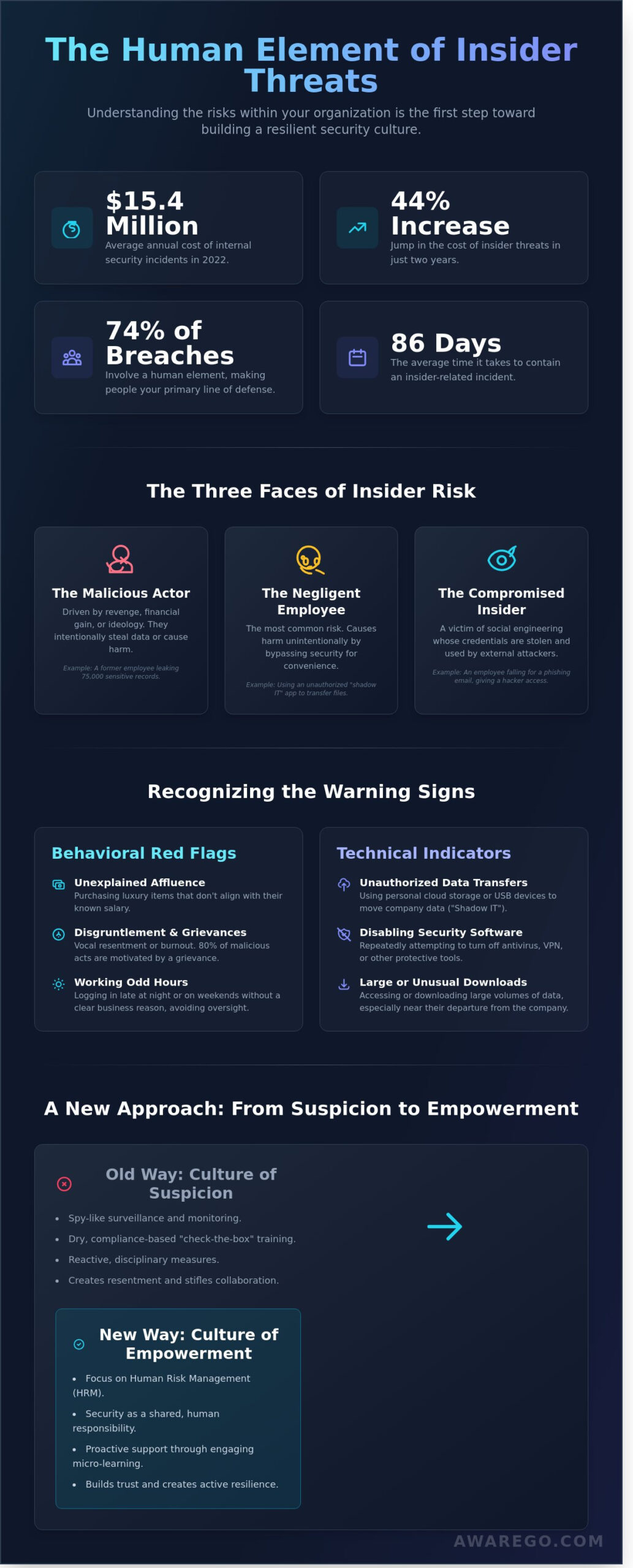
Did you know that the average annual cost of internal security incidents jumped to $15.4 million in 2022? According to the Ponemon Institute, that is a 44% increase in just two years. You likely feel the pressure to monitor every click, yet you worry that spy-like surveillance will destroy the trust you’ve built with your team. It’s a difficult balance to strike when you’re trying to tell the difference between a tired employee’s honest mistake and a genuine malicious act. Traditional, dry training sessions rarely help; they often leave your staff feeling bored or even more confused.
We believe your people are your greatest asset, not your weakest link. This article will show you how to build effective insider threat awareness by focusing on a human-centric security culture that empowers rather than accuses. You’ll learn a clear framework for identifying behavioral indicators and a strategy for training that your employees will actually enjoy. We’re moving beyond dry compliance to help you achieve a measurable reduction in human-related incidents through proactive Human Risk Management. Let’s transform your workplace into a space where vigilance is a natural habit for everyone.
Key Takeaways
- Shift from a culture of suspicion to an empowerment model where security is a shared human responsibility rather than a technical hurdle.
- Strengthen your insider threat awareness by learning to identify the subtle differences between malicious intent, employee negligence, and accidental risks.
- Recognize the behavioral and technical “red flags” that allow your team to intervene during the critical pre-attack phase.
- Discover how to design a resilient security culture using targeted Human Risk Assessments and high-impact micro-learning habits.
- Transform passive compliance into active resilience by leveraging cinematic storytelling and data-driven Human Risk Management (HRM).
What is Insider Threat Awareness in the Modern Enterprise?
Insider threat awareness isn’t a static checklist or a software suite. It’s the collective ability of your workforce to recognize, understand, and report internal risks before they escalate into full-scale breaches. While 74% of all data breaches involve a human element according to the 2023 Verizon Data Breach Investigations Report, many organizations still treat security as a purely technical challenge. We need to look past the firewalls. True awareness means your team understands the context behind security protocols, transforming them from potential liabilities into your strongest defensive layer.
You likely have Data Loss Prevention (DLP) tools in place. These systems are essential for catching unauthorized data transfers, but they lack human context. A DLP tool can’t tell if an employee is downloading files because they’re finishing a project on a flight or because they’ve accepted a job with a competitor. This is why we focus on Human Risk Management (HRM). We’re shifting the focus from invasive monitoring to a model where security is a shared responsibility. It’s about empowering people with the right habits rather than just watching their every click.
The Three Faces of Insider Risk
Internal risks aren’t one-size-fits-all. To manage them effectively, you have to understand the different motivations and behaviors that lead to a breach:
- The Malicious Actor: These individuals are driven by financial gain, revenge, or ideology. A clear example occurred in 2023 when a former Tesla employee leaked sensitive data belonging to 75,000 people.
- The Negligent Employee: This is your most common risk. These workers aren’t trying to cause harm; they’re just trying to be productive. They bypass security protocols or use unauthorized “shadow IT” apps because it feels more convenient.
- The Compromised Insider: This person is a victim of social engineering. Their credentials are stolen through phishing or “vishing” attacks, turning an innocent employee into an unwitting gateway for external hackers.
Why Compliance-Based Training Fails
Traditional training is usually a “check-the-box” exercise. A 45-minute video once a year doesn’t change daily habits; it creates resentment. When you use military-style “see something, say something” tactics, you risk creating a culture of suspicion that stifles collaboration. Modern insider threat awareness requires a more nuanced approach. Static content fails because it doesn’t meet people where they are or account for how they actually learn. Behavioral change is the only metric that truly measures your resilience against internal risk.
Recognising the Indicators: A Reference for Behavioral Signals
Prevention starts long before a data breach occurs. Most insider incidents follow a “pre-attack” phase where behavioral shifts become visible to those who know what to look for. Effective insider threat awareness isn’t about monitoring every keystroke. It’s about noticing when a colleague’s baseline behavior shifts in a way that creates risk. The 2023 Ponemon Institute report found that containing an insider incident takes 86 days on average. Early recognition cuts this timeline down, protecting both the company and the individual involved.
A single red flag isn’t an accusation. It’s a data point. When multiple indicators form a pattern, it’s time for a supportive conversation rather than a disciplinary hearing. HR and management play a vital role here. They ensure that reporting leads to help, not just heat. By focusing on human risk management, you turn potential vulnerabilities into opportunities for intervention and support.
Common Behavioral Red Flags
Human risk often manifests in daily habits. You might notice a colleague suddenly displaying unexplained affluence, like purchasing a luxury vehicle that doesn’t align with their known salary. Disgruntlement is another major factor. Research from the CERT Division of SEI indicates that 80% of malicious insiders were motivated by a workplace grievance. Keep an eye out for persistent burnout or vocal resentment toward company leadership. Working odd hours, such as logging in at 3:00 AM without a clear business case, often signals a desire to operate without oversight.
Technical Indicators of Insider Risk
Digital footprints tell a clear story. Watch for the unauthorized use of personal cloud storage or USB devices to move company data. These “shadow IT” habits often bypass security protocols. Frequent “accidental” clicks on MFA prompts or attempts to disable security software are critical warning signs. If an employee downloads 50GB of sensitive files during their final week of work, it’s rarely a coincidence. Tracking these technical shifts helps you maintain a strong security culture without sacrificing trust. Use these indicators as a guide to start a dialogue before a mistake turns into a crisis.
The Trust vs. Security Dilemma: Managing the Human Element
The biggest hurdle to effective insider threat awareness is the “spying” stigma. Many employees hear the term and immediately picture a shadow over their shoulder. They worry that reporting a concern means betraying a colleague. This mindset is the greatest risk to your organization. We solve this through the Empowerment Model. This approach stops treating employees as potential suspects and starts treating them as your most valuable defense layer. You aren’t watching your coworkers; you’re protecting the collective future of the company.
Behavioral science explains why people hesitate to speak up. The bystander effect and the fear of social friction often lead to silence. A 2023 report from the Ponemon Institute found that 55% of insider incidents are the result of simple negligence rather than malice. People don’t stay quiet because they want the company to fail. They stay quiet because they don’t want to be the “snitch” who got a friend in trouble for a mistake. Security must be positioned as a safety net. It’s the harness that catches you when you slip, not the trap that snaps shut when you make a wrong move.
Building a ‘No-Blame’ Security Culture
Mistakes are inevitable. If you click a suspicious link, your first instinct shouldn’t be to hide it. A “no-blame” culture turns a potential breach into a learning moment. When employees feel safe reporting errors immediately, you reduce the “dwell time” of a threat. Transparency is your strongest tool here. When leadership is open about security goals, employee engagement increases by as much as 30% based on recent Human Risk Management (HRM) data. IT departments must transition from being digital police officers to becoming supportive partners who help you navigate a complex digital world.
The Role of Empathy in Security Training
Empathy leads to better security outcomes. Understanding the “why” behind human behavior allows us to build more resilient systems. Most security failures happen when people are tired, stressed, or rushed. We use scenario-based storytelling to make these abstract threats feel tangible. It’s about recognizing that a colleague might bypass a protocol not out of spite, but because they’re trying to meet a deadline. Empathy is the core component of cybersecurity resilience, transforming security from a technical hurdle into a shared human responsibility. This shift makes insider threat awareness feel like a natural part of your daily professional life.
Designing an Effective Insider Threat Awareness Program
Creating a resilient security culture doesn’t happen by accident. It requires a deliberate, five-step framework focused on Human Risk Management (HRM) rather than just compliance checklists. You’re not just teaching rules; you’re building a shared responsibility. Effective programs follow this path:
- Step 1: Conduct a Human Risk Assessment. You can’t fix what you haven’t measured. Identify which specific departments or roles are most susceptible to social engineering or data mishandling.
- Step 2: Deploy micro-learning. Focus on one specific habit at a time. This prevents cognitive overload and keeps the message clear.
- Step 3: Establish anonymous reporting. People won’t speak up if they fear retaliation or blame. Make reporting channels non-punitive and easy to access.
- Step 4: Analyze behavioral data. Use real-world insights to see how training affects actual actions like password hygiene or reporting speed.
- Step 5: Iterate. Use new threat intelligence from the 2024 landscape to update your content. Your program must evolve as fast as the threats do.
The Power of Micro-Learning
Traditional 60-minute webinars fail because the human brain isn’t wired to hold that much data at once. Research shows that 80% of information is lost within 24 hours if it isn’t reinforced. Short, 2-minute videos are far more effective for long-term retention. These snackable modules fit into a busy workday without causing friction. By delivering frequent, consistent lessons, you turn insider threat awareness from a yearly chore into a daily habit. Explore our Security Awareness Videos to see how micro-learning transforms behavior.
Measuring What Matters: Metrics Beyond the Quiz
Completion rates are a vanity metric. They tell you who clicked “next,” but they don’t tell you who is actually a risk. You need to track behavioral change metrics. High-performing organizations monitor the ratio of reported suspicious activities versus actual security incidents. A 2023 study found that companies using behavioral benchmarking reduced their human risk posture by 30% within the first year. Compare your data against industry standards to see exactly where your culture stands. This data-driven approach moves you from guessing to knowing.
How AwareGO Transforms Awareness into Resilience
Traditional security training often fails because it ignores the human element. It creates an engagement gap where employees feel like they’re being tested rather than supported. AwareGO closes this gap through our Human Risk Management (HRM) platform. We don’t use dry, academic slides. Instead, we feature high-quality, scenario-based videos created by film industry professionals. These stories make insider threat awareness feel real, relatable, and urgent.
Our platform doesn’t just deliver information; it changes behavior. We bake behavioral science into every module to ensure long-term habit formation. By focusing on micro-learning, we respect your team’s time. Most modules take less than two minutes to complete. You can deploy this content seamlessly. Whether you prefer our stand-alone cloud platform or want to integrate via SCORM into your existing LMS, you can be up and running in under 24 hours.
- Engagement: 90% of users report higher retention rates with video-based micro-learning.
- Flexibility: Seamless integration with platforms like Microsoft Teams and Slack.
- Expertise: Content designed by psychologists and cybersecurity veterans.
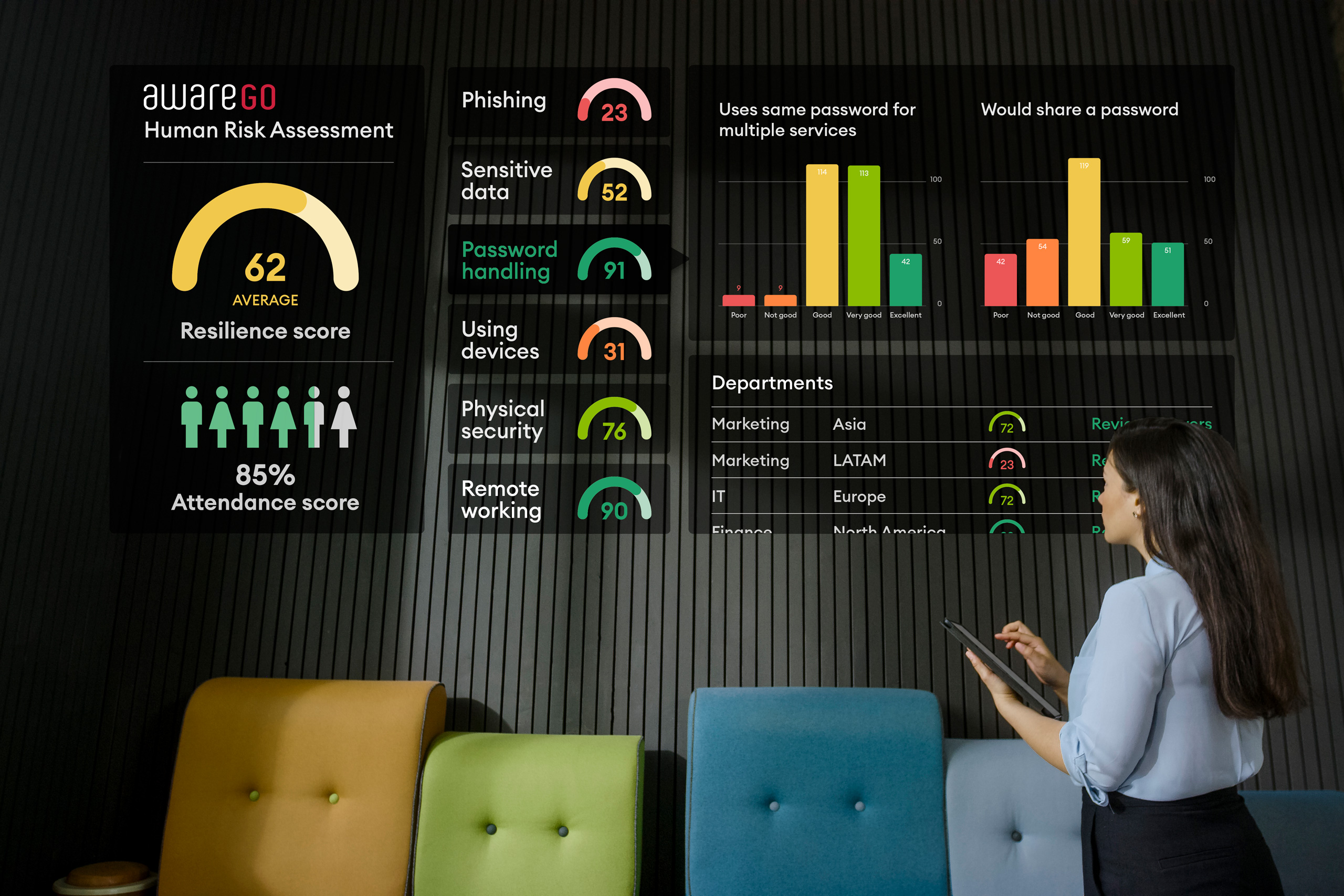
Data-Driven Human Risk Insights
AwareGO transforms abstract “security feelings” into actionable data. Our platform quantifies your security posture, showing CISOs exactly where vulnerabilities live. We identify the 20% of users who often represent 80% of your human risk. This allows for targeted, empathetic interventions instead of blanket training that bores your top performers. By mapping training outcomes to business risks, you can see how your resilience grows. The 2023 IBM Cost of a Data Breach Report shows the average breach costs $4.45 million; our data helps you prevent those costs before they occur.
Start Building Your Security Culture Today
Building a security culture shouldn’t be a burden on your IT department. For companies with limited resources, our managed service approach handles the heavy lifting. We act as your partner, providing the tools and expertise to turn your workforce into a human firewall. You’ll see a shift from passive compliance to active vigilance. We invite you to see the platform in action with a personalized demo or a trial to experience the AwareGO difference firsthand. Ready to manage your human risk? Explore AwareGO’s insider threat modules today.
From Vigilance to Lasting Resilience
Securing your enterprise starts with a shift in mindset. You’ve seen how insider threat awareness thrives when you replace fear with clear, actionable knowledge. By focusing on behavioral signals and fostering a culture of mutual trust, you protect your company without compromising its heart. True security isn’t about watching over shoulders; it’s about building a team that watches out for one another. You’ve learned that managing the human element requires a balance of transparency and technology.
AwareGO is a recognized leader in Human Risk Management (HRM), helping global enterprises secure over 1 million employees. Our platform uses proven behavioral science and micro-learning principles to transform complex security concepts into simple, daily habits. We help you measure and mitigate risk through engagement rather than enforcement. It’s time to build a workforce that’s ready for anything. We believe that when people feel empowered, your entire organization becomes an impenetrable shield.
Book a Demo to See How AwareGO Manages Human Risk
Your team is your strongest asset. Let’s give them the tools to prove it.
Frequently Asked Questions
What is a common example of an insider threat?
A frequent example is an employee downloading sensitive data to a personal USB drive for remote work, which occurred in 15% of incidents reported in the 2023 Ponemon Institute study. This negligent behavior often stems from a desire for efficiency rather than malice. You can mitigate this by building habits around secure cloud storage and approved data handling procedures.
How can I promote insider threat awareness without making employees feel distrusted?
You build trust by framing insider threat awareness as a collective safety net rather than a surveillance tool. Instead of monitoring for “bad” people, focus on Human Risk Management (HRM) to support your team. When you empower employees with knowledge, they feel like the first line of defense. This shift in security culture reduces anxiety and fosters genuine vigilance.
What are the three main types of insider threats?
The three primary types are the negligent insider, the malicious insider, and the compromised insider. Negligent insiders account for 55% of incidents through simple mistakes like misconfigured servers. Malicious insiders intentionally steal data for profit; meanwhile, compromised insiders have their credentials stolen by external attackers. Each type requires a different behavioral approach to manage the unique human risk involved.
Is insider threat awareness training mandatory for all industries?
Training isn’t legally mandatory for every small business, but it’s required for compliance with standards like SOC2, HIPAA, or the 2018 GDPR. The 2023 Verizon DBIR found that 74% of breaches involve the human element, making training a practical necessity. Even if a specific law doesn’t demand it, your insurance provider likely will to reduce your liability and premiums.
How do you distinguish between an accidental error and a malicious insider threat?
You distinguish between the two by analyzing intent and behavioral patterns over time. An accidental error is usually a one-time event, like a misplaced laptop or a typo in a firewall rule. A malicious threat involves deliberate steps to bypass security, such as accessing files outside of normal working hours or using unauthorized encryption tools to hide data transfers.
What are the most effective ways to measure the success of an insider threat awareness program?
You measure success by tracking behavioral changes, such as the reporting rate of suspicious emails or the frequency of policy violations. Data from 2022 shows that organizations using micro-learning see a 40% improvement in security posture within six months. Use Human Risk Management tools to turn these abstract actions into measurable data points that prove your security culture is strengthening.
Can micro-learning really prevent a major data breach caused by an insider?
Micro-learning prevents breaches by turning security into a daily habit instead of a yearly chore. Ebbinghaus’s Forgetting Curve shows people forget 90% of what they learn within a month without reinforcement. By delivering bite-sized lessons, you keep insider threat awareness fresh. This consistency builds the mental muscle memory needed to spot a threat before it turns into a disaster.
What should an employee do if they notice a colleague displaying behavioral red flags?
Employees should report their concerns through the company’s designated confidential channel, such as an anonymous tip line or an HR portal. Early intervention is key; the CERT Insider Threat Center notes that reporting concerning behaviors early can prevent 50% of potential incidents. Encourage your team to act out of care for the organization’s safety, ensuring the process remains supportive and non-punitive.