 Cybersecurity blog



Your phishing click-rate is a deeply flawed metric. It’s a familiar cycle. You run another phishing simulation, a percentage of your team clicks, and you’re left with a static number. You know this data doesn’t capture the full picture. It doesn’t show the frustration from employees who feel tricked, or the reality that your organization’s human risk hasn’t fundamentally changed. It’s a lot of administrative effort for very little impact.
The value of such integrations isn’t limited to security; for instance, modern expense tracking solutions let you discover more about Google Maps Timeline Import to automate mileage logs, saving significant administrative time.
We believe there’s a better way. This guide is your blueprint for 2026, designed to transform these simulations from “gotcha” traps into powerful tools for building measurable, long-term resilience. You’ll learn how to foster genuine engagement and create a security culture built on confidence, not fear.
We’ll break down the strategic shifts, the data that actually reduces risk, and the steps to prove a clear return on investment to your board.
Key Takeaways
- Learn why traditional click-rate metrics are failing and what you should measure instead to build genuine security habits.
- Discover the psychological triggers attackers use to understand why even your smartest employees can fall for a phish.
- Transform your phishing simulation program from a simple test into a strategic tool for driving measurable behavioral change.
- Identify the key features a modern training platform needs-from AI-powered templates to Vishing-to prepare your team for future threats.
What is Phishing Simulation and Why is Traditional Testing Failing?
A phishing simulation is a controlled, safe exercise designed to train your employees. It mimics real-world attacks to build recognition and response habits. Think of it as a fire drill for your digital security. You practice spotting the smoke before the building is on fire. This proactive training is the foundation of modern Human Risk Management (HRM).
For years, however, these tests were used as a “gotcha” tool. They were designed to catch people making mistakes, not to build them up. This old-school approach is completely broken. By 2026, we’re facing a full-blown “training fatigue” epidemic. Your team is tired of being tested, shamed, and then sent to a boring, hour-long training module. The result? They disengage. Old security tests become useless noise.
The entire mindset is shifting. We’re moving away from a culture of compliance, where security is just a box to check. We’re moving toward a culture of resilience, where your people become your strongest defense.
The Evolution of Phishing: Why 2026 is Different
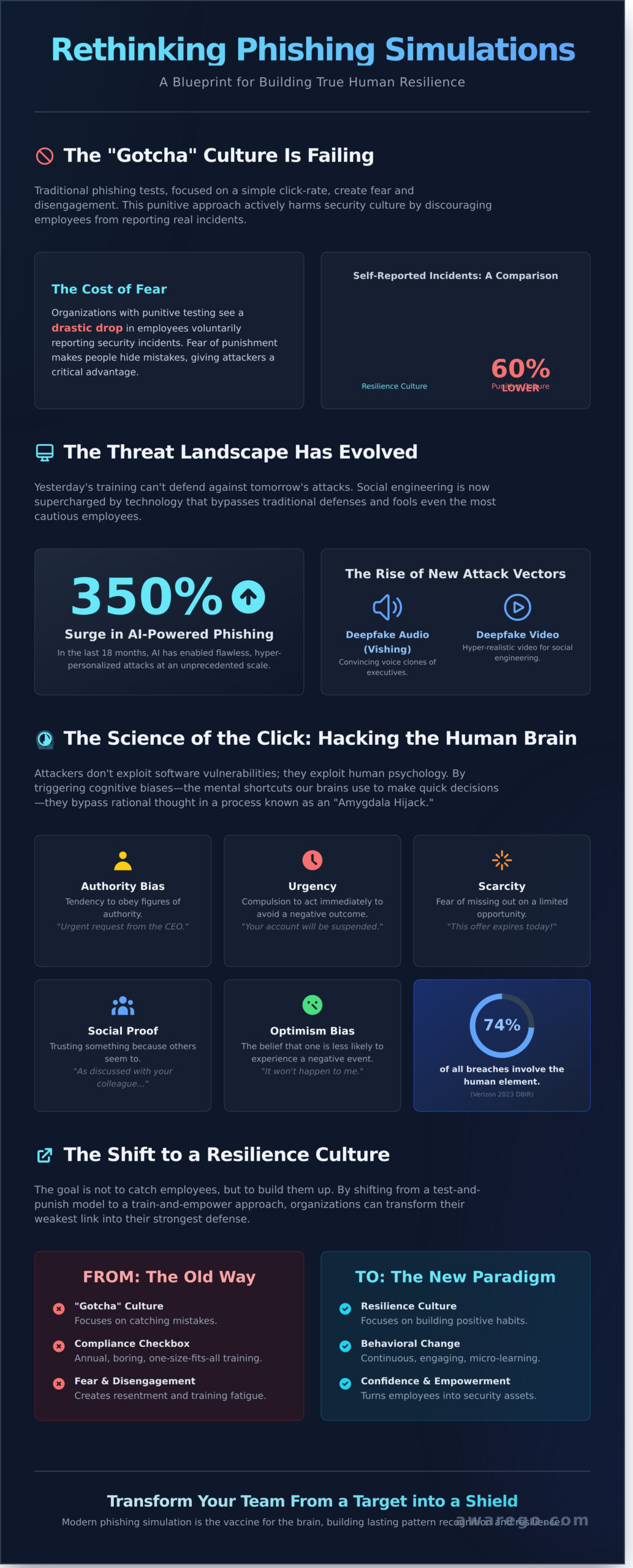
Today’s threats are not the same ones from five years ago. Attackers now use AI to generate flawless, hyper-personalized emails that bypass traditional filters. According to a 2025 report from Cybersecurity Ventures, AI-powered phishing attempts have surged by over 350% in the last 18 months alone. Add deepfake audio and video to the mix, and you have social engineering attacks that can fool even your most cautious employees. A static, once-a-year test can’t prepare your team for this dynamic reality. The ultimate defense isn’t a piece of software; it’s a deeply embedded Security Culture where every employee feels empowered and equipped to question the unexpected.
The High Cost of “Gotcha” Culture
When you use a phishing simulation to punish employees, you destroy trust. It creates an “us vs. them” divide between your IT team and the rest of the organization. This resentment has a direct and dangerous impact on your security. A 2025 study from the SANS Institute found that organizations with punitive testing cultures saw a 60% lower rate of self-reported security incidents. Why? Because people hide their mistakes. They’re afraid to raise their hand and say, “I think I clicked something I shouldn’t have.” That delay gives attackers the critical time they need to establish a foothold in your network. While the basic definition of What is Phishing remains constant, the human response to it is everything. The Human Risk Gap is the dangerous space between what your security policies assume people will do and the real, unpredictable actions they take under pressure.
The Science of the Click: Understanding the Psychology Behind Phishing
Ever wondered why your smartest, most diligent employee clicked on a malicious link? It wasn’t a failure of intelligence. It was a failure of instinct. Cybercriminals don’t target your team’s IQ; they target their humanity. They exploit the brain’s natural shortcuts, the cognitive biases hardwired into us for survival.
When an email from the “CEO” lands in your inbox demanding an urgent wire transfer, your brain doesn’t see code. It sees authority. This is Authority Bias in action. When a notification screams “Your account will be suspended in 1 hour,” it triggers a sense of Urgency. These aren’t logical puzzles. They are emotional traps. Attackers know your brain is designed to react quickly to threats and social cues, often bypassing the slower, more critical parts of your thinking.
This is the “Amygdala Hijack.” Under stress, the brain’s emotional core takes over, flooding you with cortisol and adrenaline. Your ability to make rational digital decisions plummets. In a busy workday, with dozens of emails and notifications, every employee is just one stressful moment away from a costly click. A well-designed phishing simulation acts as a vaccine for the brain, exposing users to these triggers in a safe space to build lasting pattern recognition.
Cognitive Biases in Social Engineering
Attackers masterfully weave biases into their scams. A Business Email Compromise (BEC) attack might use Social Proof, referencing a real project or colleague to seem legitimate. Or it could leverage Scarcity, with a fake offer that “expires today.” These tactics are effective because they exploit our innate desire to conform and our fear of missing out. Compounding this is Optimism Bias, the universal belief that “it won’t happen to me.” This is why a staggering 74% of all breaches involve the human element, according to Verizon’s 2023 DBIR. Effective security isn’t about eliminating these biases; it’s about building new habits through micro-learning. Building these new habits is the core of effective Human Risk Management.
From Reaction to Resilience
An untrained employee experiences a sophisticated phish as a fear response. A trained employee sees it as a routine check. That’s the difference between reaction and resilience. Infrequent, high-stakes annual testing often creates anxiety and shame. But frequent, low-stakes practice, like a 60-second video or a quick simulation, builds reflexive strength. It turns the conscious effort of “stop, think, check” into an unconscious habit. This behavioral data provides CISOs with a predictive map of human risk, showing exactly where the next breach is most likely to occur. Modern platforms even assess the sophistication of each test, using frameworks like the NIST Phish Scale to provide a much clearer picture of employee resilience than simple click rates ever could.
Evaluating Phishing Simulation Platforms: Beyond the Click Rate
Your click rate doesn’t tell the whole story. For years, the success of a phishing simulation was judged by this single, flawed metric. But a low click rate might just mean your test was too easy. A high one can crush morale. This old-school approach focuses on failure. It’s time to focus on what builds strength: positive reinforcement and proactive habits.
The goal isn’t just to stop clicks. It’s to build a vigilant team that becomes your first line of defense. True success is measured by how many people spot and report a threat, not just by how many fall for one. This shift from a “gotcha” mentality to a supportive, data-driven program is the foundation of modern Human Risk Management. You need a platform that measures the right things and provides the tools to improve them.
Critical Features for a Modern Program
Yesterday’s generic email blasts won’t prepare you for tomorrow’s threats. A modern platform must be intelligent, adaptable, and comprehensive. Look for tools that test your team’s resilience across all the channels attackers actually use, not just email. According to the 2023 anomali report, smishing attacks are on a steep rise, making multi-vector testing non-negotiable. For a comprehensive evaluation framework, see our detailed guide on choosing the best phishing simulation platform in 2026.
- AI-Driven Personalization: The platform should use AI to craft hyper-realistic simulations tailored to specific roles. Your finance team gets fake invoice attacks; your HR department gets malicious resumes. This context makes the training stick.
- Multi-Vector Testing: Threats don’t live in email alone. Your simulation tool must test for SMS phishing (smishing) and voice phishing (vishing) to prepare employees for real-world attack scenarios.
- Intelligent Automation: Your security team is busy. A great platform reduces their manual workload with smart scheduling, automated follow-up training, and dynamic campaign adjustments based on employee performance.
Measuring What Matters
Stop chasing a 0% click rate. Start tracking metrics that prove you’re building a stronger security culture. These numbers give you a clear, actionable picture of your human risk posture and show you exactly where to focus your training efforts.
- The Resilience Ratio: This is your key performance indicator. It compares the number of employees who report the simulation to the number who click. A healthy ratio (e.g., 5 reports for every 1 click) shows your culture is shifting from passive awareness to active defense.
- Mean Time to Detect (MTTD): How quickly does your team report a threat? Reducing this time from hours to minutes can be the difference between a minor incident and a major breach. Track this at the employee level to identify your security champions.
- Industry Benchmarking: Use data to see how you stack up. A good platform provides anonymized data, letting you compare your Resilience Ratio and MTTD against industry averages, like those found in the annual Verizon DBIR report.
Finally, a powerful phishing simulation platform doesn’t operate in a silo. It must integrate seamlessly with your existing systems. Look for native integrations with your Learning Management System (LMS) to automatically assign micro-training after a failed simulation and your HRIS to keep employee groups and roles perfectly in sync.
How to Design an Engaging Phishing Simulation Campaign
A great phishing simulation isn’t about tricking your employees. It’s about teaching them. Moving beyond a simple compliance checkbox requires a thoughtful, human-centric approach that builds resilience, not resentment. An effective campaign is a continuous cycle of testing, learning, and adapting, turning your team into a powerful line of defense.
Follow these five steps to build a program that genuinely changes behavior.
- Step 1: Define Your Objectives. Are you just trying to satisfy an audit, or do you want to create lasting behavioral change? Compliance is the floor, not the ceiling. Programs focused on changing habits see tangible results. According to a 2023 report from Cofense, organizations with mature simulation programs reduce their susceptibility to real phishing attacks by up to 95%. Your goal should be to build a stronger security culture, not just to generate a report.
- Step 2: Baseline Your Team. You can’t measure progress without a starting point. Begin with a stealth assessment to establish your organization’s initial phish-prone percentage. This data is your foundation. It reveals which departments are most at risk and what types of lures are most effective, allowing you to tailor your program from day one.
- Step 3: Deploy Realistic Scenarios. The most effective simulations mirror the real-world threats your employees face every day. This is where thoughtful design makes all the difference.
Crafting the Perfect Scenario
Relevance is far more important than difficulty. A simple, well-timed email about an HR policy update or an IT password reset is more engaging than a complex, obscure attack vector. High-impact scenarios often mimic routine business communications, like alerts from Microsoft 365, Slack, or your company’s CRM. The key is to avoid the “un-clickable” trap. Your test should be realistic but fair, containing subtle red flags that a trained eye can spot.
- Step 4: Provide “Just-in-Time” Feedback. The moment an employee clicks on a simulated phishing link is a critical opportunity for learning. Instead of shaming, use this as a teachable moment.
The “Teachable Moment”
Immediately redirecting a user to a short, 1-2 minute micro-learning video is incredibly effective. It explains the specific red flags they missed while the context is fresh in their mind. Equally important is positive reinforcement. When an employee correctly reports the simulation, acknowledge their good work. This fosters a proactive security culture where people feel empowered to be part of the solution. For a tactical walkthrough, see our guide on How to Run Your First Employee Phishing Test.
- Step 5: Iterate and Scale with Data. Your simulation results are a roadmap, not a report card. Analyze the data to find patterns. Is your finance team clicking on invoice-related phishes? Does your sales team fall for fake social media connection requests? Use these insights to tailor future simulations and training modules to address specific departmental risks. Your program should evolve based on your team’s performance and the latest threat intelligence.
By focusing on education and continuous improvement, your phishing simulation program becomes a powerful tool for building a resilient workforce. It transforms employees from potential targets into active defenders. Ready to build a security culture that works? Explore how AwareGO’s human risk management platform makes it simple.
From Awareness to Resilience: The AwareGO Approach to Phishing
A successful phishing test is a great start. But a single test only gives you a snapshot in time. To build lasting security, you need to move beyond simple awareness and cultivate true organizational resilience. This is the core principle behind AwareGO’s Human Risk Management (HRM) platform. We see your people not as a liability, but as your most powerful security asset waiting to be activated.
The human element isn’t just a small part of the security puzzle; it’s the centerpiece. The Verizon 2023 Data Breach Investigations Report found that 74% of all breaches involve a human factor. This is why a human-centric security model isn’t just a philosophy, it’s a strategic necessity. It reframes the goal from punishing failure to building skills, transforming your team from a potential target into a vigilant line of defense.
Our approach combines continuous education with practical testing to create a strong security culture. A well-designed phishing simulation program is a vital tool for assessment, but its effectiveness multiplies when supported by a foundation of ongoing, positive reinforcement. It’s about building secure habits, not just passing a test.
The Power of Micro-Learning
Forget hour-long training sessions and dense slide decks that employees dread. Our platform is built on high-impact, one-minute animated videos that fit seamlessly into the modern workday. Research from the Journal of Applied Psychology shows that micro-learning makes knowledge transfer 17% more efficient. We use compelling storytelling to make security concepts memorable. These aren’t dry lectures; they’re engaging narratives that resonate, dramatically reducing the “training resistance” that plagues so many compliance-driven programs.
Quantifying Your Security Posture
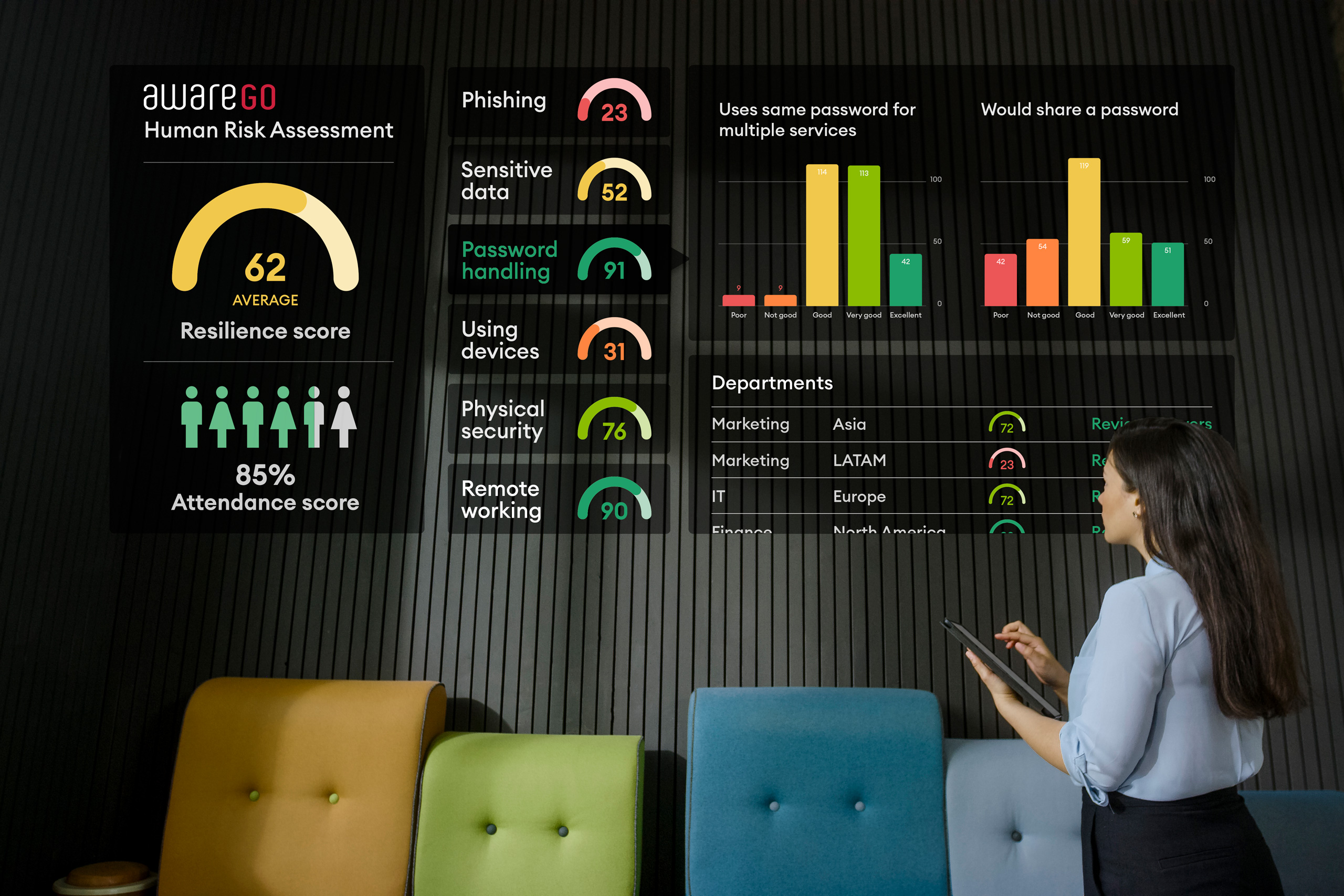
You can’t manage what you can’t measure. The AwareGO dashboard provides a real-time heat map of your organization’s human risk, identifying vulnerable departments and specific risk areas at a glance. This isn’t just data; it’s actionable intelligence. When you report to stakeholders, you can move beyond simple pass/fail rates and present a clear ROI. Show them how targeted training reduced the finance team’s risk score by 30% in a single quarter. This is how you justify security spend and prove the value of your human-centric strategy. See how AwareGO transforms human risk into human resilience.
For organizations that want an expert-led program without the internal overhead, our Managed Services offer a powerful solution. We partner with you to design, implement, and analyze your entire security training and phishing simulation program, ensuring you get maximum impact with minimal effort. It’s about making world-class security simple and accessible.
Transform Your Team into Your Strongest Defense
The threat landscape of 2026 demands more than just checking a box on your compliance list. Success isn’t measured by click rates alone; it’s about building lasting behavioral change that withstands sophisticated attacks. Understanding the psychology behind every click is the foundation for a stronger defense. An effective phishing simulation program is your tool to move your team from passive awareness to active resilience, forging a security culture that protects you from the inside out.
It’s time to stop reacting and start building. AwareGO empowers global enterprises to transform their human risk management with an award-winning library of micro-learning content. We provide the data-driven insights you need to quantify and continuously improve your security culture. Don’t just train your people. Empower them. Your strongest defense is already in your organization. Let’s unlock it together.
Start Your Human Risk Management Journey with AwareGO
Frequently Asked Questions
Is phishing simulation legal and ethical for my employees?
Yes, phishing simulations are both legal and ethical when you manage them correctly. They are a standard practice for security training, recognized by frameworks like NIST. The key is transparency. You should inform employees about the training program’s existence beforehand. The goal isn’t to trick or punish people; it’s to build a resilient security culture and provide a safe space to learn from mistakes.
How often should we run phishing simulations for our staff?
You should run phishing simulations at least monthly for the best results. Data from companies like Cofense shows that frequent, consistent testing builds strong security habits. Annual or quarterly tests are too infrequent for skills to stick. A monthly cadence keeps security top-of-mind and allows you to track behavioral improvements accurately. This approach transforms awareness from a one-time event into a continuous part of your Human Risk Management strategy.
What happens if an employee fails a phishing test multiple times?
Employees who fail multiple tests need targeted, supportive intervention, not punishment. A high failure rate signals a need for a different approach. Provide them with one-on-one coaching or specific micro-learning modules that address their knowledge gap. According to a 2022 study by Osterman Research, this positive reinforcement is far more effective than punitive measures, which can decrease morale and reporting rates.
Can phishing simulations be integrated with Microsoft 365 or Google Workspace?
Yes, modern phishing simulation platforms are designed for seamless integration. Top platforms connect directly with Microsoft 365 (via Azure AD) and Google Workspace. This allows for easy user syncing, automated campaign delivery, and simplified reporting. The integration means you can launch a campaign in minutes, not hours. It streamlines the entire process, making consistent training an effortless part of your existing workflow.
What is the difference between a phishing test and a phishing simulation?
A phishing test simply measures failure, while a simulation is a complete training exercise. A test just identifies who clicked. A simulation goes further. It provides immediate, contextual feedback and micro-training the moment an employee interacts with the simulated threat. This turns a mistake into a teachable moment. Think of it as a fire drill (simulation) versus just seeing if someone smells smoke (test). One builds resilience; the other just collects data.
How do I explain the value of phishing simulations to my CEO?
Frame it as a direct investment in reducing your biggest financial risk: human error. Explain that according to IBM’s 2023 Cost of a Data Breach Report, the average breach costs $4.45 million, and human error is a factor in 74% of them. A simulation program provides measurable data on your human risk, demonstrating a clear return on investment by actively lowering the probability of a costly incident. It’s proactive risk management, not just another IT expense.
What is the “reporting rate” and why is it more important than the “click rate”?
The reporting rate measures how many employees correctly identify and report a suspicious email. The click rate only tells you who failed. The reporting rate tells you who is actively defending your organization. A high reporting rate is the hallmark of a strong security culture. It shows your team has moved beyond simple awareness to become an active part of your security system. Verizon’s 2023 DBIR notes that reporting is a critical step in disrupting attack chains.
Does phishing simulation protect against ransomware and BEC?
Yes, it’s one of the most effective ways to defend against ransomware and Business Email Compromise (BEC). Over 90% of ransomware attacks and nearly all BEC incidents begin with a phishing email. By training your employees to spot and report these initial emails, you shut down the primary entry point for attackers. A well-trained team acts as a human firewall, neutralizing these threats before they can deploy malware or initiate a fraudulent transfer.