 Cybersecurity blog



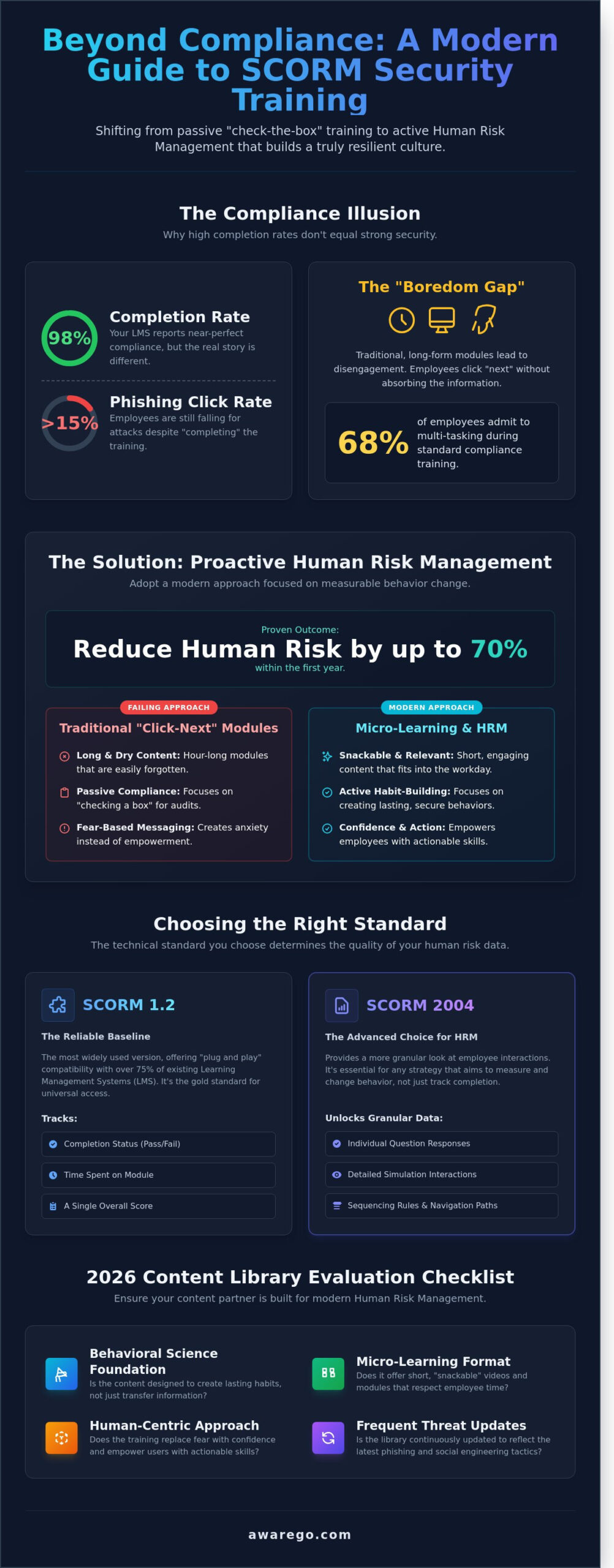
What if your 98% completion rate is actually your biggest security vulnerability? It’s a frustrating reality for many IT leaders who see perfect spreadsheet data while phishing click rates remain stuck at 15% or higher. You already know that boring, “click-next” modules don’t stop social engineering; they just train employees to ignore the message. We agree that your SCORM compliant security training should be as modern and engaging as the tools your team uses every day.
In this guide, you’ll learn how to deploy high-impact content that moves your organization from passive compliance to active Human Risk Management (HRM). We’ll show you how to eliminate technical friction in platforms like Workday or Cornerstone and use micro-learning to build a resilient security culture. You’ll discover how to automate your tracking and finally see measurable behavior change that reduces human risk by up to 70% within the first year.
Key Takeaways
- Discover how to seamlessly integrate SCORM compliant security training into your existing LMS to centralize data and simplify your reporting.
- Understand the critical differences between SCORM 1.2 and SCORM 2004 to choose the best tracking features for your organization’s specific needs.
- Learn why traditional long-form modules fail and how micro-learning can transform passive compliance into proactive human risk management.
- Master our 2026 checklist for evaluating content libraries based on behavioral science and the frequency of threat updates.
- Explore how a human-centric approach builds a resilient security culture by replacing fear with confidence and actionable habits.
Understanding SCORM Compliant Security Training in 2026
Cybersecurity isn’t just about firewalls anymore; it’s about people. By 2026, the technical landscape has shifted, yet the human element remains the most targeted vulnerability. To manage this, enterprises rely on the Sharable Content Object Reference Model (SCORM) to ensure their educational content integrates seamlessly with existing systems. SCORM acts as the universal translator between your training content and your Learning Management System (LMS). It ensures that every interaction, quiz score, and completion status is tracked accurately across the organization.
Enterprises prioritize SCORM compliant security training because they need centralized data. In 2024, the average large firm used over 100 different SaaS applications. Without a standard like SCORM, tracking who has learned what becomes a manual nightmare. This year, the focus has moved beyond simple “awareness” toward Human Risk Management (HRM). We aren’t just checking if someone watched a video; we’re measuring if their behavior is actually becoming more resilient. This integration allows security teams to correlate training data with real-world incidents, creating a clearer picture of organizational risk.
The Role of SCORM in Enterprise Security
Deploying security awareness training for compliance is significantly easier when the content speaks the same language as your infrastructure. SCORM provides the framework for this consistency. Whether you’re training a team in Reykjavik or a satellite office in Singapore, the experience remains uniform. This is vital for global organizations that must meet diverse regulatory requirements like GDPR or NIS2.
- Data Interoperability: SCORM allows for granular reporting that CISOs need for audits. You can prove exactly when a user completed a module.
- Scalability: You can push updates to thousands of users instantly without worrying about platform compatibility.
- Consistent Messaging: It ensures that the “human firewall” receives the same high-quality instruction regardless of their department.
Why Compliant Content Often Fails to Protect
Technical compliance doesn’t always equal safety. You can have a 100% completion rate on a SCORM module and still get hit by a phishing attack the next day. This happens because of the “boredom gap.” Traditional modules are often long, dry, and forgettable. Research from 2025 shows that 68% of employees admit to multi-tasking during standard compliance training. If the content doesn’t engage the learner, the risk remains high.
SCORM compliant security training acts as a bridge between technical infrastructure and human behavior. To close the gap, 2026 requires micro-learning that fits into a busy workday. It’s about building habits, not just passing a test. When training is snackable and relevant, it shifts from being a chore to being a core part of your company’s security culture. We’ve moved past the era of “check-the-box” exercises; we’re now in the era of measurable resilience.
SCORM 1.2 vs. SCORM 2004: Choosing the Right Standard for Security
Choosing a technical standard impacts how you understand your people. SCORM 1.2 has been the industry workhorse since its release in 2001. It remains the most widely used version because it offers a “plug and play” experience for over 75% of existing learning management systems. The Advanced Distributed Learning (ADL) Initiative continues to steward these standards, ensuring that content and platforms speak the same language. While its age makes it reliable, SCORM 1.2 often lacks the depth required for modern, behavior-based security programs.
Your choice between these versions determines the quality of your data. If you only need to know if someone finished a module, the older standard suffices. If you want to know why they failed a specific simulation, you need the advanced tracking found in SCORM 2004 4th Edition. This version provides a more granular look at employee interactions, which is essential for any SCORM compliant security training strategy that aims to move beyond simple compliance.
SCORM 1.2: The Reliable Baseline
This version is the gold standard for universal compatibility. Whether you use Moodle, SAP SuccessFactors, or Workday, SCORM 1.2 is guaranteed to work. Its primary strength is simplicity. It tracks completion, time spent, and a single score. This makes it ideal for standard annual security refreshers where the goal is 100% completion across a large workforce. However, it cannot report on specific question-level interactions. You see the final score, but you don’t see the specific phishing indicators an employee missed. This creates a visibility gap in your security culture.
SCORM 2004: For Data-Driven Security Programs
Security programs in 2026 are shifting toward SCORM 2004 for its “sequencing and navigation” capabilities. This allows for adaptive learning paths. If an employee demonstrates high proficiency in data privacy but fails a session on ransomware, the training can automatically adjust. It skips what they know and focuses on where they are vulnerable. This targeted approach respects your employees’ time and reduces “training fatigue.”
The enhanced data models in SCORM 2004 are vital for a modern human risk assessment. Instead of a binary pass or fail, you receive detailed analytics on where employees struggle during a simulation. This data allows you to identify the top 12% of users who represent the highest risk to your organization. When you integrate this with your human risk management software, you transform SCORM compliant security training into a proactive defense mechanism. You can view our full library to see how these data-rich standards improve your resilience.
Why Traditional SCORM Security Modules Fail (And How to Fix It)
Most legacy SCORM modules are built for compliance, not for people. In 2026, forcing your team through a 45 minute slide deck isn’t just boring; it’s a security risk. Research shows that employee engagement drops by 80% after the first 10 minutes of passive learning. When your staff zones out, they miss the critical cues that prevent a breach. Rustici Software explains SCORM as a technical standard for interoperability, but it doesn’t dictate content quality. Relying on stock-photo-heavy, generic modules creates a disconnect. Your team doesn’t see themselves in those scenarios, so they don’t apply the lessons to their daily habits.
The threat landscape moves fast. A module created in 2024 won’t cover the AI-driven deepfakes or sophisticated workspace hijacks trending in 2026. Static content fails because it treats security as a one-time event rather than an ongoing practice of Human Risk Management (HRM). To stay ahead, your SCORM compliant security training must be as agile as the threats it aims to stop.
Micro-learning: The Antidote to Training Fatigue
Science favors the sprint over the marathon. Studies indicate that 3 minute high-impact videos lead to 22% better knowledge retention than 30 minute lectures. By delivering SCORM compliant security training in snackable bites, you respect your employees’ time and mental energy. This frequent, low-friction approach is essential for building a sustainable cybersecurity culture. Micro-content reduces cognitive load by focusing on one single behavior at a time, turning complex security protocols into effortless daily habits.
Scenario-Based Learning and Storytelling
Fear is a poor teacher. It causes anxiety and leads to avoidance. Instead of “do this or get fired,” modern training uses human-centric narratives. We use real-world social engineering techniques to tell stories that resonate emotionally. When a video shows a relatable character handling a suspicious DM, your employees think, “I’ve seen that before.”
High-quality production value matters because it signals that you value your team’s experience. Professional cinematography and authentic scripts bridge the gap between a mandatory HR task and a valuable life skill. This shift from enforcer to partner is how you win buy-in and reduce human risk effectively. When training feels like a premium experience, employees are more likely to take the lessons to heart.
How to Evaluate a SCORM Content Library for Human Risk Management
Choosing the right SCORM compliant security training isn’t just about checking a box for auditors. It’s about building a resilient culture where every employee feels capable of defending the organization. By 2026, the average worker will face over 25 unique social engineering tactics every year. You need a library that treats people like assets, not liabilities. Use this guide to ensure your content library actually changes habits instead of just filling a progress bar.
High-impact security content relies on the concept of “edutainment.” This isn’t a gimmick; it’s a necessity for voluntary engagement. When training feels like a high-quality streaming service rather than a 1990s slideshow, participation rates climb. Look for content that uses vivid storytelling and scenario-based learning. This approach reduces the anxiety often associated with digital threats and replaces it with actionable confidence. If your employees don’t enjoy the training, they won’t remember the lessons when a real threat hits their inbox.
Technical and Accessibility Checklist
Your content must meet your employees where they are. In 2026, approximately 75% of the global workforce prefers mobile-first learning. Your SCORM compliant security training must be fully responsive, allowing for a seamless experience on tablets or smartphones. Accessibility is equally vital. Ensure every module meets WCAG 2.2 standards to support an inclusive workplace. Finally, test the SCORM wrapper for “plug and play” functionality. It should import into your LMS in seconds without requiring technical troubleshooting or custom coding.
Content Depth and Variety
Modern risk goes far beyond simple email links. A robust library must address the full spectrum of human risk, including vishing, smishing, and physical security breaches like tailgating. Passive video watching is no longer enough to build resilience. Look for interactive assessments that challenge the learner to make decisions in real-time. This content should be the backbone of your phishing simulation strategy. When an employee misses a red flag in a simulation, your library should automatically deliver a relevant micro-learning module to reinforce the correct behavior immediately.
- Update Frequency: Threats evolve weekly. Your library should offer monthly updates to cover 2026 risks like AI-generated deepfakes.
- Global Resilience: Ensure the library supports at least 30+ languages with localized nuances, not just direct translations.
- Measurable Impact: Choose content that provides data points beyond “completed,” focusing on behavioral change and risk reduction.
Effective Human Risk Management (HRM) requires a partner that understands the psychology of error. By selecting a library that prioritizes human-centric design, you move from passive awareness to active mitigation. You don’t need more content; you need content that sticks.
Explore the AwareGO SCORM content library today.
Integrating AwareGO’s SCORM Content into Your Security Ecosystem
Your existing Learning Management System (LMS) is the backbone of your corporate education. You don’t need to abandon your current infrastructure to upgrade your security culture. AwareGO delivers world-class content directly into your environment, ensuring that SCORM compliant security training feels like a natural part of your employees’ workday. We focus on a “plug-and-play” experience that removes technical friction for IT admins while maximizing impact for the end user.
Our approach is rooted in behavioral science. We replace long, boring lectures with micro-learning videos that last between 60 and 90 seconds. This snackable format respects your employees’ time and aligns with how the human brain actually retains information. By delivering frequent, short bursts of knowledge, you help your workforce build lasting security habits rather than just memorizing facts for a once-a-year exam.
The AwareGO SCORM Content Library Advantage
- Award-Winning Library: Gain instant access to more than 100 high-quality security videos that cover everything from password hygiene to physical security.
- 2026 Threat Readiness: Our content stays ahead of the curve. We provide regular updates that tackle modern 2026 threats, including AI-generated deepfakes and sophisticated social engineering tactics.
- Scalable Licensing: Whether you’re a mid-sized firm or a global enterprise with 50,000+ users, our licensing models adapt to your specific headcount and growth projections.
The beauty of this library lies in its variety. You can curate specific paths for different departments. For example, your finance team might receive specialized modules on wire transfer fraud, while your developers focus on secure coding practices. This targeted delivery makes the training relevant and engaging for everyone involved.
From Content to Culture: The Strategic Path
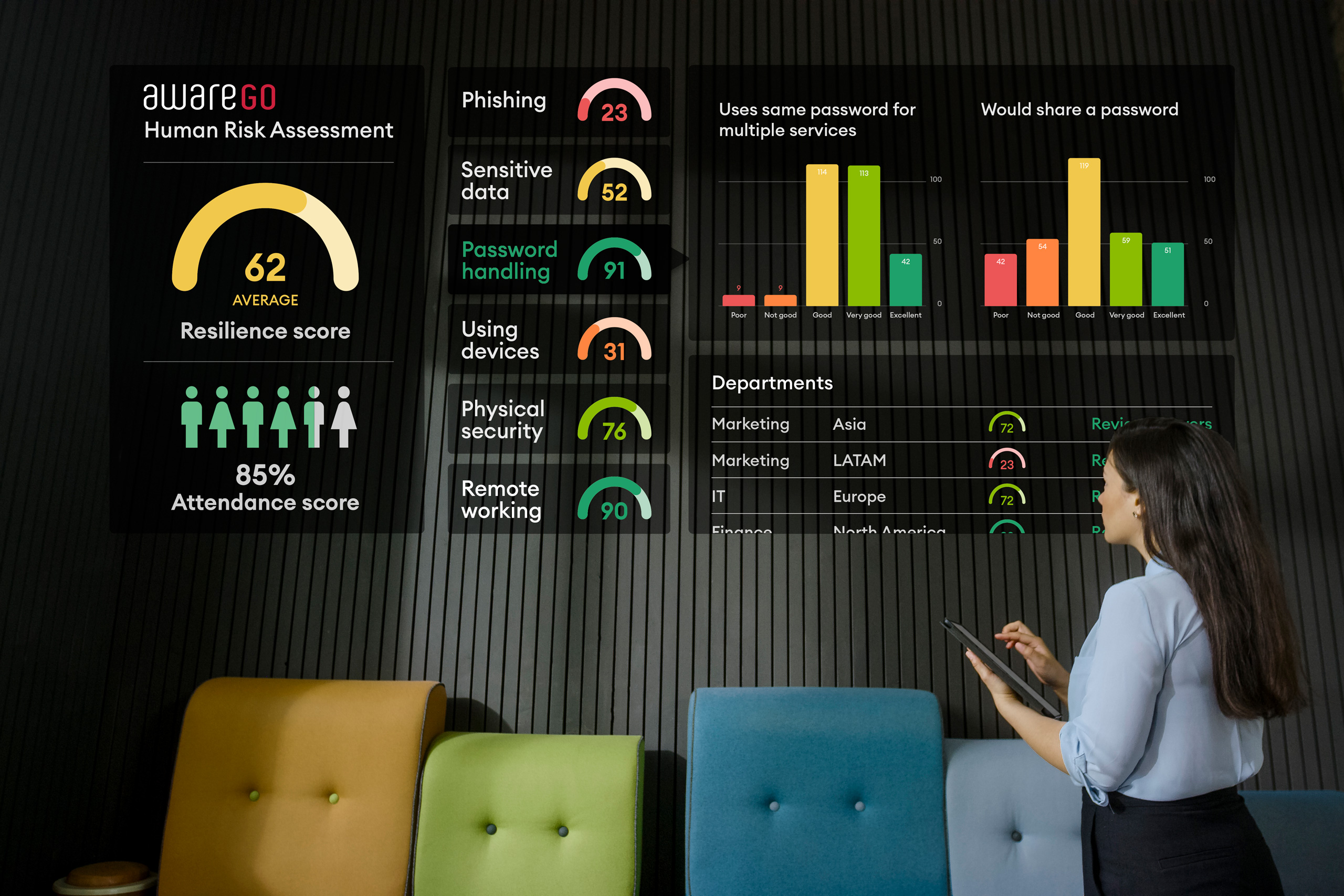
True security resilience goes beyond “check-box” compliance. While completion rates matter, they don’t tell the whole story of your human risk. AwareGO allows you to map every completion back to our Human Risk Profile. This integration transforms passive data into actionable intelligence. When you combine your LMS data with our behavioral assessments, you gain a 360-degree view of your organization’s vulnerabilities.
This data-driven strategy helps you identify which departments are most at risk and which topics require more attention. You’re no longer guessing if your training works; you’re measuring a tangible shift in security culture. It’s about moving from a state of anxiety to a state of confident, shared responsibility. Your employees stop being the weakest link and start being your most effective defense layer.
Ready to transform your training program? Explore the AwareGO SCORM Content Library and see how easy it is to bring world-class SCORM compliant security training to your workforce.
Future-Proof Your Security Culture Today
The landscape of 2026 demands more than just checking a box. You’ve seen why the technical distinction between SCORM 1.2 and 2004 matters for your LMS; however, the real impact comes from how your people respond to the material. Effective SCORM compliant security training succeeds when it treats your employees as partners, not problems. By integrating micro-learning modules that take less than 3 minutes to complete, you respect your team’s time while building lasting habits. AwareGO’s award-winning methodology is backed by behavioral science and trusted by Fortune 500 enterprises globally to manage human risk effectively. You can move beyond passive awareness and start fostering a genuine security culture that protects your organization 24/7. It’s time to replace outdated, boring lectures with content that your workforce actually enjoys. Take the next step in your Human Risk Management journey by choosing a library designed for the modern professional. Upgrade your LMS with AwareGO’s SCORM Content Library and watch your workforce become your strongest line of defense. You’ve got the tools; now it’s time to empower your people.
Frequently Asked Questions
What is the difference between SCORM 1.2 and SCORM 2004 for security training?
SCORM 1.2 is the most widely adopted standard since its 1999 release, offering simple pass or fail tracking. In contrast, SCORM 2004 provides more granular data, including complex sequencing and detailed interaction results. Most organizations find SCORM 1.2 sufficient for basic awareness, but 2004 is better if you want to track specific question-level performance across your workforce.
Can I use AwareGO security videos in my own LMS?
Yes, you can easily host our micro-learning content on your internal platform. We provide SCORM compliant security training files that integrate with 95% of Learning Management Systems on the market today. This allows you to maintain a single source of truth for all your employee development records while benefiting from our human-centric storytelling and high-quality video content.
Is SCORM compliant training enough to meet regulatory requirements like GDPR or SOC2?
SCORM is the delivery vehicle, but the content and tracking are what satisfy auditors. While 85% of compliance frameworks require proof of training, you must ensure your modules specifically cover the 99 articles of GDPR or the Trust Services Criteria of SOC2. Using these standards makes it easy to export the completion reports you need during an annual audit to prove your team is prepared.
How do I track employee progress with SCORM security modules?
Your LMS automatically communicates with the SCORM package to record start dates, completion status, and assessment scores. This data flows through the SCORM API, providing real-time visibility into your workforce’s resilience. You can see exactly which 15% of your staff haven’t finished their training, allowing for targeted follow-ups that strengthen your security culture without bothering those who have already finished.
What happens if my LMS doesn’t support the latest SCORM version?
You should use SCORM 1.2 because it remains the universal fallback for older systems. Even if your LMS was built before 2010, it likely supports this version. We offer our content in multiple formats to ensure your Human Risk Management strategy doesn’t stall due to technical limitations. If you’re unsure, a 5 minute test upload usually clears up any compatibility concerns immediately.
How often should I update the SCORM content in my security library?
You should refresh your training content every 90 to 180 days to stay ahead of evolving threats. With over 450,000 new malware variants detected daily, static training quickly becomes obsolete. Regular updates keep the material relevant for your team and ensure you’re addressing the latest social engineering tactics. Frequent, short updates are more effective than a single, long annual session.
Can SCORM training modules be used on mobile devices?
Yes, modern SCORM modules built with HTML5 are compatible with 99% of mobile browsers. This flexibility allows your employees to complete their micro-learning during a 3 minute commute or a coffee break. Mobile-friendly training is a core part of building sustainable security habits because it meets your workforce where they already spend their time, making the learning process feel seamless and natural.