 Cybersecurity blog



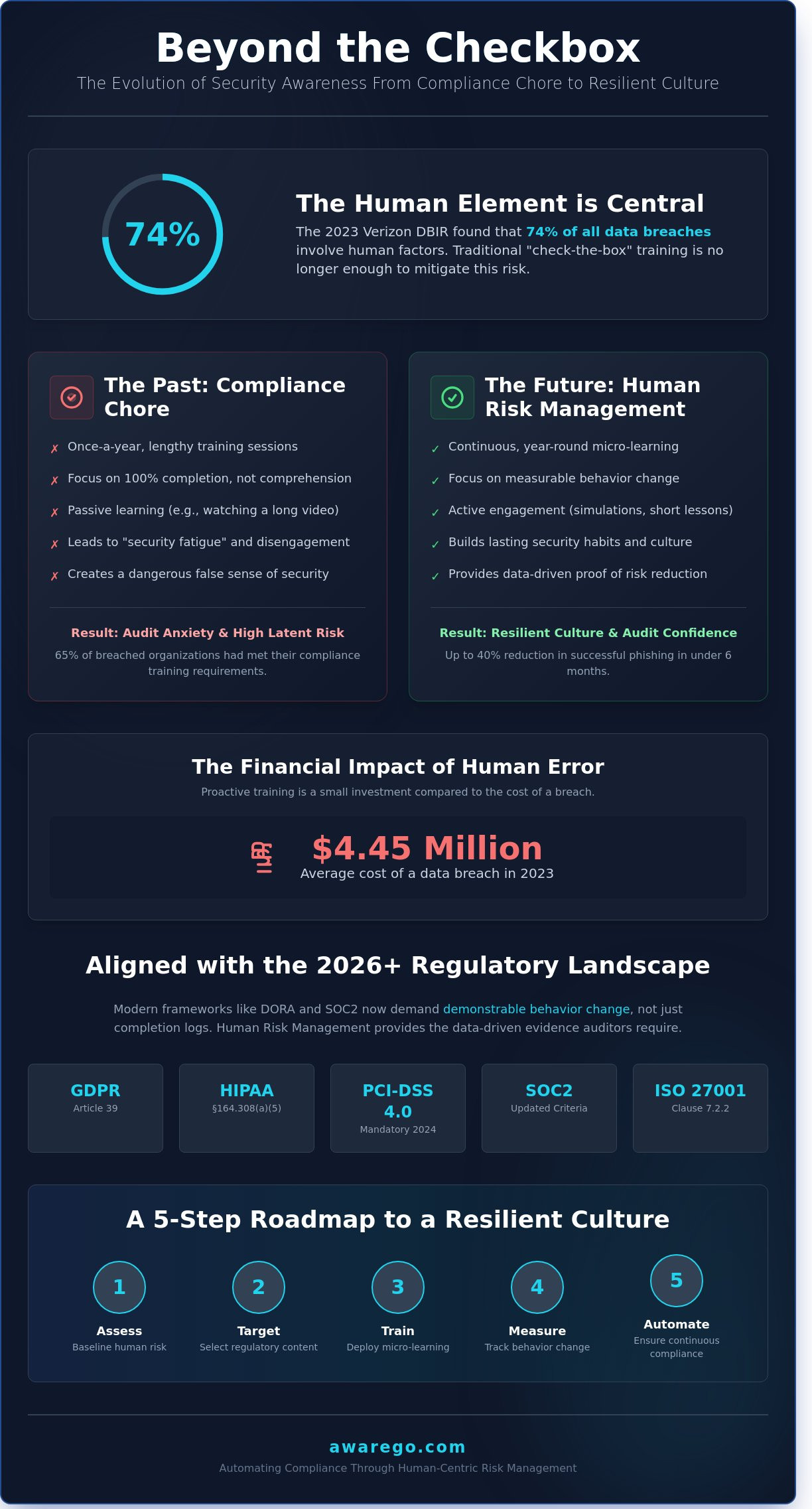
The 2023 Verizon Data Breach Investigations Report found that 74% of all breaches involve the human element, yet many organizations still treat security awareness training for compliance as a boring, once-a-year chore. You probably know the feeling of audit anxiety, wondering if your team is actually learning anything or just rushing to finish a mandatory video. It’s difficult to feel confident when training engagement is low and you can’t prove that your efforts are truly reducing risk. You deserve a strategy that does more than just satisfy a regulator’s checklist.
This guide will show you how to transform basic compliance into a robust security culture through Human Risk Management (HRM). We’ll explore how shifting to a micro-learning model can help you pass audits with ease while reducing successful phishing attempts by up to 40% in less than six months. You’ll learn how to turn your employees into a measurable line of defense, making security a shared habit rather than a technical hurdle.
Key Takeaways
- Move beyond passive checklists and learn how Human Risk Management (HRM) transforms your security strategy for 2026.
- Discover how to map your security awareness training for compliance to global frameworks like GDPR, SOC2, and HIPAA.
- Use behavioral science and micro-learning to bridge the gap between “knowing” and “doing” to build lasting security habits.
- Follow our five-step roadmap to assess your human risk baseline and select content that targets your specific regulatory needs.
- Explore how a human-centric platform automates your compliance goals while building a resilient, empowered security culture.
The Evolution of Security Awareness Training for Compliance in 2026
Compliance used to be a yearly chore. You sat through a long video, took a quiz, and forgot everything by lunch. In 2026, that model is dead. Modern auditors no longer care about who watched a video; they care about how your team behaves when a real threat hits their inbox. We’ve moved from passive awareness to active Human Risk Management (HRM). This approach treats your team as your strongest defense rather than your weakest link. It’s about building a resilient security culture where every person feels empowered to protect the organization.
The stakes have never been higher. Research from Stanford University confirms that the human element plays a role in 90% of data breaches. This isn’t a reflection of employee incompetence. It’s a sign that attackers have perfected the art of psychological manipulation. To understand the foundation of these programs, you can explore the broader definition of What is Security Awareness? and how it has evolved over the decades. Today, security awareness training for compliance must be dynamic, frequent, and deeply rooted in behavioral science to be effective.
Why ‘Check-the-Box’ Training is a Liability
Relying on 100% completion rates creates a dangerous false sense of security. A study by the Ponemon Institute found that 65% of organizations that suffered a breach had technically met all their compliance training requirements. When you prioritize completion over comprehension, you get security fatigue. Employees begin to see security as a hurdle to their “real” work. This disconnect is expensive. The average cost of a data breach rose to $4.45 million in 2023, while the cost of proactive, human-centric training is a small fraction of that risk. If your training doesn’t change habits, it isn’t compliance; it’s just theater.
The 2026 Regulatory Landscape: What’s Changed?
Regulators have caught up to the reality of modern threats. New standards in 2026, such as the fully implemented Digital Operational Resilience Act (DORA) and updated SOC2 requirements, focus on demonstrable behavior change. You can’t just show a list of names anymore. You must provide data showing that your team can identify and report threats in real-time. Micro-learning has become the gold standard. By delivering three-minute lessons twice a month, you keep security top-of-mind without disrupting the workday. Phishing simulations are also now a mandatory audit component for 85% of enterprise-level certifications. Auditors want to see a downward trend in click rates and an upward trend in reporting rates. This data-driven approach ensures that your security awareness training for compliance actually reduces your human risk profile.
Mapping Training Requirements to Global Regulatory Frameworks
Compliance isn’t just about avoiding fines. It’s about building a culture where security is second nature. While every law has its own flavor, they all share a common denominator: you must implement “reasonable and appropriate” security measures. This phrase is the heartbeat of modern regulation. It means your security awareness training for compliance shouldn’t be a generic, one size fits all video. It needs to reflect the specific risks your people face every day. Effective training turns your team from a potential vulnerability into your strongest defense.
Documenting this process is vital for multi-jurisdictional operations. If you operate in both the EU and the US, you need a centralized system to track completion rates and assessment scores. Regulators don’t just want to know that you bought a platform; they want proof that your employees understand the material. Using automated logs and real time dashboards helps you stay audit ready 365 days a year. This level of Human Risk Management ensures you aren’t just checking a box, but actually reducing the 95% of breaches that involve human error, according to the 2023 IBM Cost of a Data Breach Report.
GDPR, HIPAA, and PCI-DSS: The Big Three
GDPR Article 39 mandates that Data Protection Officers oversee the “awareness and training of staff” involved in processing operations. Failure to comply can result in fines up to €20 million or 4% of global turnover. HIPAA §164.308(a)(5) requires a formal security awareness and training program for your entire workforce. Meanwhile, PCI-DSS 4.0, which became mandatory in March 2024, demands that training programs evolve to address current threats like phishing and social engineering. These laws aren’t suggestions; they’re requirements for staying in business.
NIST, SOC2, and ISO 27001: The Gold Standards
NIST SP 800-50 provides the blueprint for building an Information Technology Security Awareness program. It emphasizes that security is a functional requirement, not an afterthought. For those pursuing SOC2, Common Criteria 1 focuses on how training supports the overall control environment. ISO/IEC 27001:2022 Clause 7.2.2 requires organizations to ensure that persons doing work under the organization’s control are aware of the information security policy. Many organizations look to SANS security awareness training resources to benchmark these high standards and ensure their content meets global expectations for technical depth.
Role based training is the final piece of the puzzle. You can’t give the same training to a marketing intern and a system administrator with privileged access. Privileged users handle your most sensitive data and systems, making them high value targets for attackers. Tailoring your security awareness training for compliance to specific roles ensures that those with the most power also have the most resilience. By focusing on specific habits and behaviors, you replace anxiety with confidence, empowering your team to act as a unified front against digital threats.
Beyond the Checkbox: Why Behavioral Science is the Secret to Audit Success
Compliance isn’t a destination; it’s a continuous state of readiness. Most organizations treat security awareness training for compliance as a once a year event. They tick the box and hope for the best. This approach ignores how human brains actually work. Behavioral science tells us that “knowing” a rule doesn’t mean “doing” the right thing. To pass an audit and actually stay secure, you must turn knowledge into habits. It’s about resilience, not just regulations. By following the NIST security awareness guidelines, you can build a framework that satisfies auditors while actually changing employee behavior.
The transition from passive awareness to active Human Risk Management (HRM) requires a shift in perspective. You aren’t just teaching people about phishing. You are training their brains to recognize threats instinctively. According to the 2022 Verizon Data Breach Investigations Report, 82% of breaches involved a human element. This data proves that technical controls alone aren’t enough. You need a workforce that acts as a human firewall. This happens when security becomes a reflex rather than a chore.
The Micro-Learning Advantage
Traditional training often fails because of the Ebbinghaus Forgetting Curve. This psychological principle shows that humans forget 70% of new information within 24 hours if they don’t apply it. Long, boring seminars are a waste of resources. Instead, use micro-learning. Short, three minute videos increase retention rates by 20% compared to traditional hour long sessions. These bite sized lessons fit perfectly into a busy workday without causing friction or “training fatigue.”
When you provide snackable content, you respect your employees’ time while building lasting habits. Frequent, low stakes engagement keeps security at the front of the mind. It turns a massive, intimidating topic into manageable pieces. This method ensures that when an auditor asks about your training program, you can show consistent, year round engagement rather than a single spike in activity once a year.
Creating a Culture of Shared Responsibility
Fear based messaging doesn’t work. It creates anxiety and leads to employees hiding their mistakes. Effective security awareness training for compliance moves away from “do this or get fired” toward empowerment. You want your team to feel like they are the defenders of the company. When people feel a sense of ownership, they are more likely to report suspicious emails or flag potential insider threats. A strong security culture reduces the likelihood of accidental breaches by making compliance a shared value.
Leadership plays a vital role here. When executives participate in the same micro-learning modules as the rest of the staff, it sends a powerful message. It shows that security isn’t just an IT problem; it’s a foundational part of how the business operates. This top down modeling encourages everyone to take their role seriously. It transforms the workplace from a group of individuals into a unified front against digital threats.
Finally, you must quantify human risk. Qualitative feedback like “the team liked the videos” won’t impress an auditor. You need hard data. Modern HRM platforms turn training participation and phishing simulation results into quantitative risk scores. You can track improvement over time, identifying specific departments that might need more support. This data driven approach allows you to prove to stakeholders and regulators that your security posture is actually improving. You are no longer guessing; you are measuring resilience in real time.
5 Steps to Implementing a Compliance-First Human Risk Program
Compliance isn’t a destination; it’s a continuous state of readiness. Most organizations treat security awareness training for compliance as a yearly hurdle to clear. This reactive approach leaves gaps that attackers easily exploit. To build true resilience, you must shift toward Human Risk Management (HRM). This means moving beyond simple slide decks and focusing on measurable behavioral change. By following a structured, five-step framework, you can transform your employees from potential liabilities into your strongest defensive asset.
Step 1: The Human Risk Audit
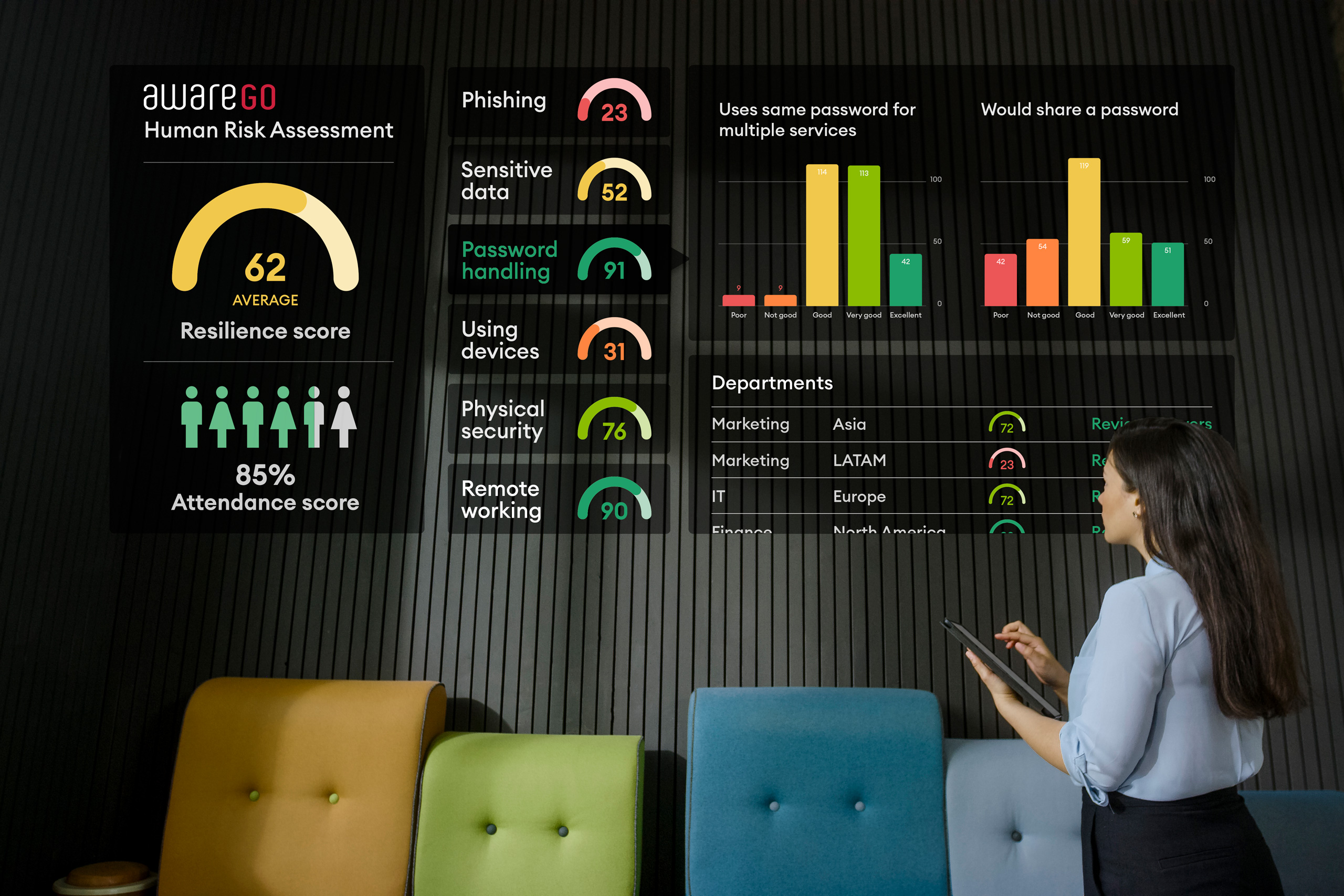
You can’t manage what you don’t measure. Start by identifying high-risk user groups within your organization. Data from the 2023 Verizon Data Breach Investigations Report shows that 74% of all breaches involve the human element. You need to know which departments are most vulnerable. For instance, finance teams often face 3x more business email compromise (BEC) attempts than other departments. Use a Human Risk Assessment to establish your baseline. This data allows you to set measurable KPIs, such as a 25% reduction in phishing click rates over six months. When you present these numbers, you justify your security training budget with hard evidence rather than guesswork.
Step two requires selecting a content library that maps directly to your regulatory obligations. Whether you’re aiming for SOC 2, HIPAA, or GDPR compliance, your training must reflect those specific standards. A one-size-fits-all video won’t satisfy an auditor looking for evidence of data privacy training under GDPR Article 32. Choose micro-learning modules that cover specific controls. These short, punchy lessons ensure that employees retain information without experiencing training fatigue. It’s about quality and relevance, not just quantity.
The third step is automating your delivery and phishing simulations. Manual scheduling is a recipe for missed deadlines and compliance gaps. Automation ensures that a new hire in your marketing department receives their initial security awareness training for compliance within their first 48 hours. Consistent, automated phishing simulations provide a safe environment for employees to practice their skills. Aim for at least one simulation per month. This frequency keeps security top-of-mind and provides a steady stream of data for your risk profile.
Step 4: Benchmarking and Reporting
Comparative data is essential for modern compliance. You need to know how your organization stacks up against others in your sector. According to the 2024 SANS Security Awareness Report, organizations with dedicated program leads show significantly higher maturity levels. Presenting security culture metrics to the board requires a shift in language. Don’t just report completion percentages; show the “Human Risk Score” across different regions or departments. This high-level view helps executives understand where the business is most exposed. Automating the evidence collection process is the final piece of this puzzle. Instead of scrambling before an audit, your system should generate real-time reports that prove risk reduction and policy adherence.
Finally, your fifth step is the generation of audit-ready reports. These documents must prove that your training actually changed behavior. An auditor doesn’t just want to see a list of names; they want to see that your “Mean Time to Report” (MTTR) a suspicious email has improved. In 2024, the average cost of a data breach reached $4.88 million. Proving that your workforce can identify a threat in seconds rather than hours is the ultimate evidence of a successful program. This level of detail turns a routine audit into a demonstration of your organization’s operational excellence.
Ready to see how your team measures up? Learn how to reduce your human risk score with our data-driven platform.
AwareGO: Automating Compliance Through Human-Centric Risk Management
Compliance often feels like a heavy administrative chore. You spend weeks chasing employees to finish a 40 minute slide deck they will likely forget by lunch. AwareGO changes this narrative by focusing on Human Risk Management (HRM). We turn your workforce into a resilient shield rather than a vulnerability. Our approach treats security as a shared human responsibility, replacing fear with actionable confidence.
Most organizations struggle because 82% of data breaches involve a human element, according to the 2023 Verizon Data Breach Investigations Report. Simply checking a box isn’t enough to stop a sophisticated social engineering attack. You need a strategy that actually changes behavior. By focusing on the psychology of how people learn and work, we help you build a security culture that satisfies auditors and protects your bottom line.
Ditch the Boring Slides: Engagement That Works
Traditional training fails because it ignores how the human brain processes information. Our Red Dot-winning video content uses high-quality storytelling to make lessons stick. These one to two minute micro-learning sessions reduce cognitive overload and keep your team focused. Research shows that shorter, frequent training sessions can improve information retention by up to 20% compared to long, annual sessions. You don’t have to force people to pay attention; the quality of the content does that for you.
Personalization is the key to relevance. You can deploy specific learning paths for different departments. Your finance team needs to understand invoice fraud, while your developers need to focus on secure coding and SOC2 requirements. This targeted approach ensures that security awareness training for compliance feels helpful rather than intrusive. Whether you use our cloud-based platform or integrate via SCORM into your existing LMS, the setup remains seamless and fast.
- High Retention: Micro-learning fits into a busy workday without disrupting productivity.
- Departmental Focus: Tailor content to the specific risks faced by different roles.
- Flexible Delivery: Choose between our cloud platform or your own LMS via SCORM.
Audit-Ready in Minutes, Not Days
Preparing for an audit shouldn’t require a week of spreadsheets and manual data entry. Our platform provides one-click reporting for the most common regulatory frameworks, including GDPR, SOC2, and HIPAA. We’ve mapped our entire content library to these specific mandates, so you can prove compliance instantly. You get a clear, bird’s-eye view of your organization’s risk posture through real-time dashboards that highlight exactly where your vulnerabilities lie.
Our Phishing Simulator adds another layer of empirical proof for auditors. It moves beyond passive learning by testing your employees with real-world scenarios. When an employee misses a red flag, the platform provides “just-in-time” training to correct the behavior immediately. This creates a measurable feedback loop that transforms raw stats into a comprehensive Human Risk Management strategy. You aren’t just training; you’re actively reducing the probability of a breach. Effective security awareness training for compliance should empower your people to be your strongest link.
Ready to transform your security culture? Book a demo to see how AwareGO automates your compliance training and helps you manage human risk with ease.
Future-Proof Your Security Culture
Regulatory landscapes are shifting fast. By 2026, meeting global standards like SOC2 and GDPR will require moving beyond static checklists toward active behavioral change. You’ve seen how traditional methods fail to stick; that’s why a modern approach to security awareness training for compliance must prioritize human psychology over simple repetition. By focusing on Human Risk Management (HRM), you transform your workforce from a potential vulnerability into a measurable asset. This shift ensures your organization stays audit-ready while fostering genuine resilience.
AwareGO empowers global enterprises to automate this process through a data-driven platform that delivers results. Our high-quality micro-learning content achieves 90%+ engagement rates, making security education a seamless part of the workday rather than a disruption. You’ll gain the visibility needed to identify specific risks and address them before they escalate. It’s time to replace anxiety with actionable confidence and lead your team toward a safer digital future.
Start your 2026 compliance journey with a free Human Risk Assessment
Frequently Asked Questions
Is security awareness training legally required for GDPR compliance?
Yes, Article 39 of the GDPR mandates that Data Protection Officers ensure staff receive security awareness training for compliance. While the law doesn’t specify a weekly cadence, 100% of employees handling personal data must understand their responsibilities. This helps you avoid fines that can reach €20 million or 4% of global turnover, proving that a strong security culture is a legal necessity.
How often should employees undergo security awareness training for SOC2?
You must conduct training at least once every 12 months to satisfy SOC2 Type 1 and Type 2 audits. However, the AICPA Trust Services Criteria suggest ongoing education is better for building resilience. Transitioning to monthly micro-learning sessions reduces your human risk score more effectively than a single annual event. This approach ensures that 100% of your team stays sharp against evolving digital threats.
What are the specific HIPAA requirements for security training?
HIPAA Administrative Simplification Regulation 45 CFR § 164.308(a)(5) requires a formal security awareness and training program for all workforce members. You’ll need to document specific modules on password management, malware protection, and login monitoring. Failing to provide this training contributed to 24% of HIPAA breaches reported to the OCR in 2023, making documentation a critical part of your defense strategy.
Can phishing simulations be used to satisfy compliance audits?
Yes, phishing simulations serve as measurable evidence of security awareness training for compliance under frameworks like PCI DSS 4.0. Auditors look for click rates and reporting metrics to prove your team can identify real-world threats. In 2023, organizations using monthly simulations saw a 75% improvement in employee reporting habits. This data transforms a passive checklist into an active, verifiable defense strategy.
What is the difference between security awareness and human risk management?
Security awareness focuses on knowledge, while Human Risk Management (HRM) uses data to change behavior and reduce actual vulnerabilities. Awareness is the first step, but HRM measures 7 distinct risk domains to provide a holistic view of your security culture. It’s the difference between telling someone to use a VPN and seeing that 92% of your remote team actually uses one daily.
How do I prove to an auditor that my training program is effective?
You provide completion certificates, quiz scores, and behavioral data logs showing participation across 100% of your staff. Auditors want to see a clear audit trail that links training modules to specific compliance controls. Using a dashboard that tracks your human risk score over a 12 month period gives them the hard evidence they need to verify your program actually works.
Does NIST 800-53 require specific role-based training?
Yes, the AT-3 control in NIST 800-53 specifically requires role-based security training for personnel with significant security responsibilities. This means your system admins need different modules than your HR team. Since the 2020 update to Revision 5, there’s a heavier emphasis on social engineering and the human element of your defense strategy, requiring tailored content for different risk profiles.
What happens if an organization fails to meet training compliance standards?
You face legal penalties, loss of certifications, and increased insurance premiums that can rise by 30% or more. Beyond the 2024 average data breach cost of $4.88 million, failing an audit can lead to the immediate termination of B2B contracts. It’s a risk that threatens your bottom line and your reputation with every single customer you’ve worked hard to gain.