 Cybersecurity blog



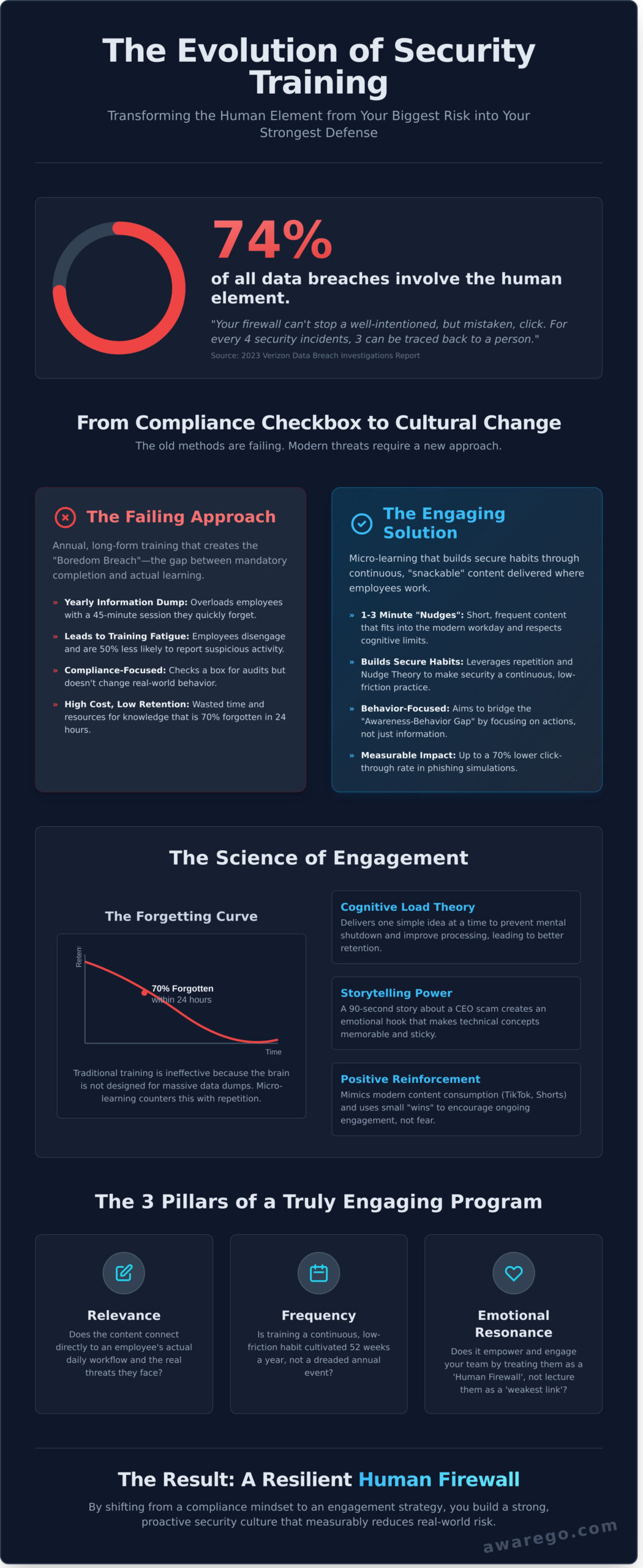
The 2023 Verizon Data Breach Investigations Report confirmed a stark reality: 74% of all breaches involve the human element. That means for every four security incidents, three can be traced back to a person, not just a system failure. Your firewall can’t stop a well-intentioned, but mistaken, click.
You already know this. You see it in the low engagement rates for your annual training and the quiet groans when security is mentioned in a meeting. You’re likely stuck in a cycle of check-the-box compliance, struggling to prove that your efforts actually reduce your organization’s real-world human risk. It’s a frustrating loop that leaves your company exposed.
But what if you could change that? This isn’t about more training; it’s about smarter training. We’ll show you exactly how to build a truly engaging security awareness training program by leveraging the core principles of behavioral science and the proven impact of micro-learning. Get ready to transform your team from a potential liability into your strongest line of defense, creating a security culture that is both effective and empowering.
Key Takeaways
- Learn why traditional, long-form security training fails to change employee behavior and can actually increase your security risk.
- Use the principles of micro-learning to deliver short, frequent training that makes secure habits stick.
- Bridge the critical “Awareness-Behavior Gap” by building engaging security awareness training that focuses on actions, not just information.
- Discover a 5-pillar framework for creating a strong security culture, starting with how to identify your biggest human risks.
What is Engaging Security Awareness Training in 2026?
Let’s be direct. Your old 45-minute annual slide deck isn’t just boring; it’s a security liability. In 2026, the threat landscape moves too fast for a once-a-year information dump. True engagement isn’t about completion rates. It’s the powerful intersection of three critical elements:
- Relevance: Does the content connect directly to an employee’s daily workflow?
- Frequency: Is training a continuous habit, not a yearly event?
- Emotional Resonance: Does it empower your team, or does it lecture them?
For decades, the goal of traditional Security Awareness was to simply inform employees about digital threats. This passive approach is no longer enough. The modern standard has evolved into a proactive strategy: Human Risk Management (HRM). It’s a fundamental shift from making people aware of risks to equipping them with the secure habits to manage them effectively. This isn’t just theory; it’s a measurable reality. Organizations that implement continuous, engaging security awareness training see up to a 70% lower click-through rate in phishing simulations compared to those stuck in a compliance-only mindset.
The 2026 Engagement Standard
By 2026, threats powered by generative AI won’t be a future concept; they will be a daily operational risk. Training must directly address hyper-personalized phishing emails and convincing deepfake voice calls. To counter this, you must treat your employees as your ‘Human Firewall,’ not your ‘weakest link.’ This empathetic approach builds a culture of shared responsibility. Remember, checking a box for your SOC 2 audit doesn’t stop a data breach; a resilient and engaged workforce does.
Measuring the ‘Boredom Breach’
Disengaged employees create hidden risks. They use unapproved apps (Shadow IT) to get their work done faster and are 50% less likely to report a suspicious email. You can spot this “Training Fatigue” in your metrics when completion rates are high but real-world security incidents and phishing simulation failures remain static. You’re getting compliance, but not behavior change. The Boredom Breach is the gap between mandatory completion and actual cognitive retention.
The Psychology of Snackable Content: Why Micro-learning Wins
Traditional security training is broken. It’s built on a flawed assumption: that a single, massive information dump can create lasting security habits. It can’t. The science proves it. According to Hermann Ebbinghaus’s “Forgetting Curve,” people forget an average of 70% of new information within 24 hours. That one-hour annual training session you mandate? Most of it is gone by Tuesday.
The human brain isn’t designed for data dumps. It’s designed for stories, patterns, and repetition. This is where micro-learning changes the game. We’re talking about short, focused, 1-3 minute content ‘nudges’ that fit seamlessly into a modern workday. This isn’t about ‘dumbing down’ security; it’s about being smart with how you deliver it, creating a truly engaging security awareness training experience.
Cognitive Load Theory explains why this works. When you overload employees with complex policies and technical jargon, their brains shut down. They can’t process it all. Micro-learning delivers one simple idea at a time. One video on spotting a phishing email. One short quiz on password strength. This simplicity is the ultimate security sophistication because it leads to retention, not frustration.
And the most powerful tool for retention? Storytelling. Instead of a dry list of ‘don’ts,’ a 90-second animated story about a CEO who almost wired money to a scammer creates an emotional hook. Your employees won’t just remember the rule; they’ll remember the feeling. That’s how you make technical concepts stick.
Behavioral Science in Security
Effective training taps into how people actually think and act. It mimics how your employees already consume information in 2026: short, visual, and on-demand, like TikTok or Shorts. Nudge Theory shows that these small, weekly nudges are far more effective at building secure habits than a single lecture. It’s about positive reinforcement, not fear. Each completed module provides a small dopamine hit-a feeling of accomplishment-that encourages ongoing engagement.
Frequency vs. Duration
A resilient security culture isn’t built in a day; it’s cultivated over 52 weeks a year. The goal is to make security a continuous, low-friction habit, not a dreaded annual event. This shift toward continuous reinforcement is a cornerstone of modern security awareness training practices, moving you from a compliance checkbox to a proactive defense. By delivering content directly through Slack, Teams, or email, you meet employees where they already work. This seamless integration is key to The Benefits of Micro-Learning in Cybersecurity, as it removes barriers and makes participation effortless.
Ultimately, this is the foundation of effective Human Risk Management. It respects your team’s time and cognitive limits by delivering the right information, in the right format, at the right moment. Short, frequent, and story-driven content isn’t just more interesting; it’s the only approach that delivers measurable, lasting change. Building this culture starts with the right content, and our library of award-winning micro-learning videos is designed to do just that in minutes a week.
Content vs. Context: Bridging the Awareness-Behavior Gap
Your employee just finished a training module on phishing. They can define it, list the red flags, and they aced the quiz. An hour later, a clever spear-phishing email lands in their inbox, and they click the link. Why? This is the Awareness-Behavior Gap in action. It’s the frustrating space between knowing the right thing to do and actually doing it under pressure.
This isn’t a failure of intelligence. It’s a failure of context. The 2023 Verizon Data Breach Investigations Report found that 74% of all breaches involve the human element. Smart people make mistakes when they are busy, stressed, or operating on autopilot. Traditional training provides the content (what a threat looks like), but it fails to provide the context (how to react to that specific threat, right now, in your workflow). Truly engaging security awareness training closes this gap by delivering the right lesson at the moment of risk, turning abstract knowledge into a real-world reflex.
It also leverages powerful social proof. When employees see their peers confidently reporting suspicious messages instead of clicking, it normalizes secure behavior. This creates a positive feedback loop where security becomes a shared, visible part of your company culture, not just a rule in a handbook.
The Myth of the ‘Weakest Link’
Let’s address the most common objection: “You can’t train away human error.” This statement treats your people as a liability. We see it differently. Your employees aren’t your weakest link; they are your most powerful and intelligent threat detection grid. We call it the Human Sensor Network. Empowering this network means shifting from a mindset of blame to one of resilience. It’s about building a security-first instinct that survives a high-pressure Friday afternoon.
Scenario-Based Learning
Effective training moves beyond a list of “don’ts.” It replaces “Don’t click on suspicious links” with “Here is how your team handles an urgent request for a wire transfer.” This is scenario-based learning. It’s relevant, actionable, and role-specific. The phishing threat for your finance team looks completely different from the one targeting your developers. One-size-fits-all content fails because it’s irrelevant to most of your audience. Using high-quality Security Awareness Videos to simulate these real-world pressures helps employees rehearse their responses in a safe space, making the right decision an automatic habit when it matters most.
5 Pillars of a Truly Engaging Security Awareness Program
Moving from a “check-the-box” mentality to a vibrant security culture doesn’t happen by accident. It’s built on a strategic framework. Effective programs are designed, not just deployed. They treat your employees like the intelligent, busy professionals they are. Forget the hour-long, fear-based lectures of the past. The future of security training is human-centric, data-driven, and genuinely engaging.
A truly human-centric approach recognizes that an employee’s focus at work is deeply connected to their well-being at home. For parents on your team, challenges with their children’s mental or behavioral health can be a significant source of stress, impacting their ability to stay vigilant against threats. Supporting the whole employee includes providing resources for their family’s needs; for example, you can discover Handspring Health for specialized pediatric therapy.
This holistic view of employee well-being is key. Just as you protect them from digital threats, a supportive culture also addresses their real-world needs, especially during major transitions like international relocation. For instance, securing compliant health coverage is a crucial step for any employee moving to Europe. If you have team members heading to Poland, you can discover Insurance VISA to see how this essential requirement is managed.
Here are the five pillars that support a truly engaging security awareness training program:
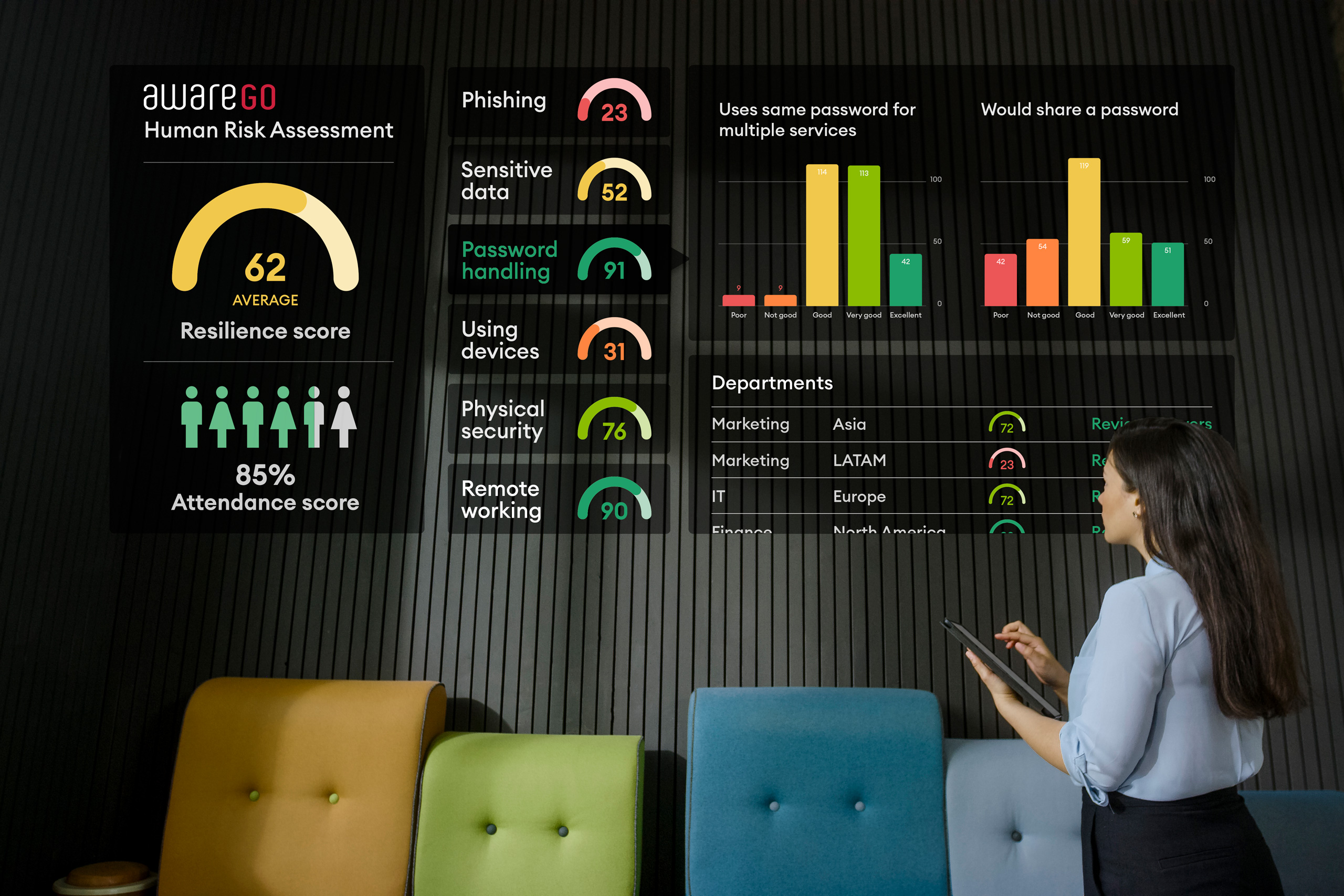
- Audit Your Current Culture: You can’t fix what you don’t measure. A comprehensive Human Risk Assessment is your starting point. It reveals the specific gaps in your organization’s knowledge and behavior, showing you exactly where to focus your efforts.
- Prioritize ‘Snackable’ over ‘Sizable’: The average professional’s attention span has dropped to just 47 seconds for any single work task. Replace outdated, 60-minute courses with dynamic, two-minute micro-learning modules that fit seamlessly into the workday.
- Gamify without the Gimmicks: Healthy competition drives engagement. Use departmental leaderboards to foster teamwork and award digital badges for completing learning paths. The goal is motivation, not public shaming of individuals.
- Automate the Reinforcement: People forget 70% of what they learn within 24 hours. A recurring, automated “drip” of content-a short video here, a quick quiz there-keeps security top-of-mind and combats the natural forgetting curve.
- Measure Behavior, Not Just Clicks: Phishing simulation click rates tell you who is vulnerable, but they don’t measure cultural strength. The ultimate KPI is your ‘Reporting Rate’. When employees actively report suspicious emails, it signals a profound shift from passive awareness to active defense.
Step 1: Data-Driven Personalization
A one-size-fits-all approach no longer works. Using tools for Benchmarking Human Risks allows you to tailor content with surgical precision. If your data shows the finance department is a high-risk group for invoice fraud, you can deliver targeted simulations just for them. This approach also helps identify ‘serial clickers’ not for punishment, but for supportive, non-punitive coaching. The most powerful learning moment is ‘just-in-time’ training delivered immediately after a failed phishing simulation, when the context is fresh and the lesson sticks.
Step 2: Creative Quality Matters
Your employees can spot cheap, boring content from a mile away. ‘Hollywood-style’ production value isn’t a luxury; it’s a necessity for building trust and improving information retention by over 65%. Avoid the ‘cringe factor’ by writing scripts that sound like real people, not corporate robots. Looking ahead, the 2026 trend is clear: interactive ‘Choose Your Own Adventure’ simulations will transform passive viewing into active problem-solving, making your engaging security awareness training a memorable experience.
Building this kind of program requires a deep understanding of your team’s unique behavioral risks. It all starts with the right data. Ready to build a security culture that works? See how a Human Risk Assessment can transform your training.
AwareGO: The Human-Centric Approach to Engagement
Traditional security training fails because it treats people like the problem. We see your employees as the solution. At AwareGO, we’ve built an entire platform around a simple truth: you can’t build a strong security culture with boring content. That’s why we combine behavioral science with world-class, live-action micro-learning videos to create training that people actually enjoy.
Our methodology is designed for the modern workforce. Each one-to-two-minute video tells a relatable story, making complex threats like phishing or password security easy to understand and remember. This isn’t about lectures or checklists; it’s about building positive security habits that stick. We replace fear with confidence and transform passive awareness into active resilience.
This approach is powered by our Human Risk Management (HRM) platform. It does more than just track completion rates. It turns engagement data into a clear, measurable picture of your organization’s human risk profile. You can identify vulnerable departments, pinpoint specific risk areas, and prove the ROI of your security initiatives with actionable insights. This is how you make engaging security awareness training a cornerstone of your defense strategy.
We designed our platform to work for you, not against you. It’s built for maximum flexibility and global scale.
- Seamless Integration: Our extensive SCORM Content Library integrates directly with your existing Learning Management System (LMS), making deployment simple and fast.
- Global Reach: Engage your entire workforce with content localized and subtitled in over 30 languages. Security is a universal language, and your training should be too.
From Awareness to Resilience
Compliance is the floor, not the ceiling. AwareGO helps your organization move beyond a check-the-box mentality to build a genuine, self-sustaining security culture. Our clients have seen human-related security incidents fall by up to 90% by replacing annual, forgettable training with our consistent, year-round engagement model. Employees look forward to our content because it’s delivered by a “cool expert”-it’s smart, cinematic, and respects their time.
Your Next Steps for 2026
Stop forcing your employees through training they resent. It’s time to build a program they value. Start by understanding your organization’s unique human risk profile with our complimentary Human Risk Audit. Our experts will then help you design a 52-week engagement calendar tailored to your specific needs, delivering the right training to the right people at the right time. This is the future of effective, engaging security awareness training.
Ready to see how engaging security training can be? Start your Human Risk Audit today.
Transform Human Risk Into Your Strongest Defense
The old model of security training is officially broken. Your organization deserves more than just check-the-box compliance; it needs a resilient security culture built by your people. The science is clear: the future belongs to short, frequent micro-learning that respects employee time and bridges the critical gap between awareness and action. Truly engaging security awareness training isn’t about fear. It’s about building secure habits that feel like second nature and empowering every team member to become a confident defender.
Ready to make the shift? AwareGO is trusted by global enterprises to manage human risk with our behavioral science-backed micro-learning library. We don’t just create content; we create change, earning a 99% employee satisfaction rate in training feedback. It’s time to stop training and start empowering. Transform your security culture with AwareGO’s micro-learning platform.
Your people are your best defense.
Frequently Asked Questions
What makes security awareness training ‘engaging’?
Engaging training is relevant, interactive, and brief. It moves beyond passive, hour-long lectures by using storytelling, real-world scenarios, and quick quizzes that connect to an employee’s daily tasks. When content respects people’s time and intelligence, it builds genuine security habits. This human-centric approach is the foundation of effective Human Risk Management, turning abstract rules into practical, memorable skills that protect your entire organization.
How long should security awareness training modules be for maximum retention?
Training modules should last between one and three minutes for maximum impact. Research from the Association for Talent Development shows that micro-learning improves knowledge transfer by over 17% compared to longer formats. This “snackable” content fits easily into a busy workday and respects employee time. It ensures key security concepts are remembered and applied when a real threat appears, not forgotten weeks after an annual seminar.
Does gamification actually improve security behavior?
Yes, gamification can significantly boost both engagement and knowledge retention. According to a 2019 TalentLMS survey, 83% of employees who receive gamified training feel more motivated. Elements like leaderboards and badges tap into our natural desire for achievement. This isn’t just about fun; it’s about using behavioral science to create positive reinforcement that builds stronger, more resilient security habits across your company.
How do I measure the ROI of engaging security training?
You measure ROI by tracking key human risk metrics before and after training. Look for a quantifiable reduction in phishing simulation click-rates, which can drop by as much as 64% with a consistent program. Also, monitor the increase in employee-reported security incidents and the decrease in help-desk tickets related to security issues. These data points provide a clear link between your investment and a stronger security posture.
How often should employees receive security awareness training?
Employees should receive brief security training at least once a month. The “forgetting curve” is steep; a one-off annual session is often forgotten within 30 days. NIST guidelines (SP 800-50) recommend a continuous training approach to build lasting habits. This consistent rhythm keeps security top-of-mind and transforms awareness from a yearly event into a core part of your company’s daily operations and culture.
Is micro-learning enough to satisfy compliance requirements like SOC2 or HIPAA?
Yes, a structured micro-learning program is a powerful way to meet and exceed compliance mandates. Frameworks like SOC2 and HIPAA require ongoing security awareness training, not just a single annual event. A documented program of frequent, short training modules demonstrates a commitment to continuous education. It creates a clear audit trail and proves you are actively managing human risk, a key component for satisfying auditors.
How do I deal with employees who are resistant to security training?
You overcome resistance by making training relevant, positive, and respectful of people’s time. Resistance often stems from previous experiences with boring or fear-based programs. Frame security as a skill that empowers employees to protect themselves, their families, and the company. When you use short, engaging content, the mindset shifts from resistant to resilient. The goal is to build a partnership, not enforce a mandate.
What is the difference between security awareness and security culture?
Awareness is knowing the rules, while culture is how people behave instinctively. Security awareness is the “what”-knowing what a phishing email looks like. A strong security culture is the “why” and “how”-it’s the shared belief that security is everyone’s job. It’s when an employee instinctively reports a suspicious email without hesitation. An engaging security awareness training program is the tool you use to build that culture.