 Cybersecurity blog



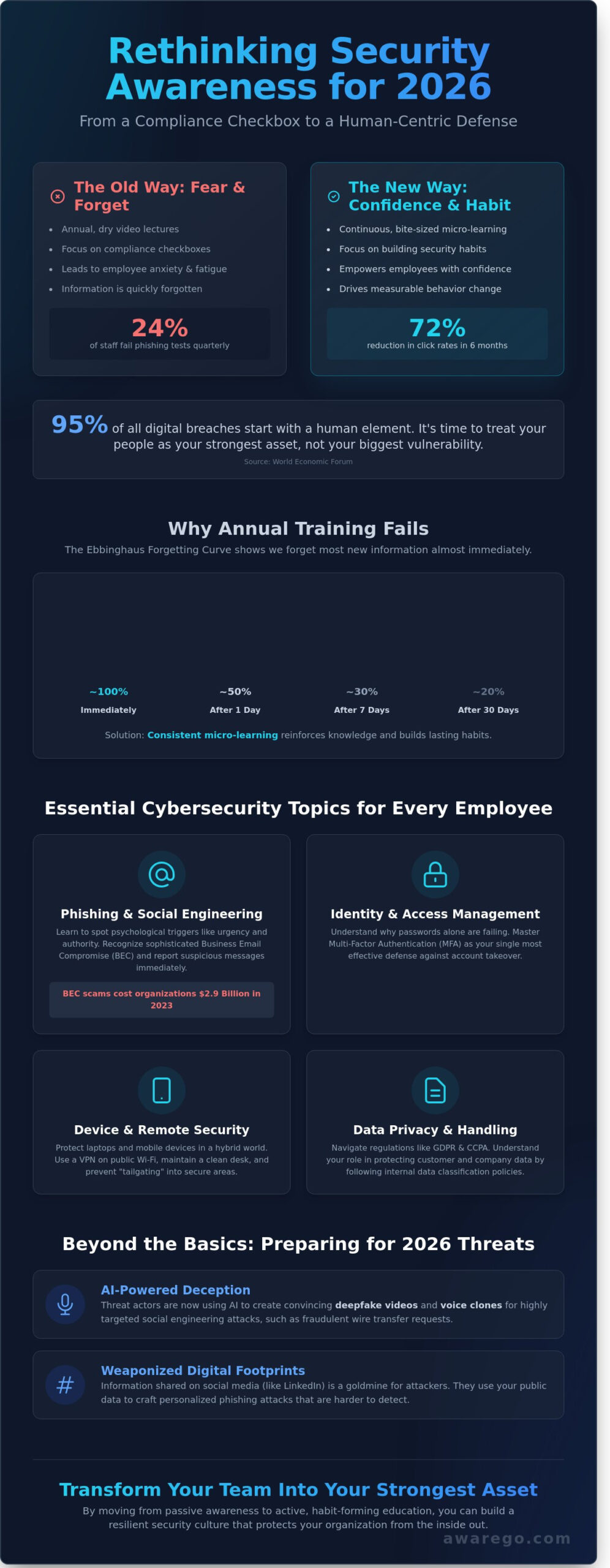
Your employees aren’t your biggest vulnerability; they’re your most underutilized security asset. You’ve likely felt the frustration of watching 24% of your staff fail the same phishing simulation every quarter despite hours of mandatory, dry videos. It’s a common struggle for leaders trying to build a resilient workforce. Most organizations treat security awareness training topics like a boring compliance checkbox rather than a genuine behavioral shift. You know that simply “knowing” about a threat doesn’t stop a tired person from clicking a malicious link at 4:50 PM on a Friday. It’s time to move past fear and start building confidence.
We’re changing that narrative for 2026. This guide provides a comprehensive, human-centric checklist designed to bridge the gap between awareness and action. By focusing on high-impact habits instead of generic lectures, you can reduce your click rates by up to 72% within the first six months. We’ll walk you through a year-long curriculum that covers everything from AI-driven social engineering to the psychology of human risk management. You’ll get a clear roadmap to build a measurable security culture that proves its ROI to leadership from day one.
Key Takeaways
- Shift your strategy from basic compliance to Human Risk Management (HRM) to build a resilient security culture. Learn how a behavior-first approach prepares your team for the unique challenges of 2026.
- Discover the essential security awareness training topics every employee needs to master, from advanced phishing to social engineering. Use our checklist to ensure no critical gaps remain in your defense program.
- Stay ahead of the AI boom by addressing emerging threats like deepfakes and voice cloning. We show you how to empower your workforce to recognize and neutralize the next frontier of digital deception.
- Master a strategic implementation process that uses baseline assessments to match content to your team’s specific vulnerabilities. Transform your training into a measurable, data-driven defense strategy that actually changes habits.
- Learn how to integrate micro-learning into the modern workday to keep security top-of-mind without causing fatigue. Turn your employees into your strongest asset with actionable knowledge and lasting confidence.
The Foundation of Modern Security Awareness Training Topics
Security isn’t just a technical hurdle; it’s a shared human responsibility. In 2026, effective Human Risk Management (HRM) means looking past the old “check-the-box” compliance mindset. We’ve entered an era where behavior-first strategies are the only way to stay resilient. The stakes couldn’t be higher. According to the World Economic Forum’s Global Cybersecurity Outlook, 95% of all digital breaches start with a human element. This isn’t a failure of technology. It’s a sign that our training needs to be more empathetic and human-centric.
Your goal isn’t just to complete a list of modules. You’re building a security culture. This means creating an environment where every team member feels confident and empowered to spot threats. When you select your security awareness training topics, you’re choosing the building blocks of your organization’s collective habits. It’s about replacing digital anxiety with actionable knowledge and calm authority.
Why a Static Topic List Is No Longer Enough
Annual training sessions are where information goes to die. The Ebbinghaus Forgetting Curve shows that humans lose roughly 70% of new information within 24 hours if it isn’t reinforced. This is why static lists fail. We use micro-learning to deliver frequent, snackable updates that fit into a busy workday. By applying behavioral science, we make security a habit rather than a chore. Short, punchy content ensures that security awareness training topics actually stick in the long term.
Mapping Topics to Your Specific Risk Profile
One size never fits all in cybersecurity. You must use risk assessments to prioritize your curriculum based on real-world threats. A developer needs to understand secure API integrations, while your finance team needs to recognize sophisticated deepfake wire transfer scams. Role-based training ensures the right people get the right information at the right time. Don’t forget to set measurable KPIs. Aim for concrete goals, such as a 50% reduction in successful internal phishing simulations over a six-month period, to track your progress effectively.
Essential Cybersecurity Topics for Every Employee: The Core Checklist
Security isn’t a task for the IT department alone. It’s a collective habit. You’re the most important shield your organization has. When you’re building a resilient security culture, your security awareness training topics must move beyond simple compliance to focus on real-world behavior. The 2024 Verizon Data Breach Investigations Report found that 68% of all breaches involved a non-malicious human element. This means your daily choices matter.
These non-negotiables form the foundation of any modern program:
- Phishing and Social Engineering: Moving past the obvious scams to recognize sophisticated psychological triggers.
- Identity and Access Management: Why passwords alone are failing and how Multi-Factor Authentication (MFA) saves the day.
- Device Security: Protecting laptops and mobile devices in a world where the office is anywhere.
- Data Privacy and Handling: Navigating GDPR and CCPA while keeping internal data tiers organized.
Phishing: Identifying Modern Manipulation
Attackers trade on your emotions. They use urgency and authority to make you bypass your better judgment. They don’t just want your password; they want to exploit your trust. Business Email Compromise (BEC) is a massive threat. The FBI Internet Crime Report noted that BEC cost organizations $2.9 billion in 2023. You must be able to spot spear phishing attempts that look like they’re coming from your own manager. If you ever have an “oops” moment and click a link, report it immediately. Fast reporting is the difference between a minor incident and a total shutdown.
Physical Security and Remote Work Hygiene
Your workspace is no longer confined by four walls. This creates new vulnerabilities. Public Wi-Fi is a favorite hunting ground for hackers using “man-in-the-middle” attacks to intercept your data. Always use a VPN when you’re off-site. At the office, “clean desk” policies prevent sensitive info from being snapped in a quick photo. Don’t let strangers “tailgate” into secure areas behind you. Security habits should follow you home; your living room router is now a gateway to the corporate network.
Social Media and Digital Footprints
What you post online provides a roadmap for attackers. LinkedIn is a goldmine for reconnaissance. Criminals use your job title and connections to craft believable lies. Avoid oversharing project details or photos of your ID badge. High-value targets like executives need to lock down their privacy settings to prevent targeted harassment. Managing your human risk management strategy involves recognizing that your digital footprint is part of the company’s attack surface. Stay mindful of the breadcrumbs you leave behind.
Beyond the Basics: Addressing Emerging 2026 Cyber Threats
The 2024 AI explosion changed the digital landscape forever. By 2026, your security awareness training topics must reflect a world where seeing is no longer believing. Hackers have abandoned the “spray and pray” method. They now use Large Language Models (LLMs) to craft flawless, hyper-personalized lures. Traditional red flags like broken grammar or strange formatting have vanished. In 2025, over 90% of successful phishing attacks used AI to mimic corporate tones perfectly, making them nearly indistinguishable from internal memos.
Shadow AI is the newest frontier of human risk. Currently, 72% of employees admit to using unapproved AI tools to speed up their workflows. When your team pastes proprietary code or sensitive customer data into a public chatbot, that information becomes part of the model’s training set. This isn’t a technical failure; it’s a behavioral one. We must empower employees to use these tools without compromising the organization’s “crown jewels.”
Combating AI-Enhanced Social Engineering
In the age of synthetic media, we have to move toward a “Trust but Verify” mindset. If a request involves money, credentials, or data, your team needs a secondary way to confirm it. We call this out-of-band verification. It means picking up the phone or using a pre-approved chat channel to double-check a suspicious request. You shouldn’t feel rude for questioning a video call; you should feel like a guardian of the company culture.
- Verify via Voice: Use a known, trusted phone number to confirm high-stakes requests.
- The “Safe Word” Strategy: Establish internal phrases for high-level executives to authenticate urgent tasks.
- Spotting the Glitch: Look for unnatural blinking or mismatched audio sync in video calls.
The stakes are real. In early 2025, a multinational firm lost $31 million after a finance clerk joined a video call where every other participant was a real-time deepfake of the company’s executive board.
Safe Usage of Generative AI Tools
Your security awareness training topics should include clear boundaries for AI interaction. It’s about enabling innovation safely, not banning it. Employees need to know exactly which tools are “Internal Only” and how to scrub data before hitting enter.
- Never input PII (Personally Identifiable Information) or trade secrets into public prompts.
- Anonymize all data sets before using AI for analysis or visualization.
- Fact-check AI outputs for “hallucinations” that could lead to insecure code or false legal claims.
- Always disclose when AI has been used to generate external-facing content.
Structuring Your Curriculum: A Strategic Implementation Checklist
Effective training isn’t a one-off event; it’s a continuous cycle of improvement. You need a framework that respects your employees’ time while building lasting resilience. Use this five-step checklist to organize your security awareness training topics into a high-impact curriculum that actually changes habits.
- Step 1: Baseline Assessment. Start with a Human Risk Assessment to identify your current score. You can’t fix what you haven’t measured. Knowing where your vulnerabilities lie helps you focus your budget where it matters most.
- Step 2: Content Selection. Match your training to identified risks. If 35% of your department fails a credential harvesting simulation, prioritize password security and multi-factor authentication (MFA) modules immediately.
- Step 3: Delivery Cadence. Abandon the annual training marathon. Research from 2023 indicates that employees forget 90% of training within 30 days if it isn’t reinforced. Move to monthly micro-learning sprints.
- Step 4: Reinforcement. Use Slack nudges, digital posters, and recurring phishing simulations. These small touchpoints keep security culture alive without causing training fatigue.
- Step 5: Measurement. Focus on behavior change. A 50% increase in reported suspicious emails is a much better success metric than a 100% completion rate on a mandatory video.
The Micro-Learning Advantage
Attention spans are shrinking. The average office worker now switches tasks every 47 seconds. Long slide decks don’t work in this environment. Micro-learning uses 1 to 3 minute videos to deliver high-impact lessons that stick. You can integrate these seamlessly into Slack or Microsoft Teams, ensuring your workforce stays protected without interrupting their flow of work. Mobile-friendly content also allows your team to learn on the go, making security a natural, low-friction part of their day.
Gamification and Positive Reinforcement
Traditional training often relies on fear or a “Wall of Shame” for those who fail phishing tests. We recommend a different path. Use leaderboard mechanics to reward Security Champions who report threats quickly. When you celebrate the 20% of employees who act as your first line of defense, you build a positive security culture. This creates a sense of shared responsibility rather than a climate of anxiety, making your team feel like valued partners in defense.
Transforming Awareness into Resilience with AwareGO
AwareGO doesn’t just check boxes; we build resilience. Our Human Risk Management (HRM) platform shifts the focus from simple compliance to real behavioral change. You get access to an award-winning library of micro-learning videos. These aren’t boring lectures. They’re 60-second stories that stick. When you’re choosing your security awareness training topics, our content ensures your team stays engaged without losing productive hours. This human-centric approach turns passive observers into active defenders.
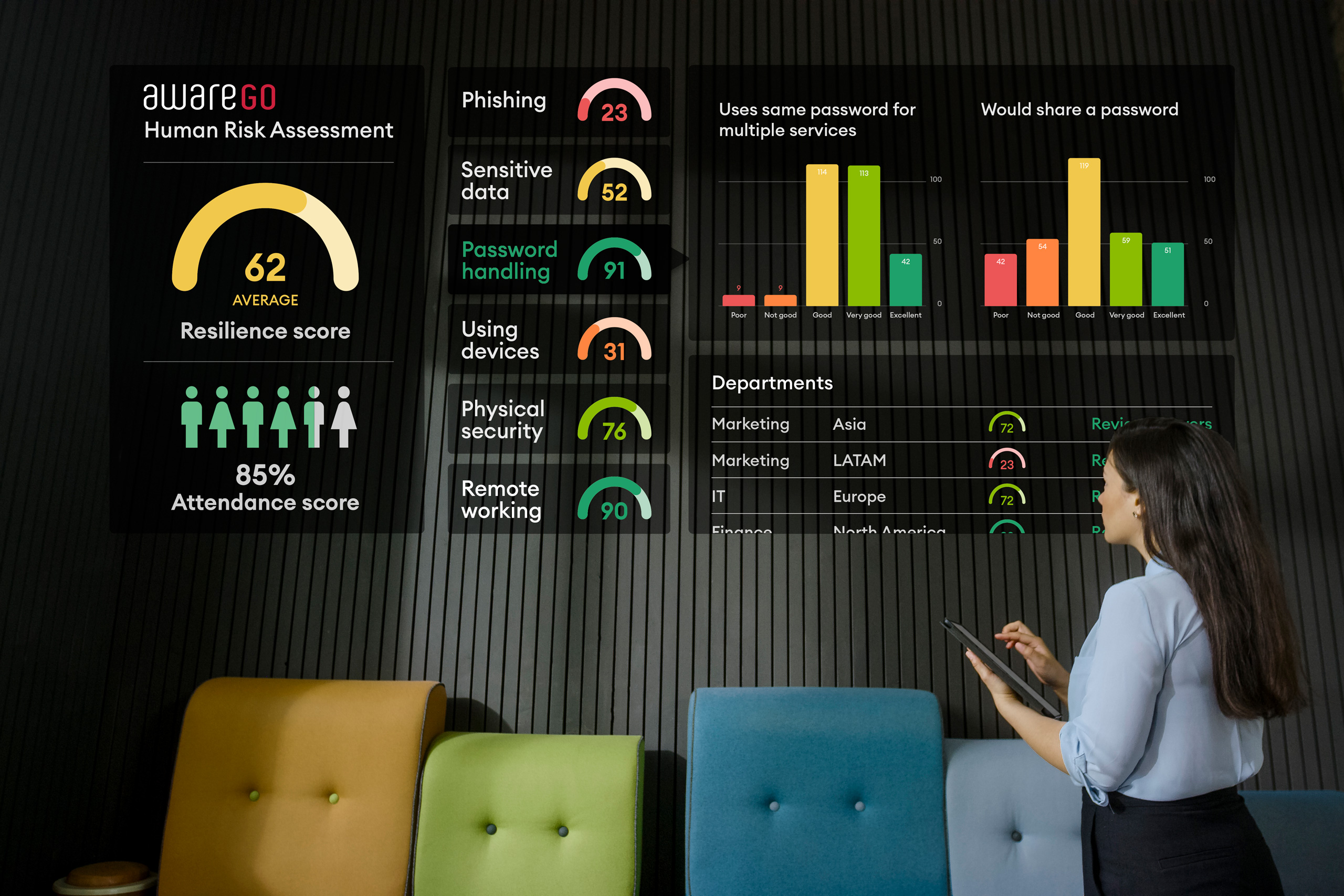
Every effective program starts with data. AwareGO’s Human Risk Assessment identifies exactly where your employees are vulnerable. It measures knowledge, sentiment, and behavior across several threat vectors. This allows you to prioritize the security awareness training topics that matter most to your specific organization. If your team is great at spotting phishing but fails at password hygiene, you’ll know exactly where to invest your energy. For those already using a Learning Management System (LMS), our content integrates seamlessly via SCORM. You keep your existing workflow while upgrading to high-quality, modern content.
Data-Driven Insights for CISOs
Quantifying security culture is no longer a guessing game. AwareGO provides a clear Human Risk Score, allowing you to track specific improvements over time. For example, many of our partners see a 40% reduction in high-risk behaviors within the first six months. You can benchmark your performance against 2,000 other organizations in your industry to see where you stand. Automation handles the heavy lifting. Our platform schedules campaigns based on individual risk levels, reducing the manual workload for IT teams by roughly 15 hours per month. You get better results with less effort.
Start Your Human-Centric Journey
Security isn’t a task you finish; it’s a habit you build. When employees feel empowered rather than blamed, they become your strongest defense. You don’t need more rules. You need a stronger culture that values vigilance and collective responsibility. It’s time to move beyond the spreadsheet and start managing human risk with precision and empathy.
Mastering Your Human Risk Strategy
The 2026 digital landscape requires a proactive shift from compliance to culture. You’ve identified that a curated list of security awareness training topics must address both foundational habits and sophisticated 2026 threats like deepfake phishing. Effective training isn’t about long lectures; it’s about frequent, snackable content that fits into a busy workday.
AwareGO provides the tools to manage this transition. Our platform is currently used by global enterprises to secure millions of employees across more than 15 industries. We replace anxiety with confidence through 3-minute micro-learning modules grounded in behavioral science. Every subscription includes a comprehensive Human Risk Assessment to measure your progress and identify vulnerabilities in real time. This evidence-based approach turns your workforce into a resilient human firewall.
Book a demo to see how AwareGO manages Human Risk
The path to a more secure future starts with a single, empowered employee. You’re ready to lead that change and build a workplace where security is second nature.
Frequently Asked Questions
What are the most important security awareness training topics for 2026?
AI-generated social engineering, deepfake detection, and personal digital resilience are the priority security awareness training topics for 2026. Since the FBI reported a 100% increase in deepfake-related fraud reports between 2023 and 2025, employees must recognize synthetic media. Focus on the human element of risk. Teach your team to pause when an urgent request feels off, even if it sounds like a trusted colleague.
How often should employees receive security awareness training?
Employees should engage with security content at least once a month through micro-learning sessions. Research on the Ebbinghaus Forgetting Curve shows that people forget 90% of new information within 30 days without reinforcement. Instead of one long annual session, use three-minute videos monthly. This approach builds lasting habits and keeps security at the front of your team’s mind throughout the year.
Is phishing simulation a necessary part of security awareness?
Phishing simulations are essential because they provide a safe environment for your team to practice spotting real-world threats. The 2024 Verizon Data Breach Investigations Report found that 68% of breaches involved a non-malicious human element. Simulations transform abstract concepts into tangible experiences. When you use them to coach rather than punish, you reduce your organization’s click rate by an average of 40% within 12 months.
How do you make security training engaging for non-technical staff?
You make training engaging by using story-driven micro-content that mirrors everyday life. Focus on relatable scenarios like securing a home Wi-Fi network or protecting family photos. Avoid technical jargon and stick to three-minute modules that fit into a coffee break. When content feels human and helpful rather than clinical, employee engagement rates typically climb above 85% across all departments.
What is the difference between security awareness and security culture?
Security awareness is the knowledge your employees have, while security culture is the shared mindset and behavior they actually practice. Awareness tells you how to spot a threat; culture ensures you report it without fear. Gartner predicts that by 2026, 50% of large enterprises will adopt human-centric security programs to move beyond simple compliance. You want to build an environment where security is a subconscious habit.
Can security awareness training help with GDPR and PCI compliance?
Security awareness training is a mandatory requirement for maintaining GDPR and PCI DSS compliance. GDPR Article 39 specifically requires organizations to train staff involved in data processing operations. For PCI DSS 4.0, you must provide awareness programs at least every 12 months. Implementing a robust checklist of security awareness training topics ensures you meet these legal obligations while protecting your customers’ sensitive financial and personal data.
What are the emerging AI threats I should include in my training?
You should include training on deepfake audio scams and AI-powered phishing emails that lack the traditional typos of the past. SlashNext reported a 3,411% increase in malicious phishing emails in 2023 due to generative AI tools. Teach your staff that seeing is no longer believing. They need to verify high-stakes requests via a second, out-of-band communication channel like a direct phone call or a separate messaging app.
How do I measure if my security awareness program is actually working?
You measure success by tracking behavioral changes like increased reporting rates and decreased click-through rates on simulations. Don’t just look at completion numbers; look at your Human Risk Management (HRM) score. A successful program often sees a 70% reduction in high-risk behaviors over the first two years. When your employees start reporting suspicious emails before IT even flags them, you know your security culture is truly thriving.