 Cybersecurity blog



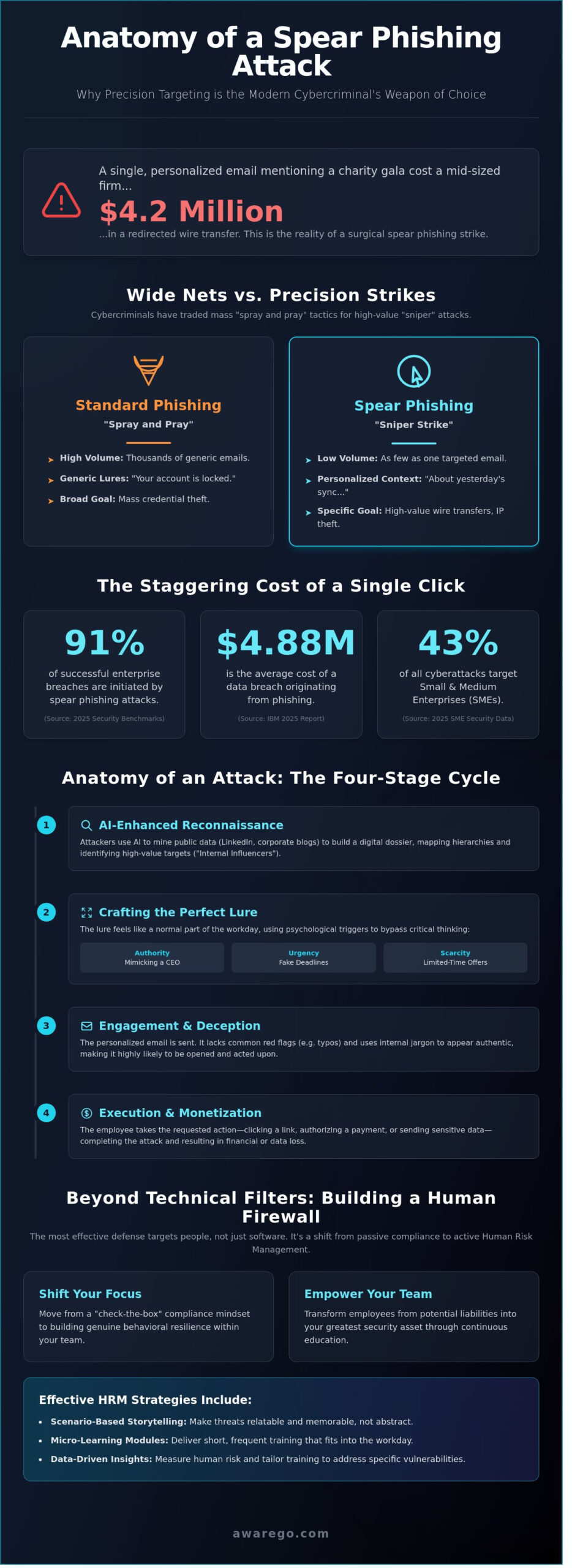
On a Tuesday morning in October 2025, a senior accountant at a mid-sized firm received an email from their CEO. It wasn’t a generic blast. The message mentioned the specific charity gala they both attended the night before. That single, personalized click cost the company $4.2 million in a redirected wire transfer. This wasn’t a broad net; it was a surgical strike. To protect your organization, you need to look past the technical jargon and understand what is spear phishing in an era where attackers study your habits before they ever hit send.
You probably feel like your current email filters are working hard, yet high-end threats still find a way through. It’s a common struggle. Even the most sophisticated software can’t always catch a lure designed specifically for one person’s psychology. We’re here to help you move from feeling vulnerable to feeling resilient. In this guide, you’ll learn how spear phishing exploits human nature and how to build a data-driven defense that transforms your team into a security asset. We’ll explore the full attack lifecycle and show you how to implement a measurable Human Risk Management strategy that strengthens your security culture.
Key Takeaways
- Understand why modern cybercriminals have traded broad “spray and pray” tactics for high-value, “sniper” precision.
- Discover what is spear phishing and why targeted psychological manipulation often succeeds where technical filters fail.
- Decode the four-stage attack cycle to identify the subtle signs of whaling and Business Email Compromise (BEC) before they escalate.
- Learn to build behavioral resilience within your team, shifting your focus from passive compliance to active Human Risk Management.
- Explore how scenario-based storytelling and micro-learning can transform abstract digital threats into manageable, everyday habits.
Defining Spear Phishing: Why Precision Matters in 2026
Spear phishing is a surgical strike designed to bypass your traditional defenses by exploiting the most flexible part of your organization: your people. Unlike generic scams, these attacks use deep research to create a narrative that feels authentic and urgent. In 2026, the shift from “spray and pray” tactics to high-value sniper strikes is complete. Attackers now prioritize quality over quantity, using AI-driven reconnaissance to gather data from professional profiles, corporate blogs, and public records.
This precision is why what is spear phishing remains a critical question for leadership teams. It’s currently the primary cause of major enterprise breaches, accounting for 91% of successful attacks according to 2025 security benchmarks. It isn’t a technical failure. It’s a human one. Success depends on psychological triggers like authority, social proof, or urgency. By focusing on Human Risk Management (HRM), you can build a resilient security culture that recognizes these subtle patterns before they cause damage.
The Core Difference: Phishing vs. Spear Phishing
The main distinction lies in the balance of volume and velocity. Standard phishing relies on massive volume, sending thousands of generic lures in the hope that a small percentage of users will click. Spear phishing uses high velocity and low volume. An attacker might send only one email, but it’s perfectly timed and highly personalized.
- Generic lures: “Your account is locked” or “View your invoice.”
- Personalized context: “Hi Sarah, can you review the Q3 budget draft we discussed in yesterday’s sync?”
- The Goal: While standard phishing often seeks broad credential theft, spear phishing usually targets high-value wire transfers, proprietary intellectual property, or administrative access.
The Economic Impact of a Successful Strike
The financial stakes have never been higher. According to IBM’s 2025 Cost of a Data Breach Report, the average cost of a breach initiated by phishing has climbed to $4.88 million. This figure includes the direct costs of remediation, but it doesn’t fully capture the long-term reputation damage or the loss of competitive advantage when intellectual property is stolen.
You shouldn’t assume these strikes only target global giants. In 2025, 43% of cyberattacks targeted small and medium enterprises (SMEs). These organizations often lack the robust security culture of larger firms, making them attractive targets for attackers seeking a quick, high-value payout. Understanding what is spear phishing and how it targets your specific role is the first step toward building lasting digital resilience.
The Anatomy of a Spear Phishing Attack: A Four-Stage Cycle
To understand what is spear phishing, you have to look past the email itself and focus on the preparation. Unlike broad phishing campaigns that cast a wide net, spear phishing is a surgical strike. It’s a high-effort, high-reward strategy. Attackers move from zero knowledge to a convincing fraudulent identity through a disciplined process. They don’t rely on luck; they rely on research. This meticulous planning is why traditional red flags, like broken English or suspicious links, are often missing from these messages. A 2024 report by Verizon found that 68% of breaches involved a human element, proving that the most effective attacks target people, not just software.
Step 1: AI-Enhanced Reconnaissance
Attackers start by building a digital dossier on your organization. They use LinkedIn, corporate websites, and social media to map out internal hierarchies. In 2024, the use of Generative AI to automate this data mining increased significantly. These tools allow criminals to identify “Internal Influencers” in minutes. These are targets like HR managers or IT leads who have high-level access and broad trust. By the time they send the first email, they know your job title, your recent projects, and even your professional tone. They’re looking for the path of least resistance into your network.
Step 2: Crafting the Perfect Lure
The best lures don’t feel like threats; they feel like part of your workday. Attackers use specific psychological triggers to bypass your critical thinking:
- Authority: Mimicking a high-ranking executive to discourage you from questioning the request.
- Urgency: Creating a “ticking clock,” such as a fake payroll deadline, to force a quick decision.
- Scarcity: Suggesting a limited window to access a new benefit or a required system update.
By using real company terminology, such as a specific “Q4 Revenue Goal” or an internal “Project Phoenix” name, they build instant trust. They’re not just sending an email; they’re creating a believable scenario that fits into your existing habits. Strengthening your security culture helps you recognize when a “normal” request feels slightly off.
Step 3: Delivery and Exploitation
Spear phishers thrive by staying under the radar. They bypass Secure Email Gateways (SEGs) by sending low-volume, high-trust messages. Instead of thousands of emails, they might send only three to a specific department. These messages often carry “payloads” like sophisticated credential harvesters or malicious attachments disguised as internal reports. The exploitation phase is the moment human intuition is bypassed by technical mimicry. Once you click that link or download that file, the attacker gains the access they need to move laterally through your organization’s digital environment.
Spear Phishing, Whaling, and BEC: Identifying the Variants
Cybersecurity isn’t a one-size-fits-all field. Attackers specialize their methods based on who they want to reach and what they want to steal. Understanding what is spear phishing requires looking at how these threats branch into specific, dangerous variants. While a standard phishing blast might target thousands, these precision strikes focus on the quality of the lead over the quantity of the emails sent. They exploit the human risk factor by mimicking the people you already trust.
Most modern attacks aren’t isolated events. They’re multi-stage journeys. An attacker might start with a simple spear phishing email to harvest credentials, then move into a full account takeover. By categorizing these threats, you can build a more resilient security culture. This clarity allows your team to move from a state of general anxiety to one of focused, actionable confidence. When you know the specific signs of a variant, you’re no longer guessing; you’re defending.
Whaling: Targeting the C-Suite
Whaling is a high-stakes version of spear phishing that targets the “big fish” in your organization. This includes the CEO, CFO, or other senior leaders who hold the keys to sensitive data and large budgets. The 2024 Verizon Data Breach Investigations Report highlighted that 68% of breaches involve a human element, and whaling is the most expensive version of that risk. Attackers use detailed research to craft messages about legal subpoenas, executive compensation, or stock price shifts. Because these leaders often have high-pressure schedules, they’re targeted with urgent, high-stress scenarios. Specialized training for executives is vital. They need to understand that their public profiles make them visible targets for extortion and corporate espionage.
Business Email Compromise (BEC)
Business Email Compromise is the financial engine of the phishing world. According to the FBI’s 2023 Internet Crime Report, BEC accounted for over $2.9 billion in reported losses. It often begins when an attacker successfully uses spear phishing to take over a legitimate internal account. Once inside, they don’t just steal data; they join the “Trust Chain.” They might jump into an existing email thread with a vendor to redirect a payment. This evolution shows that what is spear phishing today often serves as the entry point for complex financial fraud. Common tactics include:
- The Invoice Scam: Sending a “corrected” invoice with new bank details from a compromised account.
- Payroll Diversion: Impersonating an employee to ask HR to update direct deposit information.
- Executive Impersonation: Using a compromised manager’s account to authorize an “urgent” wire transfer.
Distinguishing between these variants helps you design training modules that actually stick. A developer doesn’t need the same training as a CFO. By tailoring your Human Risk Management (HRM) approach to the specific roles in your company, you turn security from a technical hurdle into a shared, manageable habit. It’s about empowering your people to recognize the nuances of the digital world they navigate every day.
Beyond Technical Filters: Building Behavioral Resilience
“Why didn’t our expensive email filter stop this?” It’s the first question leaders ask after a breach. You’ve invested in top-tier security gateways, yet a single message still lands in an employee’s inbox. Technical controls excel at spotting mass-distributed malware, but they often struggle with the precision of targeted attacks. Understanding what is spear phishing means recognizing it as a social engineering challenge rather than a code-based one. These attacks frequently use zero-malware tactics, relying on plain text and emotional manipulation to bypass filters. We must shift our focus from just blocking emails to empowering your team. When you move from technical blocking to behavioral resilience, you create a defense that doesn’t rely on a database update to be effective.
The Psychology of the Click
Cognitive biases are the primary vulnerabilities in any system. Attackers exploit our natural tendency to trust authority or react quickly to perceived crises. When you’re managing 120 emails a day, your brain takes shortcuts. This “busy-ness” reduces your cognitive load capacity; it makes a sophisticated fraud attempt look like a routine request. Building resilience requires psychological safety. Employees shouldn’t fear punishment for reporting a threat. They should feel like a vital, supported part of your defense. A culture that rewards curiosity over compliance is much harder to breach.
Quantifying the Human Risk
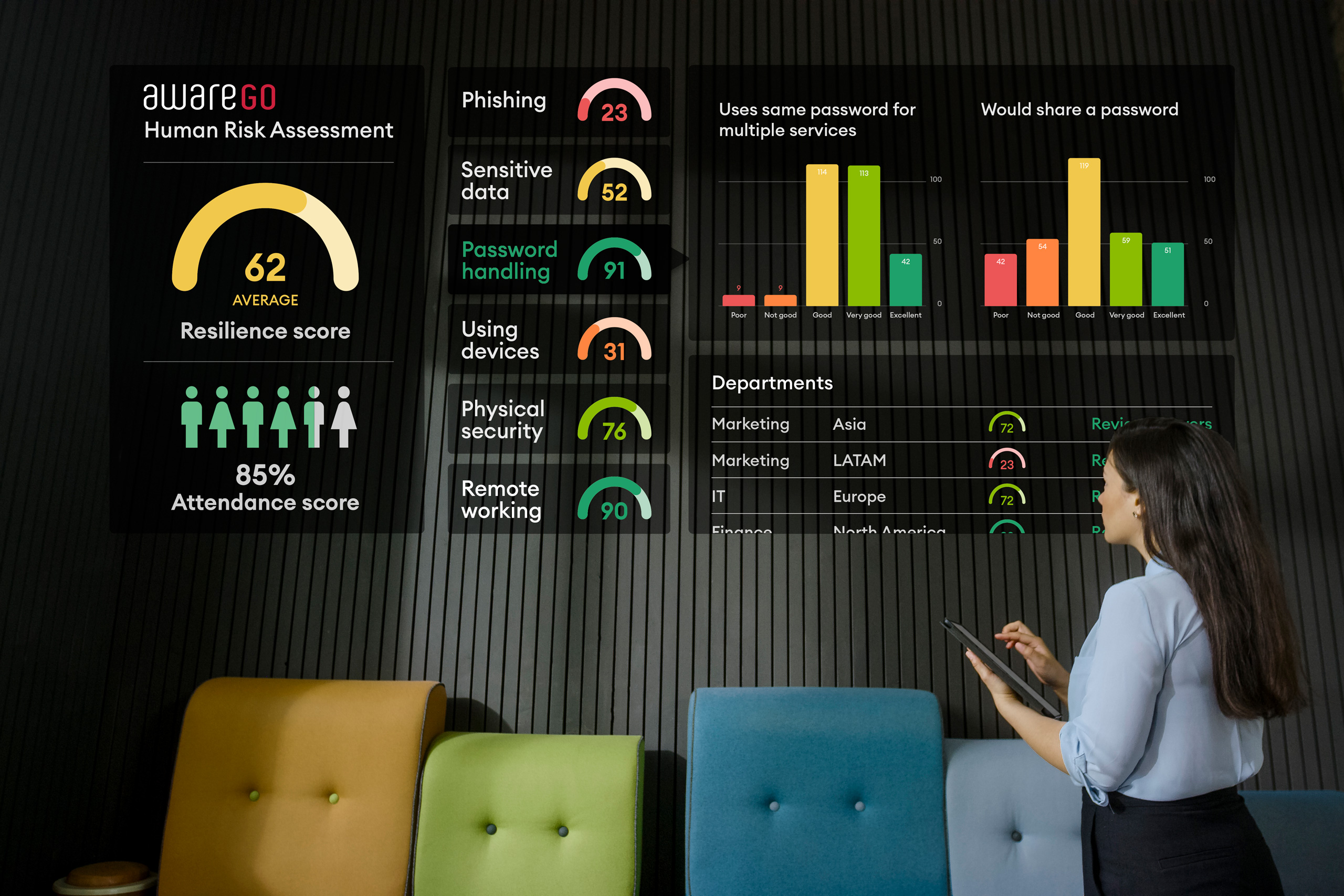
Stop relying on binary pass or fail metrics from annual training. Real security comes from benchmarking human risks across your entire organization. Data from 2024 indicates that 68% of successful breaches involve a human element. You need to know which departments are most susceptible to specific lures. By conducting a formal human risk assessment, you turn subjective worries into actionable intelligence. This data-driven approach allows you to tailor your security culture to actual behaviors. It moves what is spear phishing from a theoretical threat to a manageable risk factor.
Habit-forming education creates a human firewall that doesn’t expire. When security becomes a reflex, your organization remains protected even when technical filters fail. Short, frequent bursts of learning ensure that security stays top-of-mind without causing training fatigue. This approach turns every employee into a sensor, capable of detecting the subtle anomalies that software misses. You aren’t just teaching people to spot bad links; you’re building a sustainable culture of digital confidence.
Ready to see where your organization stands? Start your journey toward a stronger security culture with AwareGO.
Remediating Human Risk: The AwareGO Approach
Traditional security training often fails because it treats people like machines. Long, boring compliance videos don’t change behavior. They just create fatigue. AwareGO replaces this outdated model with micro-learning content designed for the modern attention span. We deliver high-impact lessons in under three minutes, focusing on one specific threat at a time. Understanding what is spear phishing shouldn’t feel like a chore. It should feel like a quick, valuable insight that fits into a morning coffee break.
Our approach centers on scenario-based storytelling. We use relatable, human-centric narratives that reflect real-world habits. By showing employees how a single mistake happens in a familiar office setting, we make abstract digital dangers feel tangible. We integrate phishing simulations that mirror the exact precision tactics used by 2026 threat actors. This isn’t about “tricking” your team. It’s about building a resilient security culture where every person feels confident in their ability to spot a sophisticated attack.
From Awareness to Habit
Cognitive science proves that frequent, “snackable” content leads to better retention. While traditional training has a 20% retention rate after one month, micro-learning can boost that figure to 80%. We help you remediate vulnerabilities through targeted, data-driven training. If your finance team shows a weakness in identifying what is spear phishing, our platform delivers specific content to that group automatically. You’re not just checking a box. You’re empowering your employees to be your most effective first line of defense.
- Short bursts of content prevent cognitive overload.
- Data-driven insights pinpoint exactly where your human risk lies.
- Positive reinforcement replaces fear-based messaging.
Implementing a Modern HRM Strategy
Our human risk management software automates the journey to behavioral resilience. It removes the manual burden from IT teams while providing deep visibility into organizational health. For an enterprise with 5,000 employees, reducing the click-through rate on malicious links by just 15% can save an estimated $2.4 million in potential breach costs. This measurable ROI proves that cybersecurity is a human investment, not just a technical one. You can stop guessing and start measuring. Start your employee risk audit today to identify your gaps and begin building a stronger, more resilient workforce.
Turning Human Vulnerability into Your Strongest Defense
Understanding what is spear phishing is the vital first step toward securing your organization in 2026. These attacks have evolved into a sophisticated four-stage cycle that bypasses technical filters by exploiting personal trust. Industry research highlights that 74% of all breaches involve a human element; this makes behavioral resilience your most critical asset. You can’t stop every malicious email, but you can empower your team to recognize the psychological triggers used in whaling and BEC variants. Real security isn’t about restrictive rules. It’s about building a sustainable security culture where every employee feels confident and prepared.
AwareGO provides a data-driven Human Risk Management (HRM) platform designed for the modern workplace. We use behavioral science-backed micro-learning videos to turn complex threats into manageable habits. Trusted by global enterprises, our approach moves beyond simple compliance to deliver measurable risk mitigation. It’s time to stop worrying about the next attack and start investing in your people. You can transform your workforce into a proactive shield that protects your brand every single day.
Start your Human Risk Assessment with AwareGO
Frequently Asked Questions
Is spear phishing the same as standard phishing?
No, spear phishing is a targeted strike rather than a wide net. While standard phishing sends generic messages to thousands of people, spear phishing uses specific details about you to build trust. Research from Deloitte shows that 91% of successful cyberattacks begin this way. Understanding what is spear phishing helps you spot these tailored traps before they compromise your organization’s sensitive data.
How can I tell if an email is a spear phishing attack?
You can identify these attacks by looking for hyper-personalized details paired with an urgent request for sensitive information. Check the sender’s email address carefully for subtle typos, such as using a “0” instead of an “o” in a domain name. If a colleague asks for a password or a wire transfer via email, verify the request through a secondary channel like a quick phone call or Slack message.
Who is most at risk of spear phishing in an organization?
Employees in finance, HR, and IT departments face the highest risk because they hold the keys to sensitive data and funds. Statistics from 2024 indicate that finance teams are targeted in 35% of all spear phishing attempts. However, every person in your organization is a potential entry point. Building a strong security culture ensures that everyone, regardless of their role, feels empowered to report suspicious activity.
Can AI help attackers create better spear phishing emails?
Yes, attackers now use generative AI to craft emails that are virtually indistinguishable from legitimate business correspondence. These tools help criminals remove the spelling errors and awkward phrasing that used to give them away. Since the launch of ChatGPT in late 2022, there has been a 1,265% increase in malicious phishing emails. This makes your personal intuition and skepticism more important than ever in maintaining digital resilience.
What should I do if I think I clicked on a spear phishing link?
Disconnect your device from the internet immediately to stop any data exfiltration or malware spread. You should then report the incident to your IT or security team following your company’s specific protocol. Acting within the first 30 minutes can significantly reduce the impact of a breach. Don’t feel ashamed; reporting mistakes quickly is a sign of a healthy, resilient security culture that protects everyone.
How does spear phishing differ from whaling?
Whaling is a specialized form of spear phishing that exclusively targets high-profile executives like CEOs or CFOs. While a spear phisher might target a mid-level manager, a “whaler” aims for the biggest “fish” in the company to authorize massive wire transfers. This is a critical distinction in what is spear phishing because the stakes and the level of research are much higher for whaling attacks.
Why do spear phishing attacks bypass traditional spam filters?
These attacks bypass filters because they often don’t contain traditional malware or suspicious attachments that software can easily scan. Instead, they rely on social engineering and plain-text requests that look like normal business interactions. Current data shows that 70% of these emails use “zero-day” links that haven’t been flagged by security databases yet. This is why human vigilance is your most effective line of defense.
What are the best ways to prevent spear phishing at an enterprise level?
You can protect your enterprise by moving beyond simple compliance to a proactive Human Risk Management (HRM) strategy. Regular micro-learning sessions keep security top-of-mind without overwhelming your team. Studies show that organizations conducting training every 30 days see a 40% reduction in phishing click rates. Combining this with multi-factor authentication (MFA) creates a robust layer of protection that technology alone cannot provide.