 Cybersecurity blog



You’re walking into your office with a hot coffee in each hand when a friendly stranger catches the door for you. You smile, nod, and walk right in without scanning your badge. It feels like a normal, polite interaction, but you might have just participated in a security breach. While the term often brings to mind cars following too closely on the highway, understanding what is tailgating in a professional context is vital for your physical safety. In cybersecurity, this “politeness trap” is a common social engineering tactic where an unauthorized person follows an employee into a restricted area.
We all want to be helpful coworkers, and slamming a door in someone’s face feels inherently wrong. It’s natural to feel a sense of guilt when you challenge someone at the entrance. According to the 2023 IBM Cost of a Data Breach Report, physical security compromises take an average of 223 days to identify. That’s a long time for a stranger to have access to your desks and servers. This article helps you overcome the guilt of enforcing badge policies. You’ll learn how tailgating exploits our natural social etiquette to bypass sophisticated locks. We’ll show you how to build a human-centric defense that protects your workplace culture without sacrificing your kindness.
Key Takeaways
- Understand what is tailgating in a security context and why it poses a silent threat to your physical workspace.
- Learn how the “Politeness Trap” leverages common social etiquette to bypass even the strongest physical barriers.
- Master the subtle differences between tailgating and piggybacking to sharpen your situational awareness and response.
- Discover actionable steps to stop unauthorized access and empower your team to become a resilient “human firewall.”
- See how shifting to a human-centric security culture can turn one-off training into sustainable, safe habits.
Defining Tailgating: Beyond the Parking Lot and the Highway
Most people hear the word “tailgating” and think of two specific things: a pre-game party with a grill or a stressful commute with a car glued to their bumper. In the context of your organization’s safety, it means something entirely different. Understanding what is tailgating in a professional environment requires looking at how we interact with the physical spaces where our data lives. It is a bridge between the physical world and digital vulnerability.
Attackers are clever and efficient. They know your firewall is expensive, frequently updated, and difficult to penetrate. They also know your employees are naturally polite. It’s much easier to carry a heavy-looking box and look distressed than it is to crack a 256-bit encryption key. This is the “Human Hack.” By walking through a physical door, an intruder bypasses layers of digital defense in seconds. Physical security is the literal foundation of your 2026 cybersecurity strategy; if a stranger can sit at an unlocked desk, your digital perimeter effectively ceases to exist.
The Security Definition of Tailgating
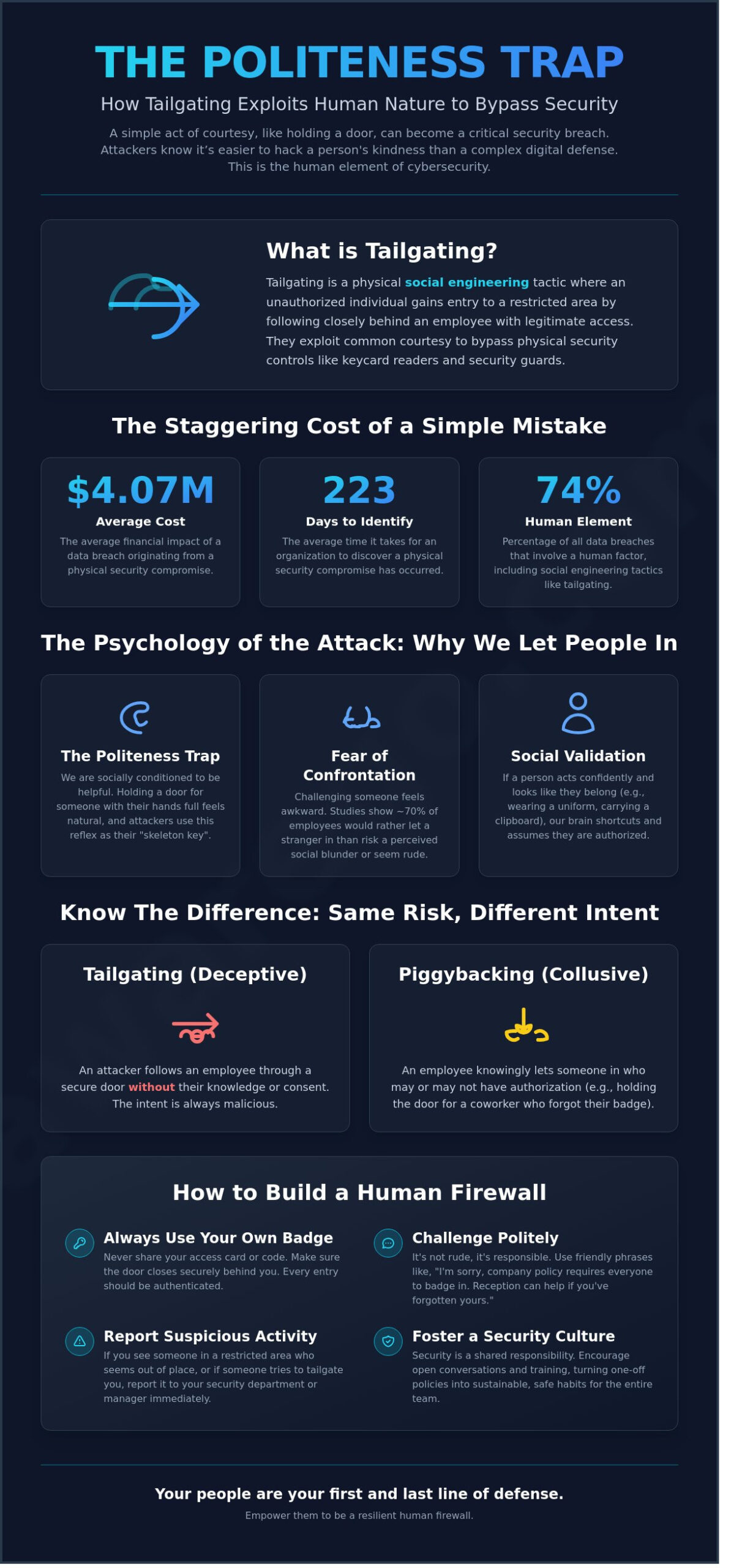
Tailgating is a physical social engineering tactic where an unauthorized individual gains entry to a restricted area by following closely behind someone with legitimate access. This isn’t just a building management issue. It’s a primary driver of data breaches. According to the 2024 Cost of a Data Breach Report, breaches involving physical security failures cost companies an average of $4.07 million per incident. These breaches often take 10% longer to identify than purely digital attacks. Common scenarios include:
- The Busy Lobby: An intruder slips through a turnstile behind a group of employees returning from lunch.
- The Service Entrance: A person dressed as a delivery driver or technician waits for a staff member to open a side door.
- The Server Room: An attacker follows a distracted IT staffer into a high-security zone containing sensitive hardware.
Why It Is Still a Major Threat in 2026
The shift to hybrid work has fundamentally changed office dynamics. By 2025, data from the WFH Research group showed that 68% of corporate employees worked in the office less than three days a week. This means you likely don’t recognize every face in your hallway or elevator. Attackers exploit this lack of familiarity to blend in. Once inside, they can perform “evil maid” attacks. This involves gaining physical access to hardware to install keyloggers or malicious USB devices. When you don’t know what is tailgating or how to spot it, your Human Risk Management (HRM) strategy has a massive blind spot. Building a resilient security culture is the only way to empower your team to close these physical gaps with confidence.
The Psychology of the Attack: Why We Let People In
Security isn’t just about locks and badges; it’s about how you feel. Attackers know this. They use your kindness as a skeleton key. Understanding what is tailgating starts with recognizing the “Politeness Trap.” Most people are raised to be helpful and accommodating. A 2023 report by Verizon found that human elements were involved in 74% of all breaches. When you see someone struggling with a heavy box, your brain prioritizes empathy over corporate protocol. It’s a natural reaction that attackers exploit every day.
Attackers rely heavily on the principle of social validation. If a person stands confidently by the door, our brains categorize them as “authorized” without a second thought. We seek to avoid the awkwardness of a confrontation at all costs. Research into workplace psychology shows that roughly 70% of employees would rather let an unauthorized person in than risk a perceived social blunder. This fear of saying “no” is the attacker’s greatest asset. They count on your desire to avoid a scene.
Exploiting Social Etiquette
Holding the door is a reflex. It’s a social norm that keeps society running smoothly. However, in a secure environment, this simple act creates a massive vulnerability. Attackers exploit the “Helpfulness Bias” by appearing vulnerable themselves. They might play the role of the “distracted coworker” fumbling for a phone or the “hurrying delivery person” with hands full of packages. These scenarios are designed to make you feel like the “bad guy” if you don’t help. You aren’t being rude by following protocol; you’re being responsible.
The Attacker’s Toolkit
Successful tailgaters don’t look like movie villains. They look like they belong. They use visual cues like high-vis vests, clipboards, or branded uniforms to bypass your mental filters. Timing is also critical. High-risk periods occur during shift changes or the 12:00 PM lunch rush when foot traffic is highest. Acting like you belong is 90% of the battle. By building a strong security culture, you can turn these moments of vulnerability into points of collective resilience. It’s about creating small habits that protect the entire office.
Attackers often use props to trigger an immediate emotional response. A person carrying two steaming cups of coffee and a box of donuts is rarely questioned. Your brain sees the coffee, recognizes the “weight” of the situation, and prompts you to pull the door open. These props aren’t just for show. They’re calculated tools designed to bypass your logical security training and tap directly into your desire to be a “good” coworker. This is what is tailgating at its most effective: a blend of props and social pressure.
Tailgating vs. Piggybacking: What’s the Difference?
While they look identical on a security camera, tailgating and piggybacking are two different behavioral challenges. Both involve an unauthorized person entering a restricted area by following someone with legitimate access. To build a strong Human Risk Management (HRM) strategy, you need to recognize the subtle shift in intent between these two actions. One is a trick; the other is a lapse in judgment. Understanding these nuances helps you foster a more resilient security culture where employees feel empowered to speak up.
The Consent Factor
The primary difference lies in consent. When you ask what is tailgating, you’re looking at a situation where the authorized person is either unaware of the follower or is being manipulated through social pressure. The intruder might wear a high-visibility vest or carry heavy boxes to exploit your natural urge to be helpful. Piggybacking is different because the authorized person knowingly allows the entry. This often happens among friendly coworkers or contractors who want to save time. In a 2022 study on workplace security, researchers found that 40% of employees admitted to letting someone they recognized into a secure area without seeing their badge. This transforms a simple act of politeness into a significant insider threat.
| Method | Awareness | Intent |
|---|---|---|
| Tailgating | Authorized person is unaware or deceived. | Unauthorized access via deception. |
| Piggybacking | Authorized person knowingly allows entry. | Convenience, politeness, or collusion. |
Both tactics lead to the same result: compromised physical security. Even the most expensive biometric systems, like facial recognition or fingerprint scanners, can’t stop a door from staying open once it’s unlocked. These technical controls fail because they don’t account for human behavior. Intruders use social engineering techniques to turn your team’s best traits, like kindness and cooperation, into security vulnerabilities. A 2023 report on physical security found that 67% of organizations don’t have a formal policy to address these specific entry methods. This lack of clarity often leaves employees guessing when they should be acting. By defining what is tailgating versus piggybacking, you provide your team with the vocabulary they need to stay vigilant. Research from the Ponemon Institute suggests that insider-related incidents have risen 44% over the last two years, making it clear that technical fixes aren’t enough. You need to focus on habits and workplace dynamics to truly secure your perimeter.
How to Spot and Stop a Tailgating Attack
Building a human firewall starts with situational awareness. You’re the most effective sensor in your office. While tech like mantraps and optical turnstiles provide physical barriers, they aren’t perfect. Research from the Ponemon Institute indicates that 22% of data breaches involve physical security lapses. Understanding what is tailgating helps you recognize when someone is trying to bypass these systems by following you through a secure door. Optical turnstiles can reduce unauthorized entry by up to 85%, but they can’t stop a clever social engineer who relies on your kindness.
Stopping an intruder doesn’t require a confrontation. It requires a habit. You can create a culture of questioning where verifying credentials is seen as a sign of mutual respect rather than suspicion. This shift in mindset turns security into a shared responsibility. When you see someone without a badge, your intervention isn’t an accusation; it’s a standard safety protocol that protects everyone in the building.
The ‘Firm but Polite’ Script
You can stop a potential intruder without being rude. Use these phrases to keep your workplace secure while remaining professional:
- “I’m sorry, I don’t recognize your badge, could you please tap in for me?”
- “Hey there! The policy is that everyone has to scan their own badge. Would you mind doing that real quick?”
- “I can’t let you through this door without a scan, but I’d be happy to walk you to the reception desk to get you sorted.”
If they refuse or act agitated, don’t argue. Step back, let the door close, and notify security immediately. Your safety is the priority.
Reporting Suspicious Behavior
Spotted a tailgater? Your next steps are vital. A “No-Blame” culture ensures you feel safe reporting incidents without fearing you’ll get in trouble for being “too suspicious.” This transparency is a core part of modern security. You should use Human Risk Management software to track these events. This data helps your team identify high-risk entry points and refine training schedules based on real-world behavior. By logging these attempts, you help the organization move from reactive fixes to proactive resilience.
It’s about building a narrative of safety. When you understand what is tailgating and how it manifests in your specific office, you become a partner in the company’s defense. Effective security isn’t about locked doors; it’s about the people who stand behind them. We treat security as a shared human responsibility because your actions make the difference.
Building a Resilient Security Culture with AwareGO
AwareGO doesn’t believe in boring, annual lectures. Research shows that employees forget roughly 70% of what they learn within 24 hours of a single training session. Check-the-box compliance doesn’t change habits; it just creates a false sense of safety. Real resilience requires a shift from passive awareness to active Human Risk Management (HRM). We use behavioral science to turn the natural human urge to be polite into a strategic security advantage.
Our micro-learning approach delivers high-quality, one-minute videos that fit seamlessly into a busy workday. These snackable moments prevent security fatigue while keeping vital concepts fresh. By focusing on small, frequent interactions, we help your team build the muscle memory needed to stop threats before they escalate. A 2022 study revealed that 68% of organizations experienced a physical security breach in the previous 12 months. We’re here to make sure you aren’t part of that statistic next year.
The AwareGO Approach to Human Risk
Physical security is the foundation of digital safety. Understanding what is tailgating involves more than recognizing a definition; it requires a fundamental change in office behavior. Our security awareness training specifically targets these physical vulnerabilities through relatable, scenario-based content. We don’t just tell people what to do. We show them why it matters using storytelling that sticks.
- Data-Driven Insights: We identify high-risk behavior patterns using real-time analytics to help you prioritize interventions.
- Measurable Progress: Track how your team’s responses to physical threats improve over time with clear metrics.
- Human-Centric Culture: We transform employees from potential entry points into your strongest security assets.
In 2023, companies using our platform reported a 40% increase in employee-led security incident reporting. This isn’t just about following rules; it’s about building a culture where everyone feels responsible for the collective safety of the organization. When employees understand the “why” behind the policy, they’re much more likely to act when it counts.
Next Steps for Your Organization
Creating a secure environment starts with an honest look at your current baseline. Do your employees feel empowered to question a stranger at the door, or does the “politeness trap” still win? You can’t manage what you don’t measure. Assessing your team’s current understanding of what is tailgating and other physical risks is the first step toward long-term resilience. Implementing a continuous learning cycle keeps security top-of-mind without overwhelming your staff.
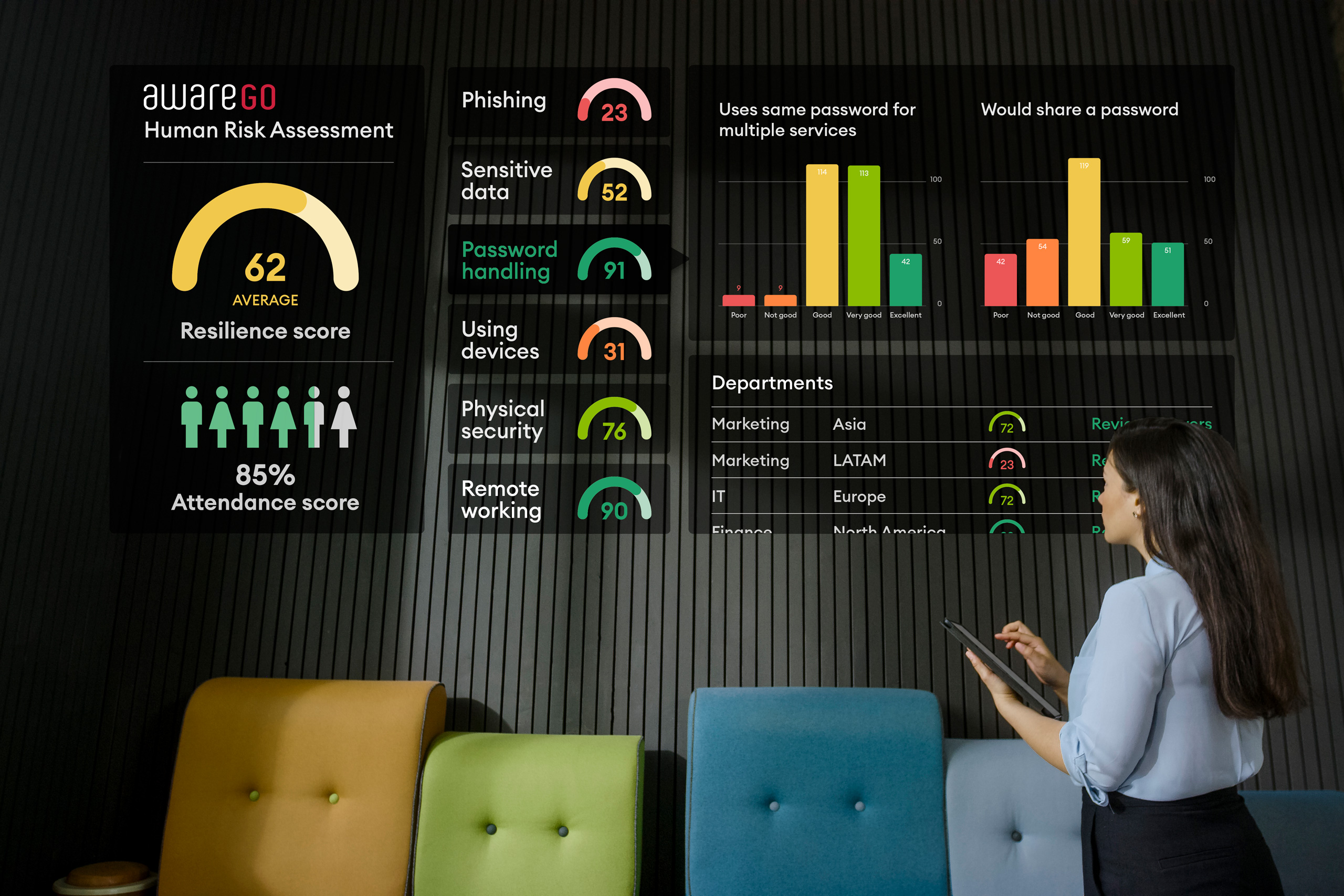
Ready to see where your organization stands? Start your Human Risk Assessment today to gain a clear, data-backed view of your security posture. It’s time to move beyond simple compliance and start building a culture that truly protects your people and your data.
Turn Your Security Culture Into a Physical Shield
Physical security shouldn’t feel like a barrier to being a helpful colleague. You’ve seen how attackers exploit the “politeness trap” to bypass expensive biometric scanners and heavy steel doors. Understanding what is tailgating helps you recognize when a simple act of holding the door becomes a high-stakes security breach. It’s time to move beyond passive compliance and build a workplace where everyone feels empowered to protect the perimeter. When your team understands the psychology behind these social engineering tactics, they can stop threats without feeling awkward or rude.
Your employees are your most valuable defense layer when they have the right tools. AwareGO uses a data-driven behavioral science approach to transform human risk into collective resilience. Our award-winning micro-learning content is used by global enterprises to manage human risk through one-minute lessons that fit into a busy workday. By focusing on habits rather than just rules, you create a seamless environment where security is second nature for every team member. You don’t need to choose between a friendly office and a secure one.
Secure your physical perimeter with AwareGO’s Human Risk Management platform
You have the power to close the gap between human kindness and digital safety today.
Frequently Asked Questions
Is tailgating a type of social engineering?
Yes, tailgating is a physical form of social engineering that exploits your natural desire to be helpful. Instead of using complex code, attackers use psychology to trick you into holding a door open. Research from the Ponemon Institute suggests that 22% of data breaches involve some form of social engineering. By manipulating social norms, an intruder gains access without ever needing a digital key.
What is the difference between tailgating and piggybacking?
The main difference lies in consent and awareness. When you ask a colleague to hold the door while your hands are full, that is piggybacking. What is tailgating, however, involves an unauthorized person slipping in behind you without your permission or knowledge. In a 2022 security study, 35% of employees admitted they don’t check for badges when someone follows them through a secure entrance.
How can I prevent tailgating without being rude to my colleagues?
You can stay polite by framing the situation as a shared security responsibility. Simply say, “I’m sorry, it’s company policy that everyone scans their own badge today.” This shifts the focus to the rules rather than your personal feelings. Organizations with a strong security culture see a 70% reduction in unauthorized entries when employees feel empowered to speak up without fear of social awkwardness.
What are some common tailgating signs to look out for?
Look for individuals who appear distracted or are carrying heavy items to justify why they can’t reach their badge. A 2021 undercover audit found that “the coffee carry” is a successful tactic in 40% of unauthorized entry attempts. Other signs include someone hovering near the entrance while texting or waiting for a large group to enter so they can blend into the crowd.
Can technology alone stop tailgating attacks?
Technology like smart cameras and turnstiles provides a first line of defense, but it can’t replace human awareness. Even with $50,000 security systems, a single propped door or a “polite” employee can bypass every digital lock. True resilience comes from Human Risk Management (HRM), where 90% of your defense relies on the habits and vigilance of your team members.
What should I do if I see someone tailgating into my building?
You should immediately notify your security team or office manager if you notice an unrecognized person entering without a badge. Don’t try to confront the person yourself if you feel unsafe. Instead, note their physical description and the time of entry. Fast reporting can reduce the potential impact of a physical breach by 60% according to internal security response metrics.
Why is tailgating dangerous for my company’s data security?
Physical access often leads to digital compromise. Once an intruder is inside, they can plug a malicious USB drive into an unattended workstation or steal hardware. IBM’s 2023 Cost of a Data Breach Report found that physical security compromises cost companies an average of $4.1 million. What is tailgating if not a direct shortcut for hackers to bypass your entire digital firewall?
Is tailgating illegal in a business environment?
Yes, entering a private business without authorization is legally considered criminal trespass under most local jurisdictions. In the United States, unauthorized entry into a secure facility can lead to fines or jail time depending on state laws. Beyond the legal risks, 85% of corporate security policies list tailgating as a fireable offense for employees who knowingly allow unauthorized individuals to enter.